Random patter from one easily amused and more easily confused.
I'D LOVE TO HEAR FROM YOU
Comments, criticisms, or (one can hope) compliments are more than welcome! Please let me know what you think, tell me I'm crazy (I suspect this) or what you'd like to hear about. Comments are screened before publication, so if you want to share something with me only, just put that in the comment and I'll keep it to myself.
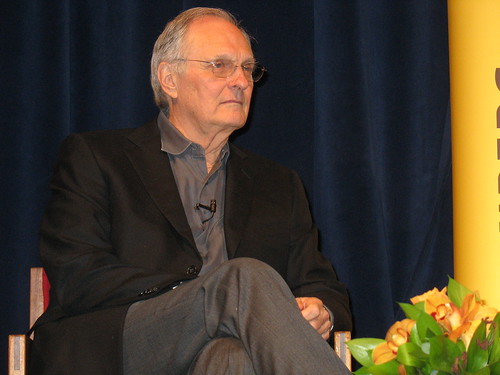
I knew very little about Alda's life other than his involvement with M*A*S*H, and was intrigued to learn about his upbringing. His father Robert Alda was an actor and his mother, Joan Browne, was a homemaker who struggled with mental illness and died when he was ten. As a child, he survived polio and endured his father's misguided attempt to console him over the untimely death of his cocker spaniel by having the poor animal stuffed (referenced in the title of Alda's memoir).
From a young age, Alda was brought along on the burlesque circuit with his parents. He vividly recalled life at age three, being collectively mothered by chorus girls and watching the show from the wings, triggering his ambition to follow his father into show-business. From that young age, he had an understanding of the inner workings of entertainment that few get to see. "I knew where he hid the pigeons," he said of the show's magician.
Subscribers to the lecture series were able to submit questions, which sparked a discussion after the lecture itself was over. Predictably, many of them were about M*A*S*H and Alda's character, Capt. Benjamin Franklin "Hawkeye" Pierce. I learned that the show had originally been conceived as a comedy along the lines of Hogan's Heroes, but Alda -- believing the show had a responsibility to more accurately portray life in the midst of war -- convinced the producers to take it in a more sober direction. He wrote and directed many of the later episodes himself, including the series finale, which was at the time the highest-viewed television episode in history.
Among Alda's favorite memories of the show was the episode in which his father guest-starred as a visiting medic. Their characters each sustain injuries to one hand and perform an operation together, each using their "good" hand. This was the senior Alda's idea, which his son originally rejected but then agreed to use, and still cites as a major growth point in their relationship.
Besides M*A*S*H, among other acting and producing roles (including The Four Seasons and The West Wing, for which he was considered for the lead), Alda produced a series of interviews for PBS with scientists in various fields of study, which at one point took him to an observatory 8,000 feet up a Peruvian mountain. While there, he was struck with an intestinal malady requiring emergency surgery (ironically, a procedure with which Alda was familiar because his M*A*S*H character "Hawkeye" had to perform it). He described how surviving that experience made him feel incredibly alive and appreciative of the world around him, and resolved to keep that awareness and gratitude intact for the rest of his life.
Alda also founded and is an active part of the Alan Alda Center for Communicating Science at Stony Brook University on Long Island. Alda had realized, through his work interviewing researchers and other experts, that there is frequently a disconnect between these highly intelligent folks doing very important work, and those who need to understand its potential benefits. He gave an example of a congressional hearing where the politicians were clearly mystified by what was being presented, despite being charged with determining if it should be funded. The Alda Center is charged with helping science students communicate the purpose and importance of their work to those outside the discipline, including the media, government officials, and the public as a whole.
Yesterday, I was privileged to see a performance of Sting's new musical The Last Ship, currently in previews on Broadway. A project that had been in the works since 2010, the production follows a concept album in 2013 last year (from which only some tracks made it to the score as presented to us) and a short run in Chicago.
Set in the village of Wallsend-on-Tyne in northeastern England, the show is a stylized account of the conclusion in 2007 of shipbuilding activity by Swan-Hunter, whose accomplishments include the legendary Cunarders RMS Mauretania (holder of the transatlantic speed record) and Carpathia (rescuer of the RMS Titanic survivors). Wallsend produced the last passenger liner built in the United Kingdom (the MS Vistafjord for Norwegian America Line, which later also sailed for Cunard as Caronia) in 1973.
MS Vistafjord, the last liner built in the UK, shown here in Cunard colors at anchor in Geirangerfjord, Norway in 1993 PHOTO CREDIT: flickr.com/aah-yeah Used under Creative Commons. Some rights reserved.
The show begins with a flashback of sorts, as Joe Fletcher (Jamie Jackson) is injured on the job and wants his son Gideon (Montclair's own Collin Kelly-Sordelet) to assume his place as breadwinner by becoming an apprentice at the yard. Gideon rejects this idea and instead signs on as a merchant mariner, promising girlfriend Meg (Rachel Tucker) he will be back for her.
Returning fifteen years later upon the news of his father's death, Gideon (played as an adult by Michael Esper) learns that the yard is to be closed for lack of any further work. This is semi-factual: Following delays and cost overruns, the still-incomplete HMS Lyme Bay, the last vessel to be laid down at Wallsend, was towed in 2006 to a competing yard and Swan Hunter was barred from further naval contracts, ending 130 years of shipbuilding on the Tyne.
Gideon seeks out Meg and discovers she is less than receptive to a reconciliation, her feelings complicated by a teenage son Tom (also portrayed by Kelly-Sordelet) and another man, Arthur (Aaron Lazar), who wants to marry her. Arthur (also a former shipbuilder) has taken a job with a company that wants to see the yard sold and used for shipbreaking and scrapping, an idea the workers find repulsive and insulting.
Encouraged by the parish priest (brilliantly wrought by Fred Applegate... if ever there was a right priest for a particular congregation, Fr. James O'Brien is it!), the workers, including Gideon and Tom, defiantly embark -- against all odds -- on one more project, which symbolizes their collective well-being and pride.
In 2007 the Wallsend cranes, which had dominated the skyline for generations , were dismantled and
shipped to India.
PHOTO CREDIT: Mick Gallagher. Used under Creative Commons license. Some rights reserved
I will not spoil with more details of the plot. I have read that the show is semi-autobiographical, which leads me to wonder what Sting's upbringing was like. There is no mother in the play, and the relationship between Gideon and Joe is clearly freighted, with allusions to abuse. The singer's parents died of cancer within months of each other in 1987 and he explained in a 1996 interview with Q that he declined to attend their funerals, and later regretted it. A period of writer's block followed, and it was not until he released The Soul Cages in 1991 that he felt properly able to mourn.
"My father was... snatched away from me at the wrong time. For me and
for him. It was just at the point when I was beginning to make my
journey home and understand my parents more - the decisions they made," Sting observed. "Having written the songs, what I learnt was to forgive myself for
my part in it and forgive my father and my mother for what they did that
hurt me."
In parallel, Gideon misses Jim's funeral by mere days and is forced to work through unrequited feelings as the story unfolds. Two tracks from The Soul Cages, "Island of Souls" and "All this Time", accompany original songs in the show.
The play gives you a lot to chew on. The theme is one that has repeated itself many times, some of them in places a lot closer to home, as traditional ways of earning a living handed down by generations give way to technology and globalization.
Layer that with the complex relationships between the players as they make difficult choices, and a cast that does well to get you invested as if this was really happening around you. Musically, Sting's influence is heavy, but he draws well from the history of the area, particularly for the company pieces.
The Last Ship is in previews at the Neil Simon Theater.
Christ has no body now but yours
No hands, no feet on earth but yours
Yours are the eyes through which He looks
compassion on this world
Christ has no body now on earth but yours.
I feel surrounded by so much sadness and strife lately. Beyond my job (which is a blog unto itself) and the conflicts in the the world (anybody notice how the Ukraine bit seems to have been eclipsed by the ISIS, which was in turn eclipsed by the Ebola? It's as if we have only the brain-power for one crisis at a time), I was involved in a leadership change at an organization of which I am a part, with the attendant posturing and choosing of sides. And before that could settle down, there is the upheaval at General Theological Seminary, which does not affect me directly but has had a profound impact on many of my friends in the church, either alumni or friends of faculty and students. Meanwhile, two of my siblings were trying to comfort their spouses and their families through painful times, and I find myself struggling to be Useful and if not Useful at least not Part of the Problem.
I can't speak with any great wisdom on any of these things. I am not politically savvy, I have no thirst for debate or inherent desire to be right. I can only tell about the way they make me feel, wonder where Christ is in all of this, and maybe hold your hand for a minute and extend the notion, perhaps a naive one, that it will all sort itself out.
If you are not already a fan, I commend you to the earthly patron saint of the Chaos Muppets, Anne Lamott. On a recent Facebook post (and if you're not following, you simply must), she began:
"Many
mornings I check out the news as soon as I wake up, because if it turns
out that the world is coming to an end that day, I am going to eat the
frosting off an entire carrot cake; just for a start. Then I will move
onto vats of clam dip, pots of crime brûlée, nachos, M & M's etc.
Then I will max out both my credit cards."
That is my kind of prophesy. Hold the clam dip in my case, but feel free to improvise as local custom dictates. The point is that -- as you keep reading -- you learn that she is facing an unspeakably sad situation, surrounded as many of us are with many others. But she approaches each with tenderness and grace, humor when appropriate, and handfuls of M&M's if that's what it takes. She messes up, as we all do, and owns up to it readily. That is the person I strive to be, and -- short of any gifts of healing I haven't yet discovered -- that is probably about as close to "Christ's hands on earth" as I am likely to get.
In the midst of all this, I was lucky to spend a few days with a dear friend at Weston Priory. As I alluded to in the recent post "Hurt People Hurt People" this Benedictine monastery is my muster station for the zombie apocalypse, the thinnest thin place I know, where I can actually believe for a moment that I might be a beloved child of God.
The Brothers say very little in public, but their tranquility speaks volumes, and their smiles reflect an inner peace that I envy. They work hard (maintaining a working farm of many acres, and they are not teenagers) but in prayer and song they are extremely gentle, and the very simple services (you get no hymnal or missal, not even a piece of paper... just listen, listen and repeat) are rich with moments of profound holiness for those present.
The altars at Weston are the only Roman Catholic ones where I still feel called to receive the sacrament. All these years later, one thing I still miss about the Mass is this verse (rough recollection of how they say it):
Lord Jesus Christ, you said
to your apostles: I leave you peace, my peace I give you. Look not on our sins,
but on the faith of your people, and grant us the peace and unity of your realm where you live for ever and ever.
On this day, the church remembers an idealistic young seminarian who lost his life defending a friend from shotgun fire during anti-racism demonstrations in Alabama in 1965. You can read a biography of him by clicking his name above.
His home church in New Hampshire, St. James: Keene, honored him this past Sunday with a transferred feast. The Gospel and a sermon, by the Rev. Canon Ed Rodman, can be heard here.
I'm struck by how little we seem to have learned in the years since. Even as we seem to be making glacial, grudging progress on sexuality issues, there seems to be a tension around race that bubbles much closer beneath the surface than I think I realized even a few years ago. Sometimes it shows itself in subtle ways, like how people who largely support his policies still won't cut the President a break. And then there are weeks like this one, where I'm sure -- for those who lived through it -- it feels like Selma all over again.
The nominating committee for the 27th Presiding Bishop of the Episcopal Church released its candidate profile this week and invited members to present their nominees.
Having read the profile, my choice, made quite a while ago, was only more apparent. We have
many deeply spiritual and talented people leading us, but yet we
continue to be bogged down with apathy and fatalism, and many of our
people and congregations have seemingly not overcome their squeamishness
about evangelism and offering unabashed welcome. Visiting many
churches feels like wandering into a private club whose signs and
symbols are presented in a way that makes you feel as if not knowing
them means you don't belong.
Meanwhile, outside the walls, the
American public continues to equate Christianity with (at best) insipid
platitudes and (at worst) attempting to erode their civil rights, fueled
largely by the media power of the far-right machine and the
politicians it controls. We continue to regard people of color as a
threat, mock or disregard those who don't adhere to our expectations of
gender and attraction, vilify the poor, and remain largely indifferent
to the violence and exploitation going on both here and abroad.
In my admittedly limited experience, there is one person who has spoken
truth to these things in a voice powerful enough to be heard over the
din. He has, in my mind, the credibility and the charisma to wake this
church up and inspire it for true mission, and he does so with grace and
self-effacing humor.
For this reason I have informed the
Committee that I nominate the Right Rev. Michael Curry, sitting bishop of the Diocese of North Carolina,
to lead us forward.
If you are
not familiar with Bishop Curry, and haven't seen it the last 4,962 times
I have shared it, please screen his sermon from our last General
Convention, "We Need Some Crazy Christians". It is, I promise you, well
worth your time, and I trust you will understand my enthusiasm.
And if you've seen that one, watch this one, which was given at the annual Convention of the Diocese of Connecticut. He addresses the very squeamishness I speak of above and the effect it is having on our ability to reach people. Oh, and baseball.
If he wins, I believe we need to devote
considerable resources to get Curry's message beyond our own membership and
to the world at large. We need to support him in this as if our very
future depends on it, because it very well might.
It's been over a decade since I found a home in the Episcopal Church and -- almost immediately thereafter -- got involved in ministry with LGBT people. As society's attitudes about sexuality have evolved and congregations have become more willing to acknowledge the diversity in their midst, this has shifted from providing "safe spaces" off to the side for our folks to pray and socialize as their whole, authentic selves, to actually getting whole faith communities to weave universal welcome into their mission and identity.
What I haven't yet offered up here is how I came to be an Episcopalian in the first place. At the tender age of 18, I was a member of the Antioch young adult group at a Roman Catholic parish. Caught up in the emotion of a retreat, I shared with a trusted friend, and a priest, the secret that I was experiencing same-gender attraction. Despite being assured that this would be kept confidential, I got a phone call (from a nun, no less!) several weeks later saying it would be "better for the others" if I wasn't around. "Some of the parents have concerns," she explained, without elaborating.
I did not actively attend church again for over ten years. I was in church, because I worked as a paid musician here and there, but it felt like a job and I was an outsider there to perform a service, not a member of the community.
At some point, I went to hear my friend Jennifer sing at St. George’s Episcopal Church in Maplewood, N.J. The denomination meant nothing to me at the time. We were both raised in the days of the Baltimore Catechism, and my CCD classes left me with the kind of "us-and-them" mentality that meant there were only two kinds of churches you needed to worry about: the Roman Catholic Church and Everybody Else. But that visit -- where the Right Rev. John Shelby Spong preached about the nuances of sin in a way I had never heard -- set me on a new course. When 9/11 devastated our area, I found myself delivering donations to another Episcopal parish, with a partnered gay priest. Okay, I get it. I said grudgingly. I went back a few times, ended up on a committee or two, and was received (a service for converts, very similar to confirmation, where you formally commit yourself as an adult member of the church) a few years later.
It should not be a surprise that my area of ministry quickly ended up being to other LGBT people. I have now worked in diocesan ministry for nigh unto ten years, and on the national level for about four. The most profound thing I have learned is -- as traumatic as my own experience was -- it was peanuts compared to what some of my brothers and sisters have experienced at the hands of the church. And, in the ecclesiastical equivalent of PTSD, the collateral damage of all those individual little wars reveals itself on a regular basis, even (aye, maybe especially) among leaders of the movement.
I have witnessed spectacular displays of distrust and hostility (some of it richly deserved) leveled at institutional religion, and sometimes laser-aimed at the unfortunate soul who naively identified as a member. In my official capacity, I attended a memorial for a man I had never met, and my expression of gratitude for his decades of service was lost when a complete stranger, learning what group I was there to represent, proceeded to publicly lambaste me for ten minutes about events that took place in that organization while I was many miles away attending grammar school.
I have also seen it -- heartbreakingly often -- among our own: we shoot accusations like arrows from the safety of our Facebook chairs, far enough away to avoid getting splattered with the mess. Too often, people all theoretically working for the same cause fall into predictable opposing teams, mess with one of us, you've messed with all of us, or something like that. Simply disagreeing with a person’s ideas or interpretation of an event is immediately labeled as bullying, slander or worse, and decades of toxic history are dragged out yet again like some kind of dystopian yearbook to prove... what exactly?
It is contagious, this; I have been guilty of it myself, which I deeply regret. I can get caught up in the need to avenge wrongs that had nothing to do with me. I have walked away from conversations and shut myself off from further contact with people who seem to be repeated triggers. And I have, truth be told, contemplated frequently whether the rate of progress, which feels downright glacial at times, is worth the emotional toll. Maybe I should just fold my tent quietly, dust myself off, and walk away. What’s another ten years in the desert?
In trying to atone for and heal from my own contribution to this malaise, I keep coming back to a conversation I had with a friend about her troubled son, whose treatment of her ricochets between intense devotion and blinding rage. The words that entered my head, which I wrote on a napkin while she was describing one such encounter, was:
HURT PEOPLE
HURT PEOPLE
Now if you are not "hearing" that in your head, maybe you recall seventh-grade English and how much fun it was to diagram sentences:
Or, to put it another way: "Hurt (adj.) people HURT (verb) people."
The one thing LGBT people almost universally have in common is that we have all been -- at one time or another -- treated badly. As children, we got mocked for being different or strange; for not liking dolls when we should, or walking funny. Later, we may have been rejected by family members, passed over for jobs, kicked out of churches, or accused of being immoral and a danger to children simply because the gender that turns our head, or that we claim as our own, is not what others expected it be. I have yet to meet the person who avoided it totally, although it is getting better, thanks be to God!
The Velveteen Rabbit
illustration by William Nicholson
Public Domain (1922)
Those of us who are doing inclusion work are -- by definition -- revisiting those old personal hurts, over and over again; either by talking other people through them, or trying to explain to potential allies how it feels to be a person like us. We don't have the luxury of shutting those bad memories in a box and celebrating the happy, well-adjusted person we became, safe to pursue career and relationship goals by nature of the progress the church and the state have made. Like the Velveteen Rabbit, it is our scars that will make us “real” to those wounded hearts whose trust we must carefully earn.
Perhaps this is the gift that we carry to the altar. Maybe we sacrifice "moving on" in order to build the church and the world where others may someday do so undamaged. If that is so, then we must acknowledge what that costs, and the attendant dangers.
This means we can, if we're not careful, see our present circumstances only through the scratched lenses and battered, taped, frames of the past. We are liable to interpret the words and actions of others as if we were back in that awful place we fought so hard to overcome, particularly when we find ourselves under stress. In that dark world, allies can easily be mistaken for tormentors, and that puts us at a higher risk of inflicting further wounds on them, if we can’t see their vulnerable spots past the scales on our own eyes. Trust me, I know there are some people who just manage to push your buttons, but in the heat of the moment it is easy to confuse the person and the issue; what is really their damage and what is just our own stuff, coming back to haunt us.
It also means we can become so used to victimhood that it has become too comfortable, or too scary, to give up. We have fought hard to achieve wider acceptance, but with equal rights comes equal responsibility. It is good that we are different, and it is important and wonderful that we are survivors, but it doesn’t make us "special" in the sense that we should continually expect to get a pass for bad behavior because of it. We find it exhausting when others do it; we should learn to recognize it in ourselves.
With the bread we need for today, feed us. In the hurts we absorb from one another, forgive us. In times of temptation and testing, strengthen us. From trials too great to endure, spare us. From the grip of all that is evil, free us.
For you reign in the glory of the power that is love, now and forever. Amen.
So what next?
As a souvenir of that fateful weekend, I have -- shoved into the top of a closet -- a grocery bag full of palancas, letters of affirmation from other Antioch members, parishioners and others that I received on the retreat. The word palanca is Spanish for "lever" and the purpose is to give someone a spiritual "boost" through prayer or encouragement. So this is my palanca for you, 21st-century style:
If any of this struck a chord with you, I invite you to play the video below, eyes closed if you want, and think about your own experience while you listen. Hold up the hurts you’ve endured, and the hurts you’ve caused, and allow yourself to feel forgiveness, given and received. Think about what you might say or do differently next time. What if you shared one of these vulnerabilities with the person who causes you the most angst, and asked them to share one of theirs with you? What would your relationship be like after that?
That song was composed by Gregory Norbet, a former member of the Benedictine monastery at Weston, Vermont. It is a working farm in a rustically beautiful setting, particularly in autumn, and has been a "go-to" place of refuge for my entire life.
The pond at Weston Priory
We can… you and I can… build that place of sanctuary for each other. We can learn to help each other heal from what has happened to us, and be the palanca, the lever, that helps them accomplish what they otherwise could not. We can have the grace to ask for forgiveness when we screw up (and we will screw up… I know I will) and know that it is offered with sincerity. We can know that it is okay not to always be perfect, and not always be right, and not always have the last word.
We can do this, aye, we have to do this. We are called to be a force of good in the world, are we not? How can we take that on with so much distrust and resentment underfoot? We need each other on this road, flaws and all, and we can get there much quicker if we learn how to bring out the best in one another, instead of the worst.
“Jesus Consoles the Women”
from Clarence Enzler’s Everyone’s Way of the Cross
Christ Speaks:
How often had I longed to take the children of Jerusalem and gather them to me. But they refused. But now these women weep for me, and my heart mourns for them-- mourns for their sorrows that will come.
I comfort those who seek to solace me.
How gentle can you be, my other self? How kind?
I Reply: My Jesus, your compassion in your passion is beyond compare. Lord, teach me,help me learn. When I would snap at those who hurt me with their ridicule, those who misunderstand, or hinder me with some misguided helpfulness,those who intrude upon my privacy – then help me curb my tongue.
Last spring, I wrote about a young woman named Dannika Nash who quoted the Macklemore song "Same Love"
in some frank advice to the institutional church on behalf of
milliennials. In a nutshell, she warned that if the church forced her
generation to choose between it and their support of LGBT rights, it was
going to be disappointed in the outcome. Her basic message was one that
research
clearly shows is shared by many in her generation, 30% of whom do not
claim any faith affiliation at all. She implied that - for them - music
and other aspects of their culture fulfill a social-consciousness need
that religion does not.
Macklemore, classified as a
rapper, was not afraid to call out the genre's reputation for homophobia
and misogyny. In January of this year, he performed "Same Love" at the
Grammy Awards while Queen Latifah witnessed the marriages of thirty couples, including some of the same gender.
I
heard a song recently in my truck which caught my attention because the
chorus starts out with the phrase "take me to church..." Not only is
this unfamiliar subject matter for popular music (for reasons explained
above, I expect), but a Facebook buddy and his friends use the
expression "go to church" as a euphemism for their favorite pastime
(kayaking over waterfalls in the Pacific Northwest), and I thought he
might get a chuckle out of a song that features that phrase.
Video for Hozier's "Take Me to Church"
(CAUTION: Violent Imagery)
Hozier at SXSW 2014
PHOTO CREDIT: WFUV Radio
Used under Creative Commons License Some rights reserved
It
wasn't til I got home and read more about it that I understood the
song's topic is no laughing matter. Having only half-heard the words
while driving, I discovered upon closer examination that Andrew Hozier Byrne
(who goes by his middle name), a 24-year-old Irish man, is not asking
to be brought to a religious institution, at least not the ones he knows.
Describing his experience as "Every Sunday's getting more bleak / A fresh poison each week" Hozier
(or at least the protagonist in the song) is -- like Ms. Nash --
eschewing life in the pews for a "religious experience" of another kind,
in his case a lover.
What caught my attention,
however, was the subject matter of the song's video. It depicts -- in
brutal honesty -- the abduction of a gay couple in Russia by a vigilante
gang. The connection to the lyrics was not immediately clear, but --
if you know a little background on what's going on there -- it starts
to make sense.
For at least the last 12 years, anti-gay
sentiment in Russia has been ramping up. Attempts to hold pride marches
in Russian cities have been generally meant with political opposition
and/or violent protests. The country's Christian, Muslim and Jewish
leaders have all spoken out against the observances, with the Grand
Mufti Talgat Tadzhuddin encouraging flogging for the participants in the Moscow Pride of 2006.
"I always stand by the song and the point that the video made, so it’s never a chore," Hozier, who is not gay, told the London Evening Standard. "The song is about loving somebody, and the video is about people who
would undermine what it is to love somebody."
Journalist Jeff Sharlet, whose books C Street and The Family
document the degree of control a cadre of evangelical Christians have
over Washington, traveled to Russia this fall in the run-up to the Sochi
Olympics and painted a stark picture of gay life in the country which appeared in February's GQ.
Sharlet describes the growing hostility towards gay people as part of a
larger social unraveling: Russian civilians, encouraged by their
government and religious institutions, have taken matters into their own
hands.
"There's a national network called Occupy Pedophilia, whose members
torture gay men and post hugely popular videos of their 'interrogations'
online. There are countless smaller, bristling movements, with names
presumptuous (God's Will ) or absurd (Homophobic Wolf). There are
babushkas who throw stones, and priests who bless the stones, and police
who arrest their victims."
In the article, Sharlet
describes shoot-ups in bars, rapes, beatings, and computer surveillance, (even on the part of private citizens). Readers learn the measures to which people will go to survive, and the lengths others will go to tear apart the lives of complete strangers in pursuit of some dystopic fever-dream. We meet two
families that live together symbiotically, presenting as heterosexual to
the world as a cover for their actual same-gender partnerships.
Sharlet talks to both targets and perpetrators, attempting to help
readers decipher what is behind the fear and violence.
The
Duma in 2013 passed an "anti-propaganda law" which makes it illegal to
communicate about "non-traditional sexual relationships" to minors. Of
course what constitutes "propaganda" can be broadly interpreted to suit
the occasion, and one could be punished for doing anything something as
simple as holding hands anywhere "where children might see." Victims of vigilante violence are laughed at or punished if they seek help from law enforcement.
Western Connection (AKA, Why We Should Care)
If the rationale of "protecting the children" sounds familiar, it is
because it is the same mantra used to justify anti-gay laws in Africa,
and -- lo and behold -- some of the same American evangelical voices,
including Scott Lively, are taking at least partial credit.
Lively is currently the target of a federal lawsuit under the Alien
Tort Act for crimes against humanity, due to his involvement in getting
Uganda's "Jail the Gays Bill" passed. He toured that country in 2009 with several other Americans, stirring up anti-gay fear at a series of rallies. He employed the same tactics in Russia and called the passage of the law there "one of the proudest achievements of my career". His enthusiasm was shared by the American Family Association's Bryan Fischer.
Most American clergy, not unaware of shifting public opinion, are more nuanced in their positions on LGBT issues, sometimes head-scratchingly so. Televangelist Joel Osteen told Larry King "I believe homosexuality is a sin, but I don't want to preach about it." Jim Wallis of Sojourners (who is frequently described as a progressive) drafted and circulated a letter to Barack Obama in favor of a "religious exemption" to the President's executive order on discrimination by companies holding federal contracts. A number of the large, venue-based churches like Hillsong NYC, attempt to avoid the topic altogether.
But we can't not talk about it, so long as crises as large and terrifying as the one unfolding in Russia continue to happen, and as long as there are places in our own "civilized" country where people think belonging to a church makes it okay for you to be a bully and want that enshrined in the law. For those of us who believe there is a place for everyone at God's table, the recent string of domestic victories should not be mistaken as a sign that we're anywhere near done doing justice work. The "religious freedom" laws being introduced in various quarters are a clear sign of that.
Nor can we rest on our laurels while we know that hurtful things are being done in God's name anywhere in the world. The one thing our Savior didn't abide well is hypocrisy, and the YouTube generation is reminding us of that by voting with its feet. Perhaps if they saw our churches witnessing to the pain being inflicted in the name of religion and how this conflicts with the Gospel we know, they'd be more inclined to stick around.
It intrigues me that, eleven-score and eighteen years ago, we thought the unfettering of church and state was important enough to start a war over*, and yet we're still arguing about it.
This week's Supreme Court ruling that gives corporations the right to (as near as I can figure it) choose a religious denomination and govern themselves according to its tenets feels completely counter to my understanding of what the Founding Grown-Ups had in mind. Despite the fact that those holding the pen were all white (presumably hetero and cisgender) males of privilege, I have preferred to believe that they envisioned a place where one person's beliefs would not be imposed upon another, even if it would take far beyond their lifetimes to get there.
Flags inside All Saints: Worcester
Thus the idea that we are now enshrining a corporate entity with the trappings of a church, and allowing even one opportunity to envelop all its employees under the beliefs of its leadership is troubling. Precedent is like a leaky roof; you will have quite a mess by the time you find all the unexpected places the proverbial rain water has traveled. I am waiting for the first time a Jehovah's Witness boss tells an employee (s)he can't have a blood transfusion. How do you think mandatory Hijab Fridays would sit with those who are celebrating this ruling?
And America yawned. All this is playing out even as an unprecedented number of Americans claim no religious affiliation at all, particularly among young people. The reality that someone's very real health care needs are conceivably now under the control of a belief system to which they don't even subscribe should be causing a much greater ruckus than it is.
My only hope is that this ruling can be exploited in positive ways as well. For those of us whose faith mandates generosity, kindness, fairness and justice, are we now free to impose these values on our employees?
Earlier this week was the feast of Harriet Beecher Stowe. As we celebrate Independence Day under not only the clouds of Hurricane Arthur but this troubling ruling, I strongly encourage anybody whom I have not already badgered into it to watch this sermon, given on that feast in 2012 by the Right Rev. Michael Curry, Bishop of North Carolina, on the floor of the 77th General Convention of the Episcopal Church as it met in Indianapolis.
In the face of rising disengagement (brought on in no small part by the extremist rantings that unfortunately manage to dominate the public's perception of what it means to be a person of faith), Curry encourages us all to similarly push the limits, but in a positive way. All of us putting up a hand and politely interjecting "I'm a Christian, too, and I don't agree with that at all!" is the only way we can respond to those who view the church (and the synagogue and the mosque) as a monolithic entity who believes it can and should be imposing its values on even those who have no association with it. We can and should be refocusing the message back on charity, compassion and community, particularly for those who society deems "the other" or "not good enough" and with the strong underscore that we don't expect you to subscribe to a restrictive dogma to be worthy of those gifts.
NOTE: Yes I am aware that is not all the Revolutionary War was about.
A few years ago, I saw one of those cartoony Facebook postcard thingies that said something to the effect of, "Love is wonderful; you should tell someone that you love them every day. But love is also terrifying and confusing, so when you tell them, scream it in German!"
Wilma-Jean Bland Pruden
When I heard that anecdote, I relished sharing it with my friend Wilma Pruden, because -- among her many talents -- she prided herself on being fluent in that intimidating language. However, she did not need to resort to Teutonic rants to command respect, either from those who knew her well or -- as it sometimes happened -- perfect strangers.
My favorite Wilma story took place in a setting that was far from our normal stomping grounds: in a "healthy food, fast" franchise that was catering, at least at that moment, primarily to the gym-obsessed male denizens of Chelsea. For the uninitiated, visitors to the Muscle Maker Grill make their selections at the counter, but the food is then brought to your table. The young man working the register, after taking Wilma's order, politely asked, "May I have your first name?"
Wilma, just as politely, replied, "No, you may not."
Our server looked stunned. Clearly this had not been included in the training; perhaps women of bearing did not typically frequent this stretch of Eighth Avenue.
Sensing his confusion, she went on to explain, "Only people I know call me by my first name. You and I have not even been introduced. You may call me Mrs. Pruden."
The employee, bless his heart, dutifully keyed "MS. PRUDEN" into the register. After two-and-a-half minutes, he knew better than to argue. And, if Wilma was tempted to school him in the correct uses of Mrs., Miss, and Ms., she chose instead to let it go.
I don't tell that story to make Wilma sound haughty or uptight; her tone throughout this whole exchange was completely cordial. It is simply an example of a woman who knew there was a right way to do things and treat people, and she was not afraid to point them out. She was no less exacting in her standards for her own conduct than her expectations from everyone else, and while we kidded around about her legendary ire, she also had a rich sense of humor and loved to laugh, especially at herself.
For several years, Wilma and The Archwarden shared responsibility for managing our now-former parish in the absence of a full-time rector, and I looked forward to ribald stories about what Wilma did or said during their epic meetings. And during our years of "leading" our church youth group and making basement-music with the Archwarden's late father Henry, I could also count on her husband, (whom we all know simply as "Doc") to share similar tales with his trademark smile. He is as easygoing as Wilma intense; a balanced partnership that helped them get through medical school, four children, and now a new generation to love and spoil.
We lost Wilma today. I'm still trying to get my head around that. My heart aches for Doc and their kids, and all the lives that will have to adjust to the hole left by her formidable presence.