I'D LOVE TO HEAR FROM YOU

Comments, criticisms, or (one can hope) compliments are more than welcome! Please let me know what you think, tell me I'm crazy (I suspect this) or what you'd like to hear about. Comments are screened before publication, so if you want to share something with me only, just put that in the comment and I'll keep it to myself.

THANK YOU FOR VISITING!
Showing posts with label Education for Ministry. Show all posts

Monday, June 12, 2017

This is Not a Drill - Sermon for EfM Graduation

Trinity Sunday


I delivered the following sermon at St. Mark's Episcopal Church in Teaneck, N.J., on Trinity Sunday (June 11, 2017) for the 2017 graduation ceremony from the Education for Ministry program, a four-year distance learning seminar on bible literacy, church history and theology for which I am co-mentor.

Through the written word and the spoken word, may we come to know Your living word. Amen.

I had that dream again recently, the one where you realize the end of the semester is coming and there’s a class you haven’t attended since the first week. You’re not even sure where it meets or what you did with the book, but there you are trying to find the classroom, late, hoping to beg the professor for mercy.

Psychologists, at least the ones on Google, say this dream is common and can represent latent anxiety about seemingly unrelated concerns. Some people who experience it report being in their pajamas or even naked, or wandering hallways that change before their eyes like an M.C. Escher drawing. In my particular version, there’s the added wrinkle of a dorm room that I paid for but haven’t been using, and on this fateful day I discovered my roommate had left it a disaster for which I was being held responsible. I woke up uneasy and confused, and trying to remember if any of it really happened.

I haven’t been a formal student in over five years so I have no idea what may have triggered it to recur. However, I told Margaret, one of three graduates from the Education for Ministry program whom we honor today, that if she finds a multiple-choice quiz on the Council of Nicea in her service leaflet today, she’s not dreaming and this is not a drill.

For the uninitiated, Education for Ministry (or EfM) is a four-year distance learning program to help adults explore their faith. It was born at and is managed by the University of the South, an Episcopal college and seminary in Sewanee, Tennessee. EfM graduates are typically not ordained, but the program reinforces the fact that all of us, clergy and laity alike, are called to engage in ministry, and their studies help them better recognize and employ their gifts to the glory of God and in service of others.

Today, as at every Sunday Eucharist, we heard readings from the gamut of scripture, beginning in the beginning, with the first of two stories of human creation in the Book of Genesis. This poetic account of how the world began does not, of course, reconcile with the things we are taught in science class. I assume most if not all of us have long accepted that the value of these ancient stories lies not in their provability, but in the narrative--as old as time--of a people and their God, who wrestle literally and figuratively with one another, break each other’s hearts, and find forgiveness.

This is all well and good when the stories are about talking serpents and burning bushes and people who live 700 years, but what happens when we get to Jesus? I think our culture has grown comfortable treating the “red letter” quotes in the Gospels as things he said verbatim, but one of the first things our second-year students learn is that the earliest of the Gospels was likely written at least sixty years after the events described. In our instant-replay world, our most direct experience of Jesus is subject to two generations of memory and interpretation. Additionally, in the Gospels as in the Hebrew scripture there are events--the resurrection and ascension being the most obvious among many--which just do not jive with what we observe and understand about the world around us.

InsomniaThe more you study, the louder this dissonance becomes. In our third-year text, Diarmaid MacCollough’s Christianity, the First 3,000 Years (which could be nicknamed 3,000 Years of Christians Behaving Badly) the historic and political origins of many of the doctrines most rank-and-file Christians take for granted are explored in depth. Some major decisions we might assume were made by the early disciples are in fact a lot more recent and seem to have been driven by political or practical concerns rather than the will of God. There are frequent occasions, right into our present century, when the institutional church hardly comes across as a hero. I re-read much of that book this year and it may well explain my anxious-exam dream. To quote Aristotle, Einstein or the British pop band UB40, depending on whom you ask, “The more I learn, the less I know.”

What, then, does it mean when we say we believe? Are we forced to choose between donning intellectual blinders when we recite the creeds, or simply picking and choosing what we want to accept?

The Rev. Dr. Peter Savastano, who teaches religion and anthropology at Seton Hall, said in a sermon recently:
“In my own quest to understand the historical Jesus, the Bible, and the Jesus of theology, the scholars I have read repeatedly point out that we twenty-first century humans have lost the art of reading and interpreting scripture symbolically and allegorically. Influenced by scientism and rationalism, we prefer instead to read and interpret scripture as though it is a scientific text or a technical manual.

Conversely, in the world of the ancients and in the medieval world, scripture was interpreted allegorically and metaphorically, drawing on our human capacity for symbolic thinking, our intuitive faculties, and by the use of our creative imagination. To interpret a sacred story or a myth allegorically—and from an anthropological perspective the Bible is both —is to read and plumb its depths for truths and lessons that have universal import, truths that can only be revealed over time by the slow and painstaking process of meditation, prayer, and contemplation.
In other words, in our endless quest for data, we run the risk of turning off our brains’ ability to find value in that which cannot be proven. Is it still possible to not know in the temporal understanding of that word, but nonetheless believe?

All of this lack of concrete historical evidence should not make our God a stranger to us. The God we experience in our lives--in the community of the church, in our compassion for one another, or in the beauty of creation--is everywhere, known as intimately to us as our own internal organs, and the love of that God is--as Anglican historian and Dean for Religious Studies at Stanford University, the Very Rev. Dr. Jane Shaw puts it--the “glue” of our relationships to one another. Although EfM is not therapy, we have seen real evidence of that glue as we supported one another through the changes and chances of life. In a recent reflection, Peter Grace, who graduated from the program in San Francisco in 2014, wrote “For us Christians, God is anything but unknowable: is not outside of us, but truly alive at the very center of our being and ‘does not live in shrines made by human hands.’ God is not a question to be answered, but a mystery to be embraced.”

Speaking of mysteries, today we focus on the Holy Trinity, the true nature of which theologians have been arguing about for almost as long as Christianity has been a thing. But this too need not and should not be limited to some arcane, eye-crossing concept that we blindly accept or mostly ignore. We are charged with using our gifts of memory, reason, and skill to explore what wise women and men of faith continue to say about this and how we can interpret it in our own lives. For example, the modern Franciscan Catholic theologian and author, Fr. Richard Rohr asserts, “In the beginning was the Relationship.” and goes on to simply and elegantly describe the three entities of the Trinity as “the God who made the world and everything in it,” “Jesus Christ, who has gone into heaven and is at the right hand of God” and “the spirit of truth...who abides with you and will be in you.”

The EfM journey may at times awaken cynicism, disenfranchisement, and uncertainty, but we would hardly be the first to wrestle with that. As we heard in today’s Gospel, even the disciples who saw Jesus in person experienced doubt. But there is great joy and comfort in exploring them together, and newfound ownership of a faith which one has examined carefully from many sides in an environment where such questions are not just welcomed, but expected.

Barbara, Margaret and Terry, it is the prayer of your EfM family that you proceed to the next chapter in your ministry equipped with clear-eyed wisdom about your faith and its often flawed but nonetheless inspiring history, having read the scriptures alongside expert--if sometimes slightly arid--context. You studied and practiced how to make the theological become personal; prayed, laughed, and sometimes wept with us.

We commission you today to use all these insights and experiences to build and strengthen the gifts you bring to a changing church and hurting world, to be--in the words of Teresa of Avila--the hands, the feet, the very body of Christ.

Finally, my sisters, farewell, but not goodbye. Your classmates and fellow alumni will be near at hand to continue supporting your walk of faith and service. We pray that the grace of the Lord Jesus Christ, the love of God, and the communion of* the Holy Spirit be with you always, even to the end of the age. Amen.

Sunday, November 6, 2016

Gratitude II: Blessed by Coincidence

All Souls’ Day

In our Education for Ministry seminar, we take turns preparing prayers to begin and end the session. The person whose turn it was today filled in a gap created by another student who is recovering from surgery (but--thanks to technology--able to participate via web conference!). However, she actually prepared them a few weeks ago for a session that ended up being cancelled.  Put that in your pocket for now.

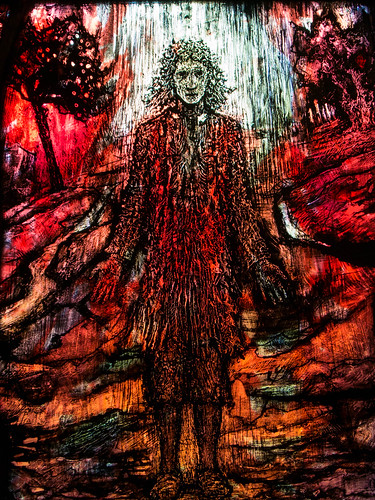
Thomas Traherne Stained Glass WindowOne of the main activities of EfM are Theological Reflections, where the students pick an "object" (which can be anything from a scriptural passage, personal story, work of art, piece of music, opinion, dilemma, or an actual physical object) to examine from many perspectives, and then we see what insights and implications we can draw from the discussion.

This was our first TR for the year, and since we have three new students we picked an "old chestnut" for the experienced folks, the story of the prodigal son. One of the First Years, who has a background in theater, gave a wonderfully animated reading of it, skillfully inflecting the emotion of the various characters in the parable.

Because that was too big to focus on, we narrowed it down to the sentence "you are always with me, and everything I have is yours." Now divorcing ourselves (de-contextualizing it) from the rest of the story, we stared at that sentence and talked about what its "world" would look like through the "perspective questions" of creation, sin, judgment and redemption. I won't bore you further with the guts of the process, but sufficient to say we landed on a resolve to be more generous and grateful for all that we have.

Then we did the closing prayer service, which concluded with the following prayer. Now remember, this was prepared a month or more before, with no knowledge of what today's class would be about, let alone what conclusion the group discussion would organically reach:
“Is not sight a jewel? Is not hearing a treasure? Is not speech a glory? O my Lord, pardon my ingratitude and pity my dullness who am not sensible to these gifts. The freedom of your bounty had deceived me. These things were too near to be considered. You presented me with your blessings and I was not aware. But now, I give thanks and adore and praise you for your inestimable favors.”
- THOMAS TRAHERNE (1636-1674)


I was bowled over by that. I wasn't familiar with the author, I noted the brevity of his life even for the time period. But I loved the perspective, given the anxiety so many of us are feeling in the days running up to this election.  It's so easy to forget what we have, and if it takes a coincidence like this to bring the point home, so be it.

Friday, September 18, 2015

Whoever has ears to hear, let them hear

I was struck this week by two passages we read in my Education for Ministry seminar, both quotes of Lloyd Steffen, Chaplain at Lehigh University in Philadelphia.

The first is to do with listening.  How often have we been speaking to someone and realized from their body language or their response that they were not so much listening as waiting for their turn to talk? How often have we realized someone has asked us something and we don't know what it was because our mind was somewhere else?  Steffen suggests there is more to this than laziness or narcissism:
“The ability to listen depends not in the first place on any particular skill or technique, but on a fundamental respect for one’s partner in conversation. Listening is thus a moral act. Listening is an act of attending to the other that discloses the strangeness of otherness, disrupting our comfortable self-images and threatening to undo our everyday experience of ourselves (and others) as familiar and basically unified personalities. Not listening becomes a way of securing ourselves from encounter with the mystery of otherness. Listening exposes us to our own desires not to want to share of ourselves. Listeners are required not only to welcome the strangeness of the other but to risk self-disclosure in the act of listening, for the listener must at some point recognize and then expose to the other his or her own strangeness—and not only to the other but to one’s own self.”
This can be damaging enough on the interpersonal level, but what about what is going on in the universal church? The recent discourse around what constitutes "religious freedom" in a pluralistic society demonstrates what happens when Christians can no longer count on the privilege of assuming the political and social norms are in line with their own... or even that their fellow Christians will agree with them on what those norms should be.  How do we find a way forward when we can't even hear one another above the noise in our own heads?
“We are in need of a theology of listening, for a willingness to listen ultimately expresses an attitude of love. Christians believe that Jesus listened to God and to those he encountered in his daily life. We do neither. If we listened to one another we should be inviting one another into new forms of relationship based on openness and respect and a willingness to share ourselves. If we listened for God, we should spend our time not praying for ourselves but listening to our prayers to see what we are saying not to God but to ourselves. The heart is a great mystery. Christians believe that God knows the human heart (and we do not), for that heart is where God’s omniscience lies. God does not need to be informed about our wants and needs. It is we who need to know what we want, what we fear, what we love.
The bolded bits struck me particularly. We have all been the recipient of mass prayer requests for this or that cause, generally with a specific requested outcome. Pope Francis recently decried the notion of God as magician... how is one left to feel when one's request is not granted?

When you agree to pray for a third party, what are you really doing beyond repeating the obvious desired result (wellness, a job offer, etc.)? Is it like opening multiple trouble tickets for the same problem, where your wish might get granted because it seems to be popular?  If non-believers see our notion of God as a cosmic suggestion box, for which we'd have only ourselves to blame, it is small wonder that they don't take people of faith seriously; it would be a very simplistic, childish view of a god, and difficult to defend when things don't turn out according to the script.

So should we stop praying for those people?  Certainly not. We agreed that a more beneficial form of prayer is to reflect on the situation and our own response to it... how can we "be Christ" in the situation for the people affected?  Knowing that giant unseen cheering squad is out there certainly can have a positive effect on a person's state of mind, the impact of which in situations requiring confidence and healing should not be understated.

If nothing else, we can pray to become better listeners.

Saturday, May 11, 2013

For Just Such a Time as This

Sermon for Education for Ministry Graduation

 
Well, nothing like a happy reading for a celebration, huh? I am sure Mark wondered what I was thinking when I chose it. He may still be in five minutes when I’m done,but I hope not. It is read each year on the Jewish festival of Purim, and the congregants use a noisemaker called a grogger to drown out the name of the evil Haman each time it is read.

Purim Exhibition at Heichal Shlomo in Jerusalem (2)
Grogger at the Purim Exhibition at Heichal Shlomo in Jerusalem

The Jewish people have known many instances of persecution during their history. As American Christians in the 21st century it is hard for us to identify personally with the idea of an evil figure cozying up to our head of state and successfully influencing him or her to have us removed from the scene, even if it meant an end to those long speeches at the National Prayer Breakfast. I also like to think Michele Obama would not need Gene Robinson or even Desmond Tutu to convince her to intercede with the President on our behalf.

But our world knows no lack of threats to our way of life, or our way of prayer. We continue to trivialize the impact of our way of life on the planet at our peril, spinning our own mental groggers when the news becomes more than we can bear. and -- despite all the electronic gadgets that purport to keep us connected -- many of us move through our lives in increasing emotional isolation. Many of our once-vibrant parish communities are waning, as individualistic, spiritual-but-not-religious ideologies and even atheism gain popularity, and volunteer programs to help those less fortunate must compete with other demands on our time. The church finds itself in a struggle for relevance, as Americans, particularly the young, are increasingly turned off by the way Christianity has been defined by those holding the microphone.

I think each of us can see aspects of ourselves in each of the major figures in this story, if not in the profound examples it offers. How often are we Mordecai, sitting in our own personal sackcloth and ashes, despairing at the state of the world, or our corner of it? How often are we Esther, taking refuge in the false security of our present comfort, or remaining silent because we don’t believe others will take our ideas seriously? Do we ever acknowledge how often we are “king” over others – even across the globe – whose lives are affected by how we spend our time, money and resources? And, being honest here, are we ever Haman, using our influence to get what we want, even when we know someone else will be hurt?

And yet, there is also redemption here. Mordecai, by making a scene his niece and the neighbors cannot ignore, triggers her to respond with compassion. Esther, in turn, is challenged by her uncle’s admonishment to risk, as our bishop often challenges us, something big for something good. If you read further, you’ll learn that The King, after learning that in fact he owes Mordecai the debt of his own life, consents to Esther’s request that the Jews will be spared, and Haman goes to a murderer’s reward.

And thus it can be for us. As we are each of the characters in this story, we can choose to use our influence for the greater good. EfM has gives lay people the scriptural, historical and theological context to respond to the many challenges and opportunities for ministry that surround us. So armed, let us not hide within the walls of our homes and churches, but show the world with our lives and our actions what people of faith can accomplish in a world that cries out for justice and peace.