I'D LOVE TO HEAR FROM YOU

Comments, criticisms, or (one can hope) compliments are more than welcome! Please let me know what you think, tell me I'm crazy (I suspect this) or what you'd like to hear about. Comments are screened before publication, so if you want to share something with me only, just put that in the comment and I'll keep it to myself.

THANK YOU FOR VISITING!
Showing posts with label New York. Show all posts

Monday, May 29, 2017

Before Stonewall, there was Juliana: Historical Novel Explores LGBT Life During WW2

MEMORIAL DAY

It is easy to think of LGBT culture in New York as beginning with the Stonewall Riots of 1969. It is particularly easy for me, since I was also born that summer. Less, however, is known about what life was like for folks prior to that, which may well be because much of it took place in secret for the participants’ own safety: in unmarked clubs, with coded language that allowed communication under the noses of a population which would betray them to family, employers or the police. Being gay, or even something as innocent as a woman wearing pants in public, could cost you your job, home, and friendships, or get you arrested, raped, or beat up.

Juliana cover.
Used with author's permission.
The first novel by playwright Vanda, Juliana gives us a look at this particular time and place by introducing her own characters to famous names of the day, many of whom risked their own careers, reputations, and marriages to indulge in “the love that dare not say its name” as the nation finds itself reluctantly drawn once again into war.

We see New York through the lens of a wide-eyed suburban Long Island girl “Al”, who moves to the city with her three childhood friends (Aggie, Danny, and Dickie).  Each has dreams of making it big in the arts world, which they quickly discover is populated by folks quite unlike the ones they knew in Huntington.  When big-talking producer Max Harlington III comes to their table, Aggie & Danny are entranced, while Al and Dickie remain skeptical. He takes them to clubs where cross-dressers, “bull daggers” and interracial couples all find sanctuary.

Taken in by the big promises of Max, the friends each set about fulfilling their dreams only to discover that, to quote Debbie Allen: ”Fame costs… and right here’s where you start payin’... in sweat.”  Running between auditions, lessons, soul-killing day jobs, and infested apartments, they struggle to keep their friendships alive.  It has always been assumed that the couples (Al and Danny, Aggie and Dickie) would marry someday, but as the book progresses, that dream becomes as elusive as the thought of your name up in lights.

For Al, the biggest distraction is Juliana, a talented vocal performer who seems perpetually on the brink of success. Juliana awakens feelings in Al she was unaware she possessed, then shocks her further by making it clear the interest is mutual. Although Al continues to harbor some disdain for Max, he proves useful in making this connection.  When things with Juliana go awry, however, Al flees back to Max’s place only to make a further unwelcome discovery that throws all her plans for the future into disarray.

Vanda 
Used with author's permission.
One of the prevailing themes for me is the degree to which LGBT people of this time period bought into the societal narrative that there was something wrong with them. Beyond entering into sham marriages and other means of protecting themselves, the characters continue to use words like “perversion” to talk about their own feelings.  It is not hard to accept this as realistic given what they were hearing from the culture at large.  Sadly this still occurs today despite all the “it gets better” cheerleading, positive role models and at least the patina of tolerance from official channels.

The declaration of war in 1941 sends the characters’ lives in different directions.  Max, Dickie, and Danny all end up overseas and Al contributes much of her time and energy to the Stage Door Canteen, a real-life place on 44th Street where military men were fed and entertained by Broadway personalities.  Here she mingles with greats like Katharine Hepburn, Ethel Merman, Alfred Lunt and Lynn Fontanne, who performed or helped staff the club. Many of these stars had cameos in a film named for the club, which stood on the site of the former New York Times printing press.

Dickie, Max and Danny all make it home alive, but not unscarred. They describe the conditions gay men and women encountered during deployment… perhaps the roots of “don’t ask, don’t tell” where camp behavior was tolerated and even encouraged in some quarters, but one misplaced word of affection could erase years of dedicated service with the stroke of a pen.  Small wonder that a study 60 years later found almost 15% of closeted LGBT veterans attempt suicide: imagine the nightmarish memories of combat layered with the constant fear of being found out.

Meanwhile, Al--at a breaking point--confides in best friend Aggie, whom she has helped through some serious setbacks, only to discover that their bond is not stronger than the prejudices with which they were all raised. Betrayed, Al turns again to the unconventional people from whom she continues to try to distinguish herself. I found it interesting and even a little vexing that these individuals, apparently further along the road of self-acceptance, continue to tolerate this behavior almost without reproach. It is not always clear what she brings to the table of these friendships besides judginess and a need for a whole lot of hand-holding. But I suspect then, as now, there are those who see their younger selves in the newcomer and thus deal with such foibles gracefully.

Nevertheless they take her under their wing and we see such real-life scenes of early gay New York as Spivey’s Roof, a nightclub on the Upper East Side where gay men and women were allowed to congregate as long as they (mostly) behaved. A young Walter Liberace played here briefly before unwittingly crossing Madame Spivy, the club’s imperious owner, namesake, and star performer, a scene described in the book.

The first volume leaves off with relationships on hold and a lot of unanswered questions. Luckily, a sequel which picks up at around D-Day is due out this summer. Meantime, an ensemble cast periodically performs scenes from the book at the legendary Duplex nightclub on Christopher Street, just steps from the Stonewall Tavern.  You can learn about upcoming events on the Juliana Project Facebook page or by visiting vandawriter.com and subscribing to her free newsletter.
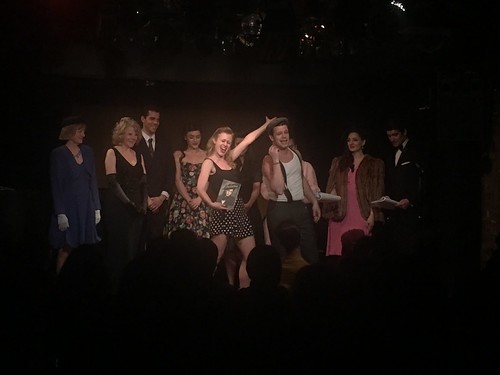
staged reading from the historical novel "Juliana"
The cast of a staged reading from Juliana at the Duplex.  My photo.

As we remember the sacrifices of those lost in our country’s wars, my mind goes particularly today to those who served and died for their country, likely leaving behind secret friends and partners who were not honored or comforted, and perhaps never even learned their fate.

Wednesday, March 5, 2014

Find the Cost of Freedom

ASH WEDNESDAY

“Hey, are you Polish?”

The question, though incongruous from a stranger as my two friends descended a busy staircase into the West 4th Street subway station, seemed innocent enough, and -- in fact -- one of them is.

The next question was even more out of place, although the intent was not immediately clear: “Are you faggots?”

My friends report that at first they thought the stranger was kidding around; an inside joke on the gayest corner of the gayest city east of Mrs. Madrigal. There has been much debate in the “community” over whether we should neutralize the venom of that word by playfully throwing it around, much as another two-syllable word has been co-opted by some of those against whom it was used. We know people who do that, with that word. The stranger had an accent, and sometimes people from other places use words differently than we do, and they were a little buzzed (they were, after all, celebrating their tenth anniversary). In a city they know well, and -- a mere block from Stonewall on a Saturday night -- they had no reason to be particularly wary.

So they said yes.

What followed happened so quickly that they struggled to recall it in detail… to the doctors, to the cops, and then to me. In a nutshell, the stranger did not like that answer, and he made that brutally and physically clear, while a station platform full of people fixed their eyes back on their phones and did nothing, said nothing. The birds are angry. Can you blame them?

Eighteen hours later, my friends finally made it home, having been up almost all night retracing their steps, paging through mugshots. One of them required stitches near his eye and may need surgery for facial fractures. They are both stunned, angry and sad. The city whose welcome we have come to take for granted now feels like a house that had been robbed.

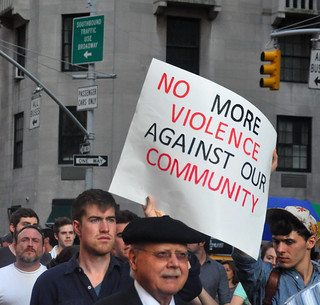
mark_carson_protest_DSC_0209
Protest in Greenwich Village after Mark Carson's murder

PHOTO CREDIT: Michael Fleshman
Used under Creative Commons License
Even as crime drops precipitously in the city and marriage equality comes to a new state seemingly every other week, two groups of people have increasingly found themselves the targets of violence and rage: gay men and transgender women. We are not just being called names or getting black eyes. In May of last year, a young man named Mark Carson was shot dead just blocks from where my friends were attacked. In August, an aspiring fashion designer named Islan Nettles was beaten on a Harlem street, right across from a police station, later dying from her injuries. Although multiple people identified her attacker, the charges were later dropped. Another man was attacked in an East Village subway station just three weeks ago. In all these cases, the perpetrator hurled homophobic and transphobic remarks at his victim.

My friends know they are lucky that what happened to them wasn’t worse. They are home eating soft foods because it hurts to chew, but they are alive. The police and doctors took their report seriously and told them they had done nothing wrong. We can be grateful: this would not have been the case thirty years ago.

As I write this, an invitation to a male couple’s wedding, which will be valid in the eyes of the church and the state, sits on top of today’s mail. My straight friends treat my partner and me like members of their families, and their kids say “uncle and uncle” without even puzzling at that idea. I think they would find a rotary phone more confusing.

It is clear, however, that some around us remain so threatened by the evolution of our rights and the normalizing of our place in the culture that the only way they can reassure themselves of their power is by lashing out: with words, with fists, with bullets. The rash of Jim Crow-evoking legislation that popped up around the country in recent weeks, was -- while failing to become law -- still successful at reinforcing the us-and-them mentality that drives such paranoia in some quarters. We can celebrate how far we’ve come, but if we let ourselves believe for a minute that the struggle is over, it is at our peril.

“It's unfair to be called a faggot your entire life; however, the slur becomes most dangerous when you let it no longer faze you.”
- PAUL FLORES

Friday, February 18, 2011

City Visit

Martin Luther - Educator and Translator (1546)

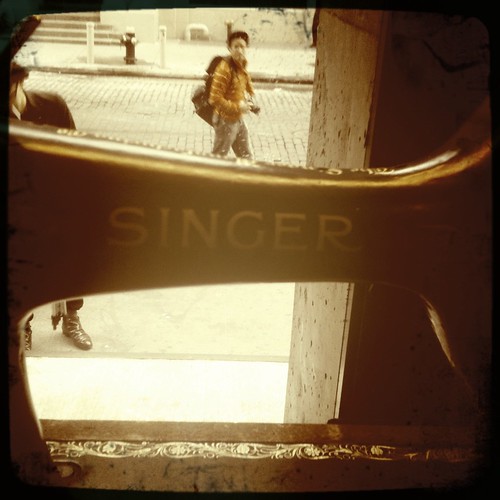
Singer
Singer, by shiftynj
(C) All rights reserved
I spent a warm Friday afternoon in the city with friends , celebrating my 20th anniversary with my employer. We had lunch at Salam in Chelsea, then walked through the Meat-Packing District (Gaansevort) and on the High Line, an elevated railroad trestle, long unused, which has been re-crafted into a wonderful park. 

One of the distractions in the park is a changing collection of art. The acoustics where it passes through a building are utilized to enhance a project called "A Bell for Every Minute" where -- once a minute -- a simulation of a bell somewhere in the city can be heard.

On the way home, we encountered another friend who is a student at General Theological Seminary, and he gave us a quick tour of the campus chapel. Then we saw Ethan Hawke on the street with his family.  Unfortunately by that time my camera had died. I hope to get back there soon and join them for Evening Prayer.

We were grateful for the unusually warm day.  More pictures in the gallery 20th Anniversary Lunch on Flickr.

Thursday, January 13, 2011

When the Ship Comes In

Hilary of Poitiers - Bishop & Doctor

Okay well it has been an embarrassing amount of time since I have posted anything here.  My friend David described this in a similarly apologetic post as having "gone galt" so then of course I had to go see what that meant, and another ten minutes were lost.

So, what's been happening?  Well right after Thanksgiving, we went to Florida, which was fun although really cold (for Florida) which meant we had a great time in the theme parks because there weren't any lines to speak of.

We got to visit a co-worker from years back and her husband, ride round on golf carts and see alligators.

Then there was Christmas, and a ridiculous snowstorm or three.   We're in the thick of winter here, now, but as someone pointed out earlier, it was still light enough to see at 5 o'clock, so the days are starting to get noticeably longer again.

We did have a rather unfortunate experience on New Years' Eve at a restaurant in Montclair called Costanera.

Queen Elizabeth 2 in 2008
There is an interesting maritime event unfolding in New York Harbor as we speak, although I am unfortunately not participating.  All three ships of the storied Cunard Line are berthed in the city at the same time: The Queen Mary 2 at the Brooklyn Cruise Terminal, and the quasi-sisters Queen Victoria and the new Queen Elizabeth at the Passenger Ship Terminal on Manhattan's west side, the latter having just completed her maiden transatlantic crossing.  My friend Doug Newman was aboard, and you can read his account on his blog.

This is is only the second time the entire fleet has been together in the port, which speaks as much about the modern need for marketing pomp as it does the state of the company's affairs: in the 1950s they operated over fifty vessels, now they have just three.

Queen Victoria at the Passenger Ship Terminal
The first was three years ago, for the Victoria's maiden arrival.  At that point the legendary QE2 was still in service, and a friend and I took a boat trip out into the Upper  Bay to watch  as the the three ships preened in front of the Statue of Liberty under a fireworks display.

I was also on hand for the mammoth Queen Mary 2's first visit to the city; in fact my dad and I were aboard, having made the maiden crossing from Southampton in April of 2004.