I'D LOVE TO HEAR FROM YOU

Comments, criticisms, or (one can hope) compliments are more than welcome! Please let me know what you think, tell me I'm crazy (I suspect this) or what you'd like to hear about. Comments are screened before publication, so if you want to share something with me only, just put that in the comment and I'll keep it to myself.

THANK YOU FOR VISITING!
Showing posts with label anti-LGBT violence. Show all posts

Tuesday, June 27, 2017

God, Gays & Guns, Redux: Connor Stephens Arrives Off-Broadway

Cornelius Hill - Priest & Chief Among the Oneida (1907)

“Oh, Jesus, I have to stop you right now. I love you dearly: You're a smart and sweet man, but you are so wrong about what matters and where the eyes should visit. The things you find so important--the attention, the prizes, the approval--yes, they matter, and never so much than when they disappear. But I'm old now, and I've walked a long and rocky road, and what really mattered, what should matter most to you, is the rare and gorgeous experience of reaching out through your work and your actions and connecting to others. A message in the bottle thrown toward another frightened, loveless queer; a confused mother; a recently dejected man who can't see his way home. We get people home; we let them know that we're here for them. This is what art can do. Art should be the arm and the shoulder and the kind eyes--all of which let others know you deserve to live and to be loved. That is what matters, baby. Bringing people home.”
- TENNESSEE WILLIAMS

Last night we had the privilege of attending the opening night of The Crusade of Connor Stephens at its new off-Broadway home in the Jerry Orbach Theater, once-home of the record-breaking The Fantasticks.  You may recall that I reviewed this show when it was included in the Midtown International Theatre Festival last summer, so I won't tell you the whole plot again.  Sufficient to say, it felt even more timely the second time around here in the Drumpfpocalypse, post Pulse Nightclub massacre, when mass shootings are a near-daily occurrence and demonizing one another with half-truths is what subsists for news.

Almost the entire cast* returned for this new production, which says something about their commitment to this important story and their devotion to writer-producer Dewey Moss. At this point I could not in good faith accept a paid gig to write something unbiased about the show because in the year since I have gotten to know Dewey and Jacques Mitchell (Bobby) and consider them friends.  However I will still say the show was just as gripping and cathartic the second time around, especially for anyone who has been church-burned or lived under the thumb of a controlling narcissist (well that would be the whole country at the moment, would it not?) as so skillfully portrayed by James Kiberd (Big Jim).

Episcopal Journal, June 2017
I did, however, write a brief interview of Ben Curtis (Jim, Junior) which appeared in the June edition of the Episcopal Journal. We discovered when we met in 2015 that we're both "PK's" (preacher's kids); my dad being a Roman Catholic deacon and his a now-retired Episcopal priest. I thought that would make an interesting angle for a story, given the contrast between his fundamentalist on-stage father and his real-life dad's progressive stance.  The text of my interview is below:

God, gays, and guns collide in The Crusade of Connor Stephens, a play written and produced by Dewey Moss which has its off-Broadway premiere later this month after an award-winning workshop run last summer. I caught up with former Dell computer pitchman Ben Curtis, who will reprise his role as Jim, Jr., a gay man whose adopted daughter's death puts him at odds with his firebrand minister father "Big Jim" and thrusts the family into the media spotlight. Ben hails from Chattanooga, Tenn, where his father was Rector of Grace Church from 1979-1994. Besides acting, he operates a yoga and wellness practice with his fiancee and performs in a variety of musical groups.

Q. I was proud to hear you identify as an Episcopalian in your recent interview with ESPN. Given your work helping others with their own health and spiritual journeys, how does the church fit into who you are and what you believe?

Well it certainly formed  some of my earliest beliefs as a Christian and my roots in spirituality. The church provided education, structure and community that I needed as a young wild rebellious PK (preacher's kid). It also helped me develop my early ideas of faith. Our parish and the Episcopal Church in general is so open-minded and accepting of all people, so that really instilled my core feelings as a child that all people are equal and all are loved by God. I still believe that today, and my father, while he was the rector of our parish, walked the walk.

Q. Like your character, you grew up as a "preacher's kid". How did that experience help you portray Jim, Jr.?

Well, it certainly helped me understand the pressures of being in the spotlight of the church. I was a satisfied customer of the Episcopal Church, so I was involved as an acolyte or in the choir. Nevertheless, if I made a mistake or got in trouble, you can be certain that everyone knew about it. However, unlike Jim, Jr., my father did not force me to think one way nor tell me that I was going to hell if I thought a different way.

Q. The Episcopal Church has been vocal about LGBT justice, as well as gun violence, both themes which the play explores. How did being an Episcopalian help shape how you see these issues?  

I feel blessed to have grown up in a church very different from the one that Jim, Jr., did, which sounds very oppressive. I have friends who grew up in churches like that and who were put in conversion therapy, which of course is never effective.

I am very grateful to have grown up in such an accepting environment that allowed me to form my own ideas of God and spirituality. I feel sorry for people who are told by their church or pastor that being a Christian is black and white: “you're either saved or you ain't.” I believe our God is a loving God and Jesus was a great prophet. We can learn a lot from his stories and how he treated other people, ESPECIALLY the outcasts or those “different” from him.

Q. How do you relate believably to an on-stage "family" whose values contrast so starkly with your character's?

It's not hard. I don't believe in their “Christian morals” as a person so it's fairly easy to be disgusted by them on stage. Furthermore, they're brilliant actors, so the tension on stage is quite palpable. That and when your stakes and intentions are clear as an actor, the rest tends to work itself out.

Q. If Dewey told you that you had to play Big Jim tomorrow, could you do it? What would you do to get into that character?

Absolutely! I've played lots of “complicated” and “awful” characters. Each character wants something. If you know what yours wants, then that's your job on stage: to listen and to get what you want, or at least try. This script is also well-crafted so the words guide you. No matter what kind of character I play, I always find and play the truth and the humanity. Even Big Jim is quite human.
Opening night of The Crusade of Connor Stephens
 
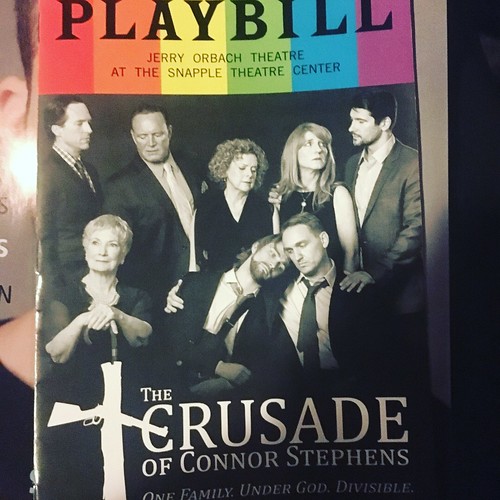
Playbill for The Crusade of Connor Stephens.

Top row, from left, Clifton Samuels (Dean), James Kiberd (Big Jim), Katherine Leask (Marianne), Julie Campbell (Kimmy), Jacques Mitchell (Bobby). Front row, from left, Kathleen Huber (Viv'in), Alec Shaw (Kris), Ben Curtis (Jim, Jr.).
 
 
 Opening night of The Crusade of Connor Stephens 
 
 The Fantasticks this is not. A makeshift memorial as you enter the theater sets the tone for this gripping and cathartic play. 

Curtain Call 
 
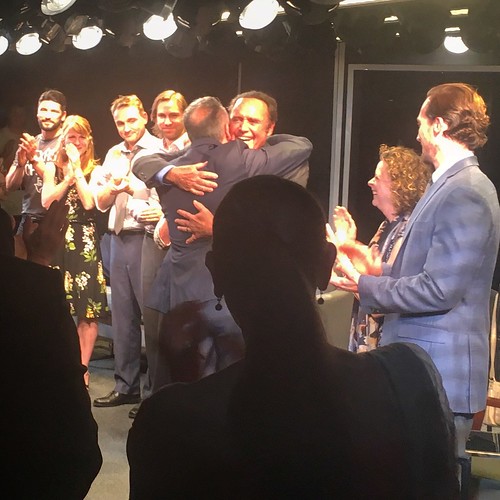
Writer-Producer Dewey Moss hugs James Kiberd (Big Jim) during the curtain call on opening night of The Crusade of Connor Stephens. From left, Jacques Mitchell (Bobby), Julie Campbell (Kimmy), Ben Curtis (Jim, Jr.), Alec Shaw (Kris). At right, Katherine Leask (Marianne), Clifton Samuels (Dean).
 
 Opening night of The Crusade of Connor Stephens 
 
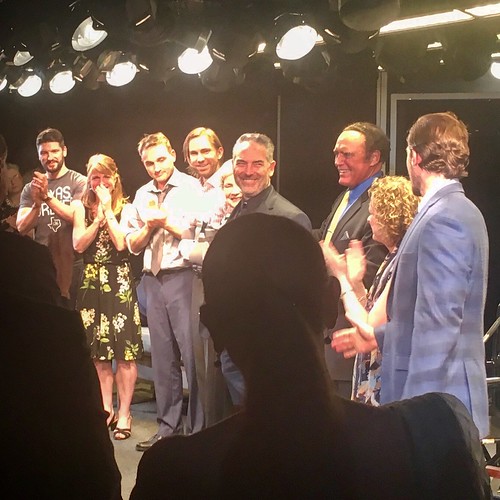
The man of the hour. Writer-producer Dewey Moss beams as the audience shows some love. From left, Jacques Mitchell (Bobby), Julie Campbell (Kimmy), Ben Curtis (Jim, Jr.), Alec Shaw (Kris). At right, James Kiberd (Big Jim), Katherine Leask (Marianne), Clifton Samuels (Dean). 
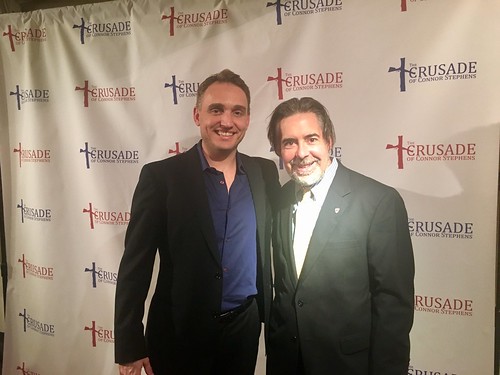
 Opening night of The Crusade of Connor Stephens 
Ben Curtis (Jim, Jr.) and yours truly on the red carpet.
NOTE: James Padric, who portrayed Kris in the workshop run, was diagnosed with esophageal cancer shortly after the production.  He is doing well but could still use your support in the face of hefty medical bills.  Thank you!

Sunday, July 24, 2016

God, Gays & Guns All Collide in a New Play

St. Mary Magdalene - First Witness to the Resurrection

My father's observation of Edward Albee's play Who's Afraid of Virginia Woolf was that the viewer squirms in hir seat, feeling as if s/he's witnessing a private conversation of which s/he should not be part. And that is precisely the point.  Two couples embark on a visit having no idea what intimate secrets are to be revealed, and leave the encounter permanently changed.

By contrast, the characters in Dewey Moss's new play The Crusade of Connor Stephens gather all knowing, by varying degrees, what to expect from one another.  Two families joined by the common tragedy of a child's murder are connected only by the parents, a same-gender couple in whose home the story unfolds. They come from different towns and vastly different world-views, a fact that becomes wrenchingly clear as each character in turn unpacks the baggage that the sudden loss of a little girl has forced into the light.  When the play was selected as part of the Midtown International Theatre Festival, the mass shooting at a gay bar in Orlando had not yet occurred, but that tragedy, coupled with the rhetoric coming from the presidential campaign, served only to make it more timely, and all performances of the limited run were sold out.

As the curtain rises, Jim Jr., broodingly portrayed by Ben Curtis (yes, the Dell spokesman... he's done quite a bit since then including starring opposite Richard Chamberlain in We Are the Hartmans), wants to drown his sorrows alone. His husband Kris (James Padric) is asleep, numbed physically and emotionally by medication; he was also struck by a bullet trying to save his daughter Tess. Kris's sister Kimmie (Julie Campbell) fusses over preparations for any post-funeral callers.  Her husband Bobby (Jacques Mitchell) arrives with Jim's mother Marianne (Katherine Leask) and grandmother Vivi'n (Kathleen Huber) in tow; the latter in a wheelchair.  Marianne reveals news Jim wasn't hoping for: his father "Big Jim" (James Kiberd) also plans to come by.

Big Jim would be a caricature of the blowhard southern evangelical preacher you love to hate if it wasn't so rapidly clear how thin a veneer his confident persona really is. Before he even arrives, his wife--ignoring whatever needs her grieving son and his husband might have--wants special tea made for him.  When he finally does bluster in, he immediately tries to establish control of everybody, ordering his mother to return to her wheelchair for no other reason than because that's what he wants. Moss quickly establishes the familiar pattern of an abuser; Big Jim manages to put down everybody in the room and anchor himself as the superior man of God.

Focusing on the handsome and athletic Bobby, the preacher wants badly to impress this newcomer with his ever-expanding church campus and involve him in it somehow. In doing so, he reveals his disappointment in Jim Jr. right in front of him with no regard for his feelings, causing everybody else to wince, but we can tell by the weary near-lack of reaction that his son is quite aware of his father's disdain.

Kris emerges, wild-eyed and disoriented. Who are these people in my house?  Jim and Kimmy hurry to settle him and it becomes clear that his fragile state buys him no free pass from his husband's family.  As the the story unfolds we learn that both Big Jim and Marianne have long blamed Kris for their son's same-gender attraction.
Jim Jr. (BEN CURTIS) comforts his husband Chris (JAMES PADRIC)
PHOTO CREDIT: Dewey Moss.  Used with permission.

As they prepare to leave for the funeral, Dean, an associate from Big Jim's church, arrives visibly distraught and detains the pastor with some urgent news. He received a letter sent by the killer Connor Stephens, prior to the murder and his own death (at his own hand?). Connor was a member of the church, a troubled youth who had been "saved" along with his mother by the charity of the organization.  In the letter he makes his motive for the killing clear, and--as the first act ends--the preacher is left alone to contemplate his own role in his son's daughter's death.

During the intermission, my cynical mind went back to how Big Jim tried to court Bobby, and I thought of the countless stories of vulnerable young men taken in and exploited by those they should have been able to trust. Cynical me wondered if we were going to learn there was something unseemly going on between Connor and either Dean or Big Jim himself. As the action resumes after the funeral, the whole story is painfully revealed as each character engages in some soul-baring.  Deep-seated resentments come to light, and alliances shift at least somewhat... the grip Big Jim has on his his family may be weakened if not failing completely.  After Jim Jr. learns Connor's motive (sorry, no spoilers. I'm hoping this play "has legs" and you get a chance to see it!), his father, fearing he'll be ruined if the truth gets out, tries to enlist everybody in downplaying the matter in the hope the story will slip from public attention.  Kris and his family are incensed, and we hope that Big Jim is going to get the take-down he so desperately deserves. Bobby or Jim, Jr. could slug him, his wife or mother could verbally eviscerate him, but ultimately he's already done the worst damage to himself.
Big Jim (JAMES KIBERD) verbally spars with Bobby (JACQUES MITCHELL)
PHOTO CREDIT: Dewey Moss. Used with permission.


The real hero of the story ends up being Grandma Vivi'n.  Without raising her voice, she orchestrates conversations that need to happen to keep the painful revelations coming.  She challenges her daughter-in-law to stand up to her husband and finally be a mother to her son after failing him for so long. And--when the time is right--she shares a long-secret truth that nobody is prepared to hear.

Grandma Vivi'n (KATHLEEN HUBER)
PHOTO CREDIT: Dewey Moss. Used with permission.


The play was staged as the Workshop Theater, a tiny space.  It deserves more eyes, particularly as the topic could not be more relevant during this troubled summer.  However, being so close to the players, close enough to see them twitch at one another's words, brings that uncomfortable intimacy that might be lost in too large a house. Curtis's Jim Jr. in particular, speaks very little but says so much with grimace and gesture that--for me, anyway--I felt like I knew him intimately and understood his pain.

You wish you weren't so close at times, right in the room hearing the things these people have been carrying around for so long, but we need to be there. Lost behind the aggregate statistic and sensational headlines, every gun-related incident wounds many more victims than the ones the bullets actually hit. Every sweeping condemnation flung from a pulpit causes collateral damage to people who never graced the pews. The day we stop seeing those affected as people like us, worthy of our sympathetic tears, is the day all hope is lost.

Friday, June 17, 2016

Say Their Names / Digan Sus Nombres

I woke up to one of those emails you aren't really prepared for in the pre-caffeine haze; the "I'm going to need for you to act like a grown-up today" kind of request that always manages to come when you're feeling least equipped to do so.

My initial reaction was, "Oh no, I couldn't possibly." I had been on an emotional skating rink ever since we learned on Sunday that 49 revelers at Orlando's Pulse nightclub had been mercilessly gunned down.  The idea of getting up in front of a church full of strangers and honoring them by reading their names aloud without going completely to pieces felt far beyond me.  I replied, vaguely, to my friend and frequent spiritual guide, indicating my concern and looking for tips on how to hold it together.

She should know: in her role as priest and rector of a congregation as well as chaplain at a nearby university, she is called upon repeatedly to be strong; to put her own emotions carefully aside and be a steadying force for families grieving a loved one, communities facing adversity, and myriad other human challenges that pockmark the territory of pastoral care.

Part of me hoped she would share some trade secrets on how to partition your own feelings, at least long enough to get through the service. Part of me hoped she might reply, "Oh, it's okay; if you don't feel comfortable I'll ask someone else."

Instead, she said nothing. I knew she had plenty on her plate without coddling me right now.

Not knowing what else to do, I "vaguebooked" that I had been challenged to do something difficult but important, and asked for prayers. The response was overwhelming: Over the course of the day, over 1/10 of my fairly substantial "friends list" chimed in with encouragement and promises of supplication. People I hadn't heard from in ages, whom I was pretty sure had long since "unfollowed" my endless string of arcane cyber-babbling, cheered me on. An actual celebrity I follow, whom I wasn't even sure manages his own feed said "You got this."

I did tell a handful of folks what I had been asked to do, and my fears. A few gave me permission to go with whatever emotion I felt at the time, one saying "If you go to pieces, it will be an honorable and truthful tribute to them."  Another suggested "Let the Lord do the work with you tonight. It's not about performing, it's about witnessing. You can be a witness tonight."

At eleven a.m., the draft program was sent over. I scrolled to the list of names and studied it. Were I to do this, I wanted to be ready to pronounce each one respectfully. The vast majority of victims were Hispanic. How could I, in my raised-in-the-woods Euro-ness, possibly do right by them? I only sort of speak Spanish, and I didn't want to sound like Peggy Hill up there, so I got some guidance from native speakers and looked up some names I didn't know how to say, but I still felt inadequate.

To my disgust, in the research process I discovered there are already "truthers" making videos claiming the massacre was staged (as was, apparently, Newtown). Yes, because this is what we do: we fake mass murders, and get the cops, first responders, doctors and nurses to help us. I'm not sure how these people would explain where the victims are now, or where the dozens of corpses came from. In the wake of this attack, jetBlue gave away free tickets to family members needing to get to Orlando. I wonder if we should round up the "truthers" and bring them there, too, so they could explain themselves to the survivors.

Part of me wanted to spend more time on each person... connect their name to their picture and understand who they were. But I was afraid to: not yet. I knew getting to "know them" was not going to help me to remain intelligible thorough this; it would likely do the opposite. But I will do that now that the service is done.

Various friends suggested--with varying degrees of seriousness--herbal tea, a nap, a joint. I had work to do, so none of that was going to happen, and in the end I just stayed distracted until it was time.

The woman reading the other half of the names is a "P-FLAG Mom", a colleague from my activist days. (Oh, that's the other thing. I was listed as "an activist" in the leaflet. I've been shamefully inactive these past few years.)  We strategized briefly about how we would walk, where we would stand, and who would read what. Having her there was comforting: I know she was ready to jump in for me if I needed her to, and vice-versa.

The service was well-planned and well-attended. We heard from an imam, a rabbi and several Christian pastors. There were songs and prayers, and then it was time. Stepping into the aisle, I waited for my P-FLAG Mom and we walked to the front. Looking over the room from the pulpit, I took a deep breath, and started reading.

And it was fine. I was a little shaky for the first group of seven, but I thought about all my cyber-cheerleaders, and hunkered down. I said seven names, she said seven, a bell rang, and we kept going. It was over quickly, and we took our seats.

Writing this, I know I probably made a lot more of it than I should have. But it was incredibly important to me that I get it right; that my reaction not detract from what anybody else needed from the service. I knew that--at something like this--one person falling apart could trigger a chain reaction, which I guess would be okay if it was meant to happen. But I didn't want to be the one to cause it.

For the last part of the service, we gathered on the labyrinth in the back of the church, around a giant sculpture, a stylized swan. We were directed to use Post-It notes to share our feelings and reactions to the event.  Holding candles we joined in a few verses of Holly Near's "Fighting For Our Lives".

And then we went home.


Say their names:
Stanley Almodovar III, 23
Amanda Alvear, 25
Oscar A. Aracena-Montero, 26
Rodolfo Ayala-Ayala, 33
Antonio Davon Brown, 29
Darryl Roman Burt II, 29
Angel L. Candelario-Padro, 28
Juan Chevez-Martinez, 25
Luis Daniel Conde, 39
Cory James Connell, 21
Tevin Eugene Crosby, 25
Deonka Deidra Drayton, 32
Simon Adrian Carrillo Fernandez, 31
Leroy Valentin Fernandez, 25
Mercedez Marisol Flores, 26
Peter O. Gonzalez-Cruz, 22
Juan Ramon Guerrero, 22
Paul Terrell Henry, 41
Frank Hernandez, 27
Miguel Angel Honorato, 30
Javier Jorge-Reyes, 40
Jason Benjamin Josaphat, 19
Eddie Jamoldroy Justice, 30
Anthony Luis Laureano-Disla, 25
Christopher Andrew Leinonen, 32
Alejandro Barrios Martinez, 21
Brenda Lee Marquez McCool, 49
Gilberto Ramon Silva Menendez, 25
Kimberly Morris, 37
Akyra Monet Murray, 18
Luis Omar Ocasio-Capo, 20
Eric Ivan Ortiz-Rivera, 36
Joel Rayon Paniagua, 32
Jean Carlos Mendez Perez, 35
Enrique L. Rios, Jr., 25
Jean C. Nives Rodriguez, 27
Christopher Joseph Sanfeliz, 24
Xavier Emmanuel Serrano Rosado, 35
Edward Sotomayor Jr., 34
Yilmary Rodriguez Sulivan, 24
Shane Evan Tomlinson, 33
Martin Benitez Torres, 33
Jonathan Antonio Camuy Vega, 24
Franky Jimmy Dejesus Velazquez, 50
Juan P. Rivera Velazquez, 37
Luis S. Vielma, 22
Luis Daniel Wilson-Leon, 37
Jerald Arthur Wright, 31

Monday, June 13, 2016

I've Learned to Live With a Very Flexibile Definition of 'Okay'

"Are you okay?"

I've been asked that a lot in the past 24 hours. I may have a bit of a reputation for emotional fragility, I'm afraid. I've been in a "thin place" for a very long time, and it doesn't take much to move me.

"Abrazo" by Hermán Marina
Neon, 2012
I'm not really sorry for that, though. We saw Steel Magnolias (yes, again!) recently and this production strangely omitted one of my favorite lines: "I have a strict policy that nobody cries alone in my presence." I subscribe to that philosophy without shame, because the alternative--being unable to respond to others' pain--sounds like prison. I know men in this culture are supposed to be stoic (the two acceptable expressions appear to be "winning" and "rage") but I've been told most of my life that I'm not a normal man and I've made my peace with that long ago.

So friends have been checking in, cautiously, like I might re-enact Sally Field's hysterical graveyard scene at the slightest provocation. The sweetest was the co-worker who offered to lend me her puppy.

"Are you okay?"

And the truth is, I don't know. I'm not even sure if I know what that is anymore.The world has been so crazy for so long that, as Sister Lily Tomlin's character on Grace and Frankie described it, "I've learned to live with a very flexible definition of okay."

"Okay" as in "Not in immediate danger to self or others?" Yes, I can go that far. I have a support system, I am not neglecting my basic needs. I eat and sleep (a lot). I made myself exercise and buy food. I know I am loved.

But isn't there more to "okay" than that? Aren't I entitled to feel safe? Shouldn't the people in charge be doing more to end the scourge of bloodshed than making hollow promises of "thoughts and prayers" (especially ironic when coming from some of the same public voices who keep reinforcing the notion that people like me are somehow "less than")?

So if you're queer in America in the Year of Our Lord Two Thousand Sixteen in the Month of Pride, all the world is not at peace, and "okay" is relative. You're okay because you woke up this morning and found yourself alive, you have a job and a place to stay, and a family that accepts you. But you still have to second-guess any action that might draw attention to yourself, weighing whether some man (it's seemingly always a man, have you noticed?) will have a problem with it, and whether he might have a gun.

49 people were killed by one man with one gun, which he bought in a store despite multiple queries by the FBI into his behavior. 49 people. How many is too many? 100? 200? "It was just one small town"? Sadly I despair that the will even exists to make it stop. Horrible as it is, I agree with the person who tweeted that the gun debate ended at Newtown: If 'murica wasn't heartbroken enough by the deaths of toddlers, I doubt that the slaughter of LGBT folks will be the tipping point. There are already tweets out there saying they deserved what they got.

And that, my friends, is Not Okay.

Pulse Nightclub Victims Fund

Thursday, March 24, 2016

Fear is Poison, and Someone's Left the Cap Off the Bottle

MAUNDY (HOLY) THURSDAY

Little children, I am with you only a little longer. You will look for me; and as I said to the Jews so now I say to you, “Where I am going, you cannot come.”  I give you a new commandment, that you love one another. Just as I have loved you, you also should love one another.  By this everyone will know that you are my disciples, if you have love for one another.’
JOHN 13: 33-35

Holy week again and--much like our Gospel ancestors--we find ourselves gathering at the table in fear.

In the past week, a European city has been struck by terrorist violence, triggering the usual wave of "Will it happen here?" Our "leaders" have sprung into "action" with South Carolina's Senate passed a bill to create a "refugee registry" the contents of which will, of course, only be available to our trusty law enforcement friends, because that won't cause any problems.  Just like it didn't in 1930s Germany. One of the (God help us) presidential candidates stated that under his watch, we would "patrol Muslim neighborhoods" to stamp out any hint of suspicious activity.

But one bogeyman isn't enough, you know, so two adjoining states in the same part of the country (and one elsewhere lest we think there's something in the water), no doubt still smarting from the Supreme Court telling them "Yes you WILL let same-gender couples marry" are cobbling together what restrictions they can still impose on LGBT folk to make sure they still feel oppressed.  Georgia's governor is considering a "religious liberty" bill that allows one to discriminate based on one's so-called beliefs, and North Carolina up-ended non-discrimination bills in several cities by passing its own that specifically excludes orientation and gender identity, and also forbids lower jurisdictions from enacting broader protections. It ordered government buildings to assign a single gender to bathrooms and ensure the anatomy of those using them matches the sign. In the latter case, they clearly did exhaustive study first, since the entire thing went down--from proposal to signature by the governor--in under twelve hours.

Kansas went even further, encouraging vigilantism by offering a $2,500 reward to anyone who "catches" someone whose "plumbing doesn't match" using the "wrong" bathroom. Really? How is that not creepy and invasive? Who is going to check, and on what grounds? The sad irony is that this law, which states its purpose is to prevent violent, traumatic encounters, will pretty much require the same in order to be enforced.

Fear is at the root of all of this; fear we attempt to assuage with reactive window-dressing.  The truth none of us wants to face about violence is that it is--by definition--random. While vigilance and keen observation of our surroundings are doubtless important, the idea that we will plug all the holes is delusional. And following people around based on religion or identity will neither prevent violence nor do anything to de-escalate the tension that leads to it.  The vast majority of Muslim people in the world are horrified by the acts perpetrated by DAISH and other extremist groups, just (I hope) as most Christians would be horrified by the violence the church has perpetrated on Muslims and others throughout its history, and is perpetrating now on LGBT people in Russia, Africa, and the good old US of A.

Which brings it back to us, here in a crazy and uncertain world, where seemingly endless bad news and a 24-hour ticker of threats seems bent on making us a bunch of suspicious insomniacs peeking under bathroom stalls. The goal of "religious freedom" as described by people who would likely also describe our country (right or wrong) as a "Christian nation" should, one would assume, free us to act as our savior would.  The same savior, who--knowing one of those he called his friends would imminently perpetrate violence upon him--nonetheless greeted each of them with a kiss, and sat with them to eat and drink.


Thursday, July 17, 2014

Bloody Sunday: Irish Rocker Spotlights Church's Role in Anti-Gay Russia

 I wrote this for Walking With Integrity.

Last spring, I wrote about a young woman named Dannika Nash who quoted the Macklemore song "Same Love" in some frank advice to the institutional church on behalf of milliennials. In a nutshell, she warned that if the church forced her generation to choose between it and their support of LGBT rights, it was going to be disappointed in the outcome. Her basic message was one that research clearly shows is shared by many in her generation, 30% of whom do not claim any faith affiliation at all. She implied that - for them - music and other aspects of their culture fulfill a social-consciousness need that religion does not.

Macklemore, classified as a rapper, was not afraid to call out the genre's reputation for homophobia and misogyny. In January of this year, he performed "Same Love" at the Grammy Awards while Queen Latifah witnessed the marriages of thirty couples, including some of the same gender.

I heard a song recently in my truck which caught my attention because the chorus starts out with the phrase "take me to church..."  Not only is this unfamiliar subject matter for popular music (for reasons explained above, I expect), but a Facebook buddy and his friends use the expression "go to church" as a euphemism for their favorite pastime (kayaking over waterfalls in the Pacific Northwest), and I thought he might get a chuckle out of a song that features that phrase.

 
Video for Hozier's "Take Me to Church"
(CAUTION: Violent Imagery)


Hozier at SXSW 2014
PHOTO CREDIT: WFUV Radio
Used under Creative Commons License
 Some rights reserved
It wasn't til I got home and read more about it that I understood the song's topic is no laughing matter.  Having only half-heard the words while driving, I discovered upon closer examination that Andrew Hozier Byrne (who goes by his middle name), a 24-year-old Irish man, is not asking to be brought to a religious institution, at least not the ones he knows.  Describing his experience as "Every Sunday's getting more bleak / A fresh poison each week"  Hozier (or at least the protagonist in the song) is -- like Ms. Nash -- eschewing life in the pews for a "religious experience" of another kind, in his case a lover.

What caught my attention, however, was the subject matter of the song's video.  It depicts -- in brutal honesty -- the abduction of a gay couple in Russia by a vigilante gang.  The connection to the lyrics was not immediately clear, but -- if you know a little background on what's going on there -- it starts to make sense.

For at least the last 12 years, anti-gay sentiment in Russia has been ramping up. Attempts to hold pride marches in Russian cities have been generally meant with political opposition and/or violent protests.  The country's Christian, Muslim and Jewish leaders have all spoken out against the observances, with the Grand Mufti Talgat Tadzhuddin encouraging flogging for the participants in the Moscow Pride of 2006.

"I always stand by the song and the point that the video made, so it’s never a chore," Hozier, who is not gay, told the London Evening Standard. "The song is about loving somebody, and the video is about people who would undermine what it is to love somebody."

Journalist Jeff Sharlet, whose books C Street and The Family document the degree of control a cadre of evangelical Christians have over Washington, traveled to Russia this fall in the run-up to the Sochi Olympics and painted a stark picture of gay life in the country which appeared in February's GQ.  Sharlet describes the growing hostility towards gay people as part of a larger social unraveling: Russian civilians, encouraged by their government and religious institutions, have taken matters into their own hands.
"There's a national network called Occupy Pedophilia, whose members torture gay men and post hugely popular videos of their 'interrogations' online. There are countless smaller, bristling movements, with names presumptuous (God's Will ) or absurd (Homophobic Wolf). There are babushkas who throw stones, and priests who bless the stones, and police who arrest their victims."
In the article, Sharlet describes shoot-ups in bars, rapes, beatings, and computer surveillance, (even on the part of private citizens).  Readers learn the measures to which people will go to survive, and the lengths others will go to tear apart the lives of complete strangers in pursuit of some dystopic fever-dream. We meet two families that live together symbiotically, presenting as heterosexual to the world as a cover for their actual same-gender partnerships.  Sharlet talks to both targets and perpetrators, attempting to help readers decipher what is behind the fear and violence.

The Duma in 2013 passed an "anti-propaganda law" which makes it illegal to communicate about "non-traditional sexual relationships" to minors. Of course what constitutes "propaganda" can be broadly interpreted to suit the occasion, and one could be punished for doing anything something as simple as holding hands anywhere "where children might see."  Victims of vigilante violence are laughed at or punished if they seek help from law enforcement.

Western Connection (AKA, Why We Should Care)

If the rationale of "protecting the children" sounds familiar, it is because it is the same mantra used to justify anti-gay laws in Africa, and -- lo and behold -- some of the same American evangelical voices, including Scott Lively, are taking at least partial credit. Lively is currently the target of a federal lawsuit under the Alien Tort Act for crimes against humanity, due to his involvement in getting Uganda's "Jail the Gays Bill" passed.  He toured that country in 2009 with several other Americans, stirring up anti-gay fear at a series of rallies.  He employed the same tactics in Russia and called the passage of the law there "one of the proudest achievements of my career".  His enthusiasm was shared by the American Family Association's Bryan Fischer.

Most American clergy, not unaware of shifting public opinion, are more nuanced in their positions on LGBT issues, sometimes head-scratchingly so.  Televangelist Joel Osteen told Larry King "I believe homosexuality is a sin, but I don't want to preach about it." Jim Wallis of Sojourners (who is frequently described as a progressive) drafted and circulated a letter to Barack Obama in favor of a "religious exemption" to the President's executive order on discrimination by companies holding federal contracts.  A number of the large, venue-based churches like Hillsong NYC, attempt to avoid the topic altogether.

But we can't not talk about it, so long as crises as large and terrifying as the one unfolding in Russia continue to happen, and as long as there are places in our own "civilized" country where people think belonging to a church makes it okay for you to be a bully and want that enshrined in the law.  For those of us who believe there is a place for everyone at God's table, the recent string of domestic victories should not be mistaken as a sign that we're anywhere near done doing justice work. The "religious freedom" laws being introduced in various quarters are a clear sign of that.

Nor can we rest on our laurels while we know that hurtful things are being done in God's name anywhere in the world. The one thing our Savior didn't abide well is hypocrisy, and the YouTube generation is reminding us of that by voting with its feet.  Perhaps if they saw our churches witnessing to the pain being inflicted in the name of religion and how this conflicts with the Gospel we know, they'd be more inclined to stick around.

----
An adaption of this article was reposted on believeout.com on August 8th, 2014
"Millennials, the Church, and LGBT Global Social Consciousness"

Wednesday, April 30, 2014

"... Then You Have No Share With Me"

"I hate, I despise your festivals,
and I take no delight in your solemn assemblies.
Even though you offer me your burnt-offerings and grain-offerings,
I will not accept them;
and the offerings of well-being of your fatted animals
I will not look upon.
Take away from me the noise of your songs;
I will not listen to the melody of your harps.
But let justice roll down like waters,
and righteousness like an ever-flowing stream."
- AMOS 5:21-24

It's days like this that it's embarrassing to be a Christian.

How am I supposed to be a proud member of the institution whose ranks include a woman who compares waterboarding (a brutal form of torture), to baptism, our most sacred and widely-recognized sacrament? 

How am I supposed to seek unity or concord with a self-proclaimed archbishop in our own "civilized" country who -- when pressed -- refused to condemn the draconian new laws in Africa and Nigeria that not only make the simple condition of being gay (which is not something one chooses) a criminal offense punishable by arrest, abuse and (in some places) death, but compels the entire populace to take part in a witch hunt against the same, or face similar mob justice?  

How do I accept the leadership of the titular head of my own church, who would use very shaky evidence of a connection between mass murder in a country torn by civil war and the progress western churches have made on sexual and gender justice, as a rationale for keeping his own province in the past as the country around them moves forward, further cementing its increasing irrelevance?  

How do I explain this to the people I encounter (either LGBT themselves or just  believing in equal rights) who have a deep (and deserved) distrust of religious institutions in general and the church in particular?

The simple answer is, I can't.

I hereby declare myself "out of communion" with those who would use Christ and the Bible as a weapon against those around them. I concede that what is broken between us cannot be fixed. You can't be taken seriously when using "Biblical authority" as a rationale for endorsing continued persecution and murder.   If you don't see the defense of one vulnerable member of the human family as equally important to another, then -- frankly -- I'm not sure what Gospel you're reading, but it's not the one I know. 

Your "Christian cred" is hereby null and void here at the Church of Me if you think sinking to the level of torture is the way to make terrorism stop, and then glorify it by comparing it to the joyful initiation into the Body of Christ.  You cannot wash away another's sins while there is blood on your hands.

I cannot control what my denomination or the communion of which it is part does or says, or fails to.  Archbishop Welby claims that Christians might suffer at the hands of the intolerant if the church continues to move forward.  I fail to recall an instance where Christ promised the road of discipleship would be an easy one.  I am blessed to live in a place where we have grown so used to feeling included that we take it for granted, and a large part of the conversation is reminding those who "got theirs" that there is still work to be done.  I urge my similarly comfortable brothers and sisters to look at the world and the church outside your doors, pick up the rope and help us soldier on.

I only know that -- for me -- I can no longer be at peace with the notion that others identify me as part of an institution that is capable of what I've seen done in its name. I will continue to bore and annoy people by talking about it as long as I have a voice. I wish our leaders would put the radical inclusion that Christ preached ahead of politics and the facade of unity, an altar at which fairness and progress have been sacrificed so many times. I thank God for the opportunity to break bread with prophetic voices like the Rev. Winnie Varghese, the Rev. Canon Susan Russell, Louie Crew-Clay, and Jim Naughton, who have spoken truth to power many times when it was inconvenient or even dangerous to do so.  They are the reason I have found it possible to stay at the table when my head and my heart have told me to walk away.

We have much to be grateful for, and I know on one level that what we are seeing is the inevitable "growing paints" of progress.  But for today, I can't help but believe that the Almighty looks down at our folderol, especially at this time of year, and shakes his head, wondering, "when will they ever learn?"

Friday, April 4, 2014

Where is the Lamb for the Sacrifice?

Martin Luther King - Civil Rights Leader (1968)

I have had a volatile relationship with the See of Canterbury since I joined the Anglican fold some twelve years ago.  Those in my first congregation were no fans of Lord Carey, and thus the election of a Welsh poet to replace him filled this new adherent with enough hope to compose a Mass setting for the Sunday of his coronation.  It is probably terrible, has never been performed again, and -- as one whose "manner of life" apparently posed a challenge for His Grace -- my enthusiasm for Archbishop Williams' circuitous shepherding lasted just about as long, reaching a nadir when he appeared at our own church's convention to strong-arm us into a three-year moratorium on ordaining any further gay or lesbian bishops.  Thankfully, three years later, we remembered we don't actually have a Pope, and went about our business, electing Mary Glasspool.

Thus I greeted the Current Occupant, the Most Rev. Justin Welby, with no particular relish, especially given his corporate background and evangelical ties.  I watched his installation anyway (pleased that he eschewed the term "coronation") and learned a new hymn in the process.

While the Church of England struggles to come to grips with concepts we in the Episcopal Church have (for the most part) put to rest, society in the Kingdom is moving along without them.  Last week, civil marriage equality became the law of the land in England and Wales.  Even Her Majesty has gotten in on the fun, and the church -- somewhat grudgingly, I suspect -- issued a statement dropping resistance to the inevitable.

So I was somewhat knocked over today when I learned from the President of Integrity (the LGBT ministry of the Episcopal Church, of which I am a board member)  that his Grace, in the midst of a radio interview, basically said the CofE can't move ahead on LGBT issues because -- if they did -- African Christians would die.


"Scapegoat at Holy Trinity: Southport"

PHOTO CREDIT:  Julia (flickr.com/loscuadernosdejulia)
Used under Creative Commons License
In response to a listener's question about the Church of England's reluctance to allow its clergy to exercise their consciences on blessing same-sex relationships, the Archbishop cited the impact on the church's decisions on Christians in other parts of the world. He went on to describe standing at a mass grave in South Sudan earlier this year and being told that the victims were killed "because of something that happened in America."

While the Archbishop did not elaborate, in the context of the conversation it is difficult to imagine that "something" as anything besides the progress that American churches, and ours in particular, have made in the inclusion of LGBT people and recognizing their relationships.

In the absence of any clear evidence of a direct connection, it strikes me as irresponsible at best and dangerous at worst for a religious leader to link this tragedy and the actions of a relatively small church on the far side of the globe, amid a civil war, sectarian violence and other local perils, and use it as precedent to deny the church's blessing to the faithful same-gender couples who seek it. 

My particular mission is to minister to and protect the lesbian, gay, bisexual and transgender people, both those within the church and those who need its care. Thus I feel compelled to remind the Archbishop and the church that – even if this vague correlation is based on fact – anti-LGBT violence directed at non-LGBT people is still anti-LGBT violence, and it is still wrong. If we capitulate to it by denying rights to LGBT people in other places, the violence will not go away. Instead, we send the message to the church and the world that if you bully us, we will back down, thus inviting more of the same.

This whole event comes shortly after two African countries in which the Anglicsn church has a strong presence (Nigeria and Uganda) passed draconian new laws  which criminalize those known or suspected to be gay, as well as those who fail to turn them in.  The Archbishop's alarmist statement today comes in the wake of a far more muted one when his peers in those countries expressed enthusiastic support of the new laws, despite reports that LGBT people were already being subjected to violence. 

I remembered -- guiltily -- well past cocktail time that today is the feast of Dr. King (we observe our "saints" principally on the anniversaries of their deaths).  If I know one thing about his work, it is this: When you take a stand against the status quo, someone -- generally the person who is benefiting from the status quo -- is going to make noise.  They may threaten, they may even harm.  But that risk cannot be enough to make us fail to stand up for what we believe in.

Dr. Welby would apparently have the LGBT members of his own church give up their own full participation therein at the altar of a great and unproven "what if." I learned there was only one sacrificial lamb in our theology, and that part has been spoken for.

In the 150 egg-faced  years since we -- by and large -- sat shamefully by and watched emancipation happen around us, it seems my church has learned a few things about justice and equality. I wish I could say the same for our friends across the pond.

Wednesday, March 5, 2014

Find the Cost of Freedom

ASH WEDNESDAY

“Hey, are you Polish?”

The question, though incongruous from a stranger as my two friends descended a busy staircase into the West 4th Street subway station, seemed innocent enough, and -- in fact -- one of them is.

The next question was even more out of place, although the intent was not immediately clear: “Are you faggots?”

My friends report that at first they thought the stranger was kidding around; an inside joke on the gayest corner of the gayest city east of Mrs. Madrigal. There has been much debate in the “community” over whether we should neutralize the venom of that word by playfully throwing it around, much as another two-syllable word has been co-opted by some of those against whom it was used. We know people who do that, with that word. The stranger had an accent, and sometimes people from other places use words differently than we do, and they were a little buzzed (they were, after all, celebrating their tenth anniversary). In a city they know well, and -- a mere block from Stonewall on a Saturday night -- they had no reason to be particularly wary.

So they said yes.

What followed happened so quickly that they struggled to recall it in detail… to the doctors, to the cops, and then to me. In a nutshell, the stranger did not like that answer, and he made that brutally and physically clear, while a station platform full of people fixed their eyes back on their phones and did nothing, said nothing. The birds are angry. Can you blame them?

Eighteen hours later, my friends finally made it home, having been up almost all night retracing their steps, paging through mugshots. One of them required stitches near his eye and may need surgery for facial fractures. They are both stunned, angry and sad. The city whose welcome we have come to take for granted now feels like a house that had been robbed.

mark_carson_protest_DSC_0209
Protest in Greenwich Village after Mark Carson's murder

PHOTO CREDIT: Michael Fleshman
Used under Creative Commons License
Even as crime drops precipitously in the city and marriage equality comes to a new state seemingly every other week, two groups of people have increasingly found themselves the targets of violence and rage: gay men and transgender women. We are not just being called names or getting black eyes. In May of last year, a young man named Mark Carson was shot dead just blocks from where my friends were attacked. In August, an aspiring fashion designer named Islan Nettles was beaten on a Harlem street, right across from a police station, later dying from her injuries. Although multiple people identified her attacker, the charges were later dropped. Another man was attacked in an East Village subway station just three weeks ago. In all these cases, the perpetrator hurled homophobic and transphobic remarks at his victim.

My friends know they are lucky that what happened to them wasn’t worse. They are home eating soft foods because it hurts to chew, but they are alive. The police and doctors took their report seriously and told them they had done nothing wrong. We can be grateful: this would not have been the case thirty years ago.

As I write this, an invitation to a male couple’s wedding, which will be valid in the eyes of the church and the state, sits on top of today’s mail. My straight friends treat my partner and me like members of their families, and their kids say “uncle and uncle” without even puzzling at that idea. I think they would find a rotary phone more confusing.

It is clear, however, that some around us remain so threatened by the evolution of our rights and the normalizing of our place in the culture that the only way they can reassure themselves of their power is by lashing out: with words, with fists, with bullets. The rash of Jim Crow-evoking legislation that popped up around the country in recent weeks, was -- while failing to become law -- still successful at reinforcing the us-and-them mentality that drives such paranoia in some quarters. We can celebrate how far we’ve come, but if we let ourselves believe for a minute that the struggle is over, it is at our peril.

“It's unfair to be called a faggot your entire life; however, the slur becomes most dangerous when you let it no longer faze you.”
- PAUL FLORES