I'D LOVE TO HEAR FROM YOU

Comments, criticisms, or (one can hope) compliments are more than welcome! Please let me know what you think, tell me I'm crazy (I suspect this) or what you'd like to hear about. Comments are screened before publication, so if you want to share something with me only, just put that in the comment and I'll keep it to myself.

THANK YOU FOR VISITING!
Showing posts with label family. Show all posts

Sunday, September 8, 2019

She Did It Her Way: Remembering My Grandmother

Grandma At 97
PHOTO CREDIT: Tammy Paolino

Firstly I want to thank you for taking the time to remember my grandmother with us today. She did love a gathering and some of her happiest moments were the birthday parties that we staged in her honor, especially in recent years.

It’s hard to imagine having had ninety-seven birthdays. For most of them, someone probably started the familiar chorus of Stolat! Stolat! Niech żyje, żyje nam.... ​May you live a hundred years. And she must have taken them seriously, because she came pretty darn close.

I feel very grateful to be a white-bearded old man myself--and though she couldn’t see too well by the end she never missed an opportunity to tell me to shave it off--before I had to say goodbye.

I lived in her house on two separate occasions, once when I was a toddler, and one of my earliest memories is eating Froot Loops with my cousin Diane in the apartment upstairs, an apartment that would later be my first home of my own. And in between we were always welcome at her table for ​pierogi​ or deep fried calzones or pot roast, or whatever was on the menu.

She wore many hats over the years: softball player, school lunch lady, master gardener. I remember countless trips to the mall in her series of Oldsmobiles, with a pack of Kools and a bingo stamp in permanent residence in the center console, and the pine tree hanging from the rear view mirror.

One of the main things she helped instill in me is a love of music. A progression of three parlor organs, each one grander and more complicated than the last, held a place of honor in the living room, and--though she never quite mastered what all the buttons did--playing, and the sheer fact that she could--​ brought her endless joy. The soundtrack of those years includes many a halting rendition of “Moonglow” or “Mack the Knife” or “Spanish Eyes”. Over the years there were a number of songs, from Sinatra, or Bobby Vinton, or Susan Boyle, or Clay Aiken, that she took on as a personal anthem for a season or longer. She encouraged me to stick with playing beyond childhood lessons and i know she was proud of my amateurish efforts even if they weren’t exactly her style.

After we lost my grandfather 21 years ago, Jessie was on her own for the first time in her life. Like her mother, she was determined to maintain that independence for as long as she could, and she did, for a long time. As she gradually had to concede her autonomy and allow others to care for her, we filled the time and tried to distract her by sharing memories and getting her to talk about happier times.

One of my favorite stories was the time the family towed the camper down to Disney World. Grandma wisely elected to fly down and meet us rather than endure three days in Grandpa’s suburban with six other people. On the day she was supposed to arrive, it was discovered that--true to form--everybody thought someone ​else​ knew her flight information. In those pre-cell-phone days there was no easy way to find each other, and somehow grandma--in a strange city, without a solid idea exactly where we were--got herself to the campground and came marching up to us, suitcase in hand, madder than a hornet.

She didn’t think it was too funny at the time, but It was an example of the resourcefulness her immigrant, depression-surviving parents must have instilled in her as she navigated growing up in Greenpoint, returning to her native Bloomfield as a young bride and mother, and then to Little Falls as the eventual matriarch of an ever-growing family. She got such a proud gleam in her eyes when she recited how many grandchildren and great-grandchildren she had. While in some ways she was definitely a product of her generation, she was also surprisingly progressive at times, and gracefully accepted the changes and chances of this life, and the direction each of ours took. We... you... were her life’s work, and she would be not-so-secretly pleased to see you all here.

Though she wasn’t quite around physically for those hundred years, she’ll live on a lot longer than that in our memories and stories, a lady who truly did it ​her​ way.

Tuesday, June 16, 2015

Too Many Flags to Fit

 “A boy like that will kill your brother
Forget that boy, and find another
One of your own kind, stick with your own kind”
- WEST SIDE STORY

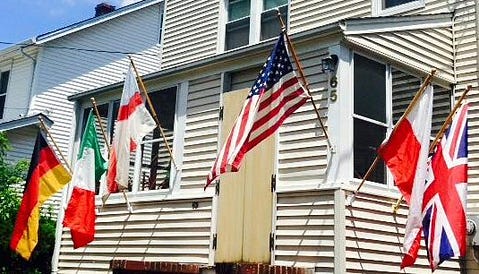
This Sunday was Flag Day in the U.S. We have an enclosed porch with the ability to fly eight flags, which I do only on special occasions. Besides the American and Episcopal Church flags, which I fly on most nice days, I have a bunch of others, representing my partner’s and my varied ethnicity, places we’ve been, and some (like Wales) that I just have because visually it’s a cool flag. I have a vague sense of the major holidays in these various countries, as well as seasonal fillers to trot out when appropriate. We may the only people in New Jersey with Mardi Gras flags, for example, but I have attended the real thing in Louisiana many times and think observing it with gusto is a great way to usher in Lent.


Since my youngest sister married, it occurred to me that — just among my siblings and our partners — we now don’t have enough spaces to represent everybody’s background completely. Besides our own Italian, Lebanese, and Polish roots, some of which our spouses share, we have connections to Germany, Peru, and various British isles. I guess we can’t have everybody over at once, or someone’s going to feel slighted when they pull up to the house.

With that in mind, I saw with pleasure that a blogger whom I discovered recently, Joe Kay, had a piece from last year republished today by Sojourners. From This Day Forward… or Backward” starts out by describing the pressure Kay experienced from his family to marry someone just like them: Eastern European and Catholic. There was a tremendous fear that “the old ways” would be lost if this purity was not preserved. As he put it:
“To so many people, my relationship wasn’t about finding someone who fit me — it was more about me finding someone who fit them.”
My family has one pretty homogeneous narrative: my mother’s mother’s mother came from Poland as a teenager, quickly married a Polish man, and lived for most of her life in Greenpoint, Brooklyn, where it was (and may well still be) possible to get by while speaking and reading only Polish. When my grandmother was of age, she also married a Pole, and her two siblings who married did likewise (in fact their spouses were also siblings, children of another family from the neighborhood).

My dad’s background is somewhat different. When my Italian-American grandfather brought his Lebanese-American wife to live with his Italian-immigrant parents above their grocery store, the two women both continued to do what they did best: cook amazing meals, each in her own kitchen. In fact, my grandmother was among the few people whose cooking my great-grandmother would eat besides her own.

There was some initial resistance, however, on her folks’ part: Italians, in that age of Mussolini, were viewed with an extra layer of the suspicion that most immigrant groups faced, and the Lebanese compensated for their share of discrimination by playing up their political and cultural association with the French. Once they proved themselves, however, both my grandfather and my cousin’s husband (also Italian) were adopted as part of the tribe.

My parents’ disparate backgrounds did not, as far as I know, cause any strife for their respective families , and neither did they impose any such restrictions on us (our mindset is pretty much Hey, another food to try!). As fate would have it, my sisters still all married Catholic men, two of whom are at least part Polish.

I guess by choosing another dude (and a WASP, to boot!) I wandered furthest from the field of what anybody might have expected from me, but I am grateful to say none of this has been an issue for anybody in my extended clan, including that same Polish grandmother, who is now 94. Thus I had tremendous sympathy for what Kay experienced.

This kind of concern still exists, even in the ethnic soup that is New Jersey. Some cultures prefer to associate only with their own, and to not do so can trigger suspicion and displeasure. An Indian friend’s family took a long time to get used to the idea that his lovely wife, also Indian, was not of their religious tradition; and a young Italian guy I dated briefly told me that if were to ever meet his family, I should not disclose my mixed heritage, the fact that I grew up in another town, or that I was no longer Catholic. And that was just to describe me as “a friend”! I never did end up meeting his family, as there was no way I was going to keep up that charade.

On June 12, we recalled a milestone in our collective recovery from such fear: 48 years ago, the Supreme Court ruled in Loving v. Virginia that the state had no interest in preventing people of different races from marrying. Since 2003, the precedent this ruling set has been employed in the case for marriage equality for same-gender couples. As we approach the expected ruling that may finally put that struggle to rest (at least on paper) I’m grateful to my kin for embracing the relatively newfangled idea that a relationship is primarily for the people who are in it. As Kay said it:
“If someone really cares about you, they’re going to want to know whether this other person makes you laugh, helps you feel loved, brings out the best in you, and challenges you to grow. Does being with them bring you joy? Does your relationship bring you a deep experience of love? It does? Great! Congratulations! I am so happy for you! You are truly blessed.”
Would that it doesn’t take another 48 years before same-gender couples achieve the same degree of normalcy those of mixed race, ethnicity or religion are at least starting to achieve. In the meantime, as I look forward to empanadas joining the pierogi, insalata caprese, and tabbouleh on the table at family gatherings, I am glad that there is always room on my family’s mental porch for another flag, even if the real one can’t hold it.

Monday, March 11, 2013

Right-Sizing

Gregory the Great - Bishop & Doctor (604) 

“Baby I've been thinkin’ ’bout a trailer by the sea
We could go to Mexico, just you, the cat, and me”

- JESSIEby JOSHUA KADISON

Much is made of how complex our lives have become. In addition to the people with whom we interact with in real life, most of us are entrenched in social networks of virtual friends, interest and action groups. Besides choosing from 300 channels of TV programming available 24/7 and automatically getting recorded for you to watch some other day, there are myriad streaming and on-demand selections to choose from right now. I read the other day that one TV service lets you record up to five programs simultaneously. I’m lucky if I can find one thing I want to sit through.

A whole store devotes itself to giving you new ways to put stuff away. You can subscribe to a magazine whose touted purpose is to unravel the mysteries of decorating, child care, and emotional health. Squads of “geeks” stand ready to spring into action and make all the bells and whistles jingle and toot in harmony. An invisible cast of thousands labors unseen to ensure that your ability to watch “Cat Friend vs. Dog Friend” on your phone at a traffic light is unimpeded, and if you feel tempted to get a new phone before your two-year commitment is over, there are companies ready to take the old one off your hands... for a fee of course.

Living With Less.  A Lot Less.” - Graham Hill, Sunday New York Times

When I first saw today’s “most emailed” article, I assumed it was going to be about an individual or a family whose consuming habits were suddenly cut to the quick by the ongoing economic situation which seems to be if not directly affecting everyone, at least keeping us all under the same anxious pall.

In fact, it was the experience of a successful entrepreneur named Graham Hill (founder of treehugger.com) who has the means to live however he wants to, but discovered -- completely by accident -- that his consumer habits seemed to be driven more by inertia than actual need or even desire.  Having made a bundle on the sale of a successful start-up, he purchased a large house, and hired someone to fill it with things: in many cases, his role was limited to a hasty choice from a series of Polaroids. He then ended up seeking roommates because the house was too big for him, especially because he was rarely there. By this point, his vocation had taken him to the opposite coast, where he did the same thing with a big loft before he realized how much time, cost and energy was being expended for so little personal payout.

The next chapter of Hill’s life brought him to Europe, where he discovered that -- in the right company -- he could be happy and productive with just what he could transport in a backpack. Today he lives in a tiny but extremely functional studio, which can be adapted to host dinner parties for 12 or a pajama party for four.

What few of us stop to think about is what compels us to purchase, engage, and accumulate so many objects and obligations , let alone to what degree they actually make us happier people. The Gospel reading on Ash Wednesday, which kicks off the Lenten season, invites to rethink our priorities a bit:
“Do not store up for yourselves treasures on earth, where moth and rust consume and where thieves break in and steal; but store up for yourselves treasures in heaven, where neither moth nor rust consumes and where thieves do not break in and steal. For where your treasure is, there your heart will be also.”
MATTHEW 6:19-21

While not everybody subscribes to the notion of an afterlife, for me this passage definitely invites some reflection about how I spend not only my money, but my time.  I'm not 22 any more, and -- just because I can -- I don’t necessarily have to get a new outfit or drop a chunk of change on drinks in the city, just because “everybody else is.” As we face more economic and vocational uncertainty, I take more pleasure in a zero-balance credit card.

Airstream Sunset on South Beach
“Airstream Sunset on South Beach” by Monica Bennett
Copyright, all rights reserved.
We live in a house which is -- like Hill’s -- far more than we really require. When we first met, the same two people and two cats survived in what was essentially two rooms for many months. It did not take us long to “grow into” and find uses for all the space we have now, but it isn’t necessary, and the amount of money and work it takes to maintain it often makes me think the protagonist in Joshua Kadison’s ballad was on the right track. I spend an annoying amount of time staving off unwanted catalogs and recyclables, purging clothing out which I've grown (or aged), and -- after ten guilt-inducing minutes of Hoarders: Buried Alive on a recent Saturday -- cleaning out an entire closet, most of whose contents hadn't seen the light of day in years.  While I'm not quite ready to live out of a backpack, we could certainly pare things down quite a bit and get along just fine.  When it comes down to it, if you can’t find happiness by surrounding yourself with the kind of people who bring you joy, no amount of bling is going to fix it.

The same can be said for the “networks” into which we become immersed. A foray into the game Second Life was cut short when I realized how much it was eating into the first one.  We have a family joke about people bringing their little electronic friends to the table: we are all trivia buffs, so inevitably an argument will require someone to look up a batting average or film credit. Even the biggest protester is occasionally guilty of whipping out the digital version of Grandma’s Brag Book, but we do strive to be “in the moment” on the rare occasions that we are able to get everybody together. 

Now, if you’ll excuse me, I’m off to IKEA... I just need something real simple to hold all these magazines!

Friday, June 24, 2011

The Old Country, Part One: La Marche

THIRTY years ago, my family and I flew a TWA 747 from JFK to Rome.  It was -- as far as I know -- my first time on a plane, and this was when flying, especially internationally, was still kind of an event.  I do not remember as much about that trip as I would like to, but I do remember a few things very distinctly: tangling with a German woman in St. Peter's Square, drinking hot chocolate made the right way by the Graymore Sisters whose convent was our temporary home, and my cousins trying to see just how much I could eat before I would explode.

So, it was time to go back, and my dad had been offered the use of a house in La Marche, and of course we would need to go see the family.  This time around we flew Swiss, and I learned that the Zurich airport is, in fact, not made entirely made out of Lego.  So much for that fantasy.

Il Ducato
There were five of us in the party, and my dad -- wanting to ensure there was room for us all -- went big with the rental vehicle, a Fiat Ducato.  Ducato is apparently Italian for "too big."  It was big by European standards... it was big by AMERICAN standards, and that's saying something considering we have the Hummer.  The closest thing I've seen on these shores is a Sprinter delivery van.  Dad, who drove a delivery truck for his family's grocery store, was undaunted by its size or the flaky gearshift, once we figured out how to get it into reverse!  I snagged shotgun and operated multiple maps and GPS devices, and still managed to get us terribly lost several times.
 
After one night in Rome, we headed for the hills.  La Marche, located on the Adriatic coast north and east of Rome, but not quite as far as Venice, is a lumpy blanket of hills and valleys, dotted with sunflower fields, olive groves and pristine lakes fed by mountain springs as they tumble down to the sea.  Amandola, the town closest to our temporary home, is perched on a hilltop, with the old city at the very peak.  Of course, due to my stellar navigation skills, we managed to steer the Ducato into a one-way street which got narrower and narrower like a scene from a Lewis Carroll story .  At one point we had to stop and wait for some locals to come out of their houses and move their cars so we could squeeze through.

One of our number had booked her own accommodations in a beautiful bed-and-breakfast whose only downside is its location at the end of a long, remote track made of snow-white gravel.  When we arrived at the address on the main road, a man came out to see what his dog was barking about, and -- after learning what we were looking for -- got in his car and beckoned us to follow him to the place rather than try to explain it.  This became a recurring theme, and we were grateful that the local populace was so patient with befuddled tourists.

La Mela Rosa
Once we found La Mela Rosa, our friend's B&B, we were told by the Australian proprietress that she'd made arrangements for all of us, including a British couple also staying with her, to have dinner on a working farm some distance away.  We had been driving for hours and were tired and hungry, but we were also kind of at her mercy as we stood little chance of finding our own house in the dark, and she was willing to guide us there if we'd participate in this complicated arrangement of people and vehicles to get everybody to and from the restaurant.  The Briton had -- after barely getting his little rental car up the steep hill to the B&B -- thrown his keys on the table and relied on his hostess to navigate the local roads.

We bumped and jostled our way along behind her to La Conca, the agriturista where we'd be dining.  What we didn't know was this was a once-a-year event, and the place was swarming with people, but a table was waiting for us.

In case we had forgotten, we quickly learned that there is no such thing as a quick meal in Italy.  Each dish was presented in succession, with plenty of time to enjoy it before the next one followed.  After almost two hours we begged for mercy and our guide returned to shepherd us along the dark country roads to the house where we'd be staying.

The view from our house
The house is modern by rural European standards, made of stone with casement windows within and louvered shutters without, although the latter were made of sturdy plastic instead of wood.  It is surrounded by  farmland, and the dirt road twists through the fields and hills far beyond where Dad and I grew tired of walking and  headed back.  We never walked the way we drove in, as the neighbors have a pretty aggressive German Shepherd who chased the Ducato every day as we approached (but never as we left, oddly.  What was he trying to say?).

We spent our days there exploring the villages and lakes around Amandola.  We had some amazing fresh mozzarella in Sarnano, bought some local bread, cheese and fruit for a picnic on the shores of the Lago di Fiastra and sampled the signature dish of Ascoli Piceno: Olive all'ascolana - fried olives stuffed with pork or beef, tomato paste, and Parmesan cheese.

Driving in Italy is fun!
Ascoli Piceno is the largest city in the region, and an incident involving the Ducato is worth mentioning.  Since it does not fit into a normal parking space, we asked a policeman for help and -- after trying to think how to explain to us where we could park -- he thought better of it, borrowed a scooter and gestured for us to follow him (sensing a theme yet?).  We dutifully entered the parking garage he showed us, only to discover that there were sprinkler heads protruding from the ceiling which were lower than the peak of our little bus's rounded roof.  With two of us directing from outside, dad maneuvered a complicated geometric dance to get into a space. After our tour, he performed an even more elaborate one (backwards) to get out again.without scraping the roof, let alone triggering some kind of aquatic calamity in the unstaffed garage.

One whole day was spent driving to San Marino, a tiny country-within-a-country that occupies the top of a mesa surrounded by flat plains.   A steep, winding road leads you up into the fortified complex which is chock full of churches, museum, and (surprise) gift shops.  In the spirit of the occasion I forked over 5 Euro to have my passport stamped, just to say I was there.  On the way home, I managed to get us REALLY lost, and a local guy who we flagged down in a parking lot tried to explain how to get where we needed to go, sighed and then asked if it would be okay for him to buy his beer before leading us back to the highway.  Sometimes pity is useful!

Monday, March 21, 2011

La Bella Luna

Thomas Cranmer - Archbishop of Canterbury and Martyr (1556)

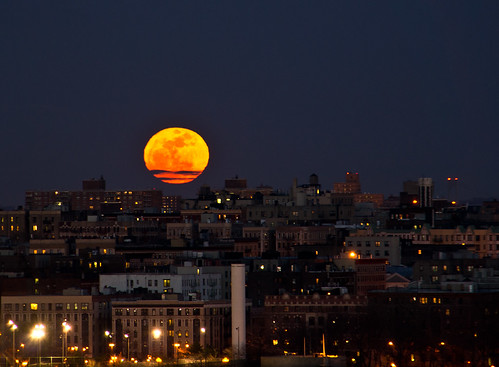
So New York was abuzz about the perigee-syzygy  (extreme supermoon) that took place this weekend.  The Archwarden and I were busy running around visiting family and friends and did not pay more than a few moments' attention, however we did mark the occasion by screening Moonstruck.  The 1987 film is one of the family institutions to which he has been indoctrinated, and -- veteran of the silver screen that he now is -- he pointed out some subtle foreshadowing that escaped my notice during my approximately 4,962 previous screenings.  Next time you watch it, pay attention to the scene in the airport where Ronnie asks Loretta to invite his brother to their wedding.  A hint: five years.

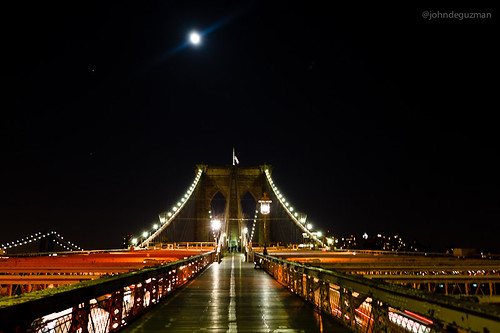
I am not good at night photography and thus did not attempt this at home, but many New Yorkers took many photos of the moon. You can see some of them in a slide show here.  Otherwise let's hear your favorite Moonstruck quotes in the comments.

Super-moon-on-Manhattan
Super-Moon-on-Manhattan by Lydia2222 on flickr.com.  (C) All rights reserved.

"Super" moon on Brooklyn Bridge
"Super" Moon on Brooklyn Bridge by John de Guzman (C) All rights reserved.

manhattan moonrise
Manhattan Moonrise by dshep727 on flickr.com.  (C) All rights reserved.

Sunday, January 23, 2011

Gonna Fly Now

THIRD SUNDAY AFTER THE EPIPHANY

I didn't know Maurice, but I've seen Rocky, his horse.

Horses are (or were) a dime a dozen where I grew up, but -- unless you go looking for them -- you don't expect to see one in somebody's yard in the busy, densely-packed suburbs where I live now.  Thus Rocky caught my eye on a couple of occasions when making my way through the back streets of Montclair, but I never learned the circumstances of how he came to be there until this week.

Besides the prize-fighter portrayed so prolifically by Sly Stallone, Rocky was also the nickname of another odds-beating dude: a young California man named Rocky Dennis who led a short but rich life despite the effects of a rare disease that eventually disfigured his face, affected his hearing and vision, and gave him crippling headaches. His life is loosely portrayed in the film Mask, directed by Peter Bogdanovich.  As deftly depicted by a  young Eric Stoltz, Rocky maintains a sense of humor and grace that wins him the respect of not only his biker/addict mom (whose portrayal by Cher won her Best Actress at Cannes in 1985) but his formerly-cruel classmates and misguided principal.  Without necessarily trying to do so, Rocky taught those around him quite a bit about life, and about themselves.

Rocky the horse belonged to another young man, the aforementioned Maurice.  Maurice was born a year to the day before 9/11 in Washington D.C.  His mother was also addicted to drugs, and was HIV-positive.  Both Maurice and his twin sister Michelle were born with a host of physical and developmental problems, and she died before her second birthday.

Maurice's prognosis was not much better.  When he was three, two men named Tim came into his life.  They were intent on giving Maurice a home, despite being told by doctors that he was unlikely to live much longer.  It took another three years to negotiate the red tape, during which time the Tims continued to care for Maurice, and he responded by growing stronger and healthier.  A year after they adopted Maurice, big brother Kindoo joined the family and they moved to Montclair shortly thereafter.

Maurice loved horses, and -- although it was certainly not the norm  -- the family's new house had enough property, so they surprised him one Christmas with a horse of his own.  Thus Rocky came to town.

I didn't know Maurice, but I know how kids act around somebody who is different.  We've all seen it, and we know that no amount of us telling them not to prevents prying questions, cruel comments, taunts. In fact, if kids get the idea that the adults treat you "special" it can just make things worse.  Sadly, adults who should know better do it, too, and there's a whole element of our entertainment culture that encourages this survival-of-the-meanest mentality.

Ultimately it is up to the individual to claim his place, assert his right to participate, and earn the respect of the group.  What kind of support the child gets at home is key here, because a kid who has been taught to believe he has worth is far better equipped to handle this kind of flack.

I didn't know Maurice, but I can tell from reading about him that he had that kind of home.  Two people who could have spent their disposable income on circuit parties and mid-century tchotchke  instead reached out to a baby the world had already decided wouldn't make it, and gave him the best life they could, and -- in their care -- he thrived despite his shaky health and accomplished quite a bit: earning a black belt, graduating from high school and volunteering to serve the poor at St. Luke's Episcopal Church.  When their own relationship didn't survive, they did the best they could to make sure Maurice and Kindoo still had a stable home with two parents who loved them.   He had goals for himself, including living independently and teaching kids with special needs. 

Maurice died this week after a sudden illness.  He was 20.  The New York Times describes him here and includes a photo of a handsome and confident young guy astride his horse. To read about and look at him, this would not be a kid that you would pity.  This was a kid that you could (and should) learn from.  I can't say more about the man he grew to be, because I didn't know him.

That is my loss.

Tuesday, October 5, 2010

Brother Sun, Sister Moon

Francis of Assisi - Friar (1226)

I am supposed to be going through the giant jumble of CD's, shucking them from their jewel cases and installing them in a giant album, along with the little booklet that accompanies most of them. Needless to say, tedious work. I have the attention span of a fruit fly under the best of circumstances, but this is just plain eye-crossing, and the little booklets really don't want to fit in the little pockets, so instead I keep getting up and finding other things to do. Then there is the problem of what to do with the jewel cases, which have an annoying tendency to slide off their stacks into a jumble of 'eighties synth-pop chaos that fuels my desire to eject them from my home. But do I just throw them out? Surely someone, somewhere can do something with them, since they sell new empty ones in the store. There must be a market, but who? Where? Thus, the project has been oft-delayed.

And if I didn't feel bad enough about the entropy that surrounds me, I see that in a New York Times interview, folk legend and community activist Pete Seeger, 91, feels guilty if he stays in bed past 8 a.m. "There's letters to answer," he explains, and in my head I hear it in the voice I know so well. "There's logs to split." My association with the Seeger and Guthrie families goes way back, so of course I let Rhythm Nation (don't judge!) slip off the pile and sat down to read.

Grabbing whatever is handy from the "icebox", Pete is out the door to tackle whatever project the day brings. He is still writing and recording music, and active at the Beacon Sloop Club, which he "tricked people" into helping him build several years ago by promising (and presumably delivering) a pot-luck dinner. "Food is one of the great organizing tools," he confides.

Seeger's association with boats goes back a long way: in the 1960's he and Toshi-Aline Ôhta (his wife of 67 years), along with Don "American Pie" McLean and others raised the money for the construction of a handcrafted sloop, the Clearwater, which they sailed from her birthplace in Maine to the South Street Seaport and then up the Hudson in 1969. The Clearwater Foundation has had notable success in driving the cleanup of industrial contaminants, and a report two years ago noted a "significant decline" in the mercury found in sampled fish. The Clearwater is now joined by the gaff sloop Woody Guthrie and at times by the schooner Mystic Sailor, in providing educational cruises to schools, environmental groups and the public. Funded in large part by the annual two-day Clearwater Festival, the organization is credited with influencing much of the progress in local and national environmental policy.

GARDEN STATUE of ST. FRANCIS
G.E. (the company who bore much of the blame, and the cleanup expense, for the Hudson River mess) notwithstanding, Seeger is not without his critics: His early concerns about the rights of workers drew him to a brief involvement with the Communist Party. That and some recordings he made prior to WW2 landed him in front of Joseph McCarthy in 1955 and eventually in contempt of Congress, although the ruling was later overturned. In 1995, Seeger told the New York Times Magazine, "I still call myself a communist, because communism is no more what Russia made of it than Christianity is what the churches make of it."

Politics aside, it's difficult (and probably unwise) to argue with a 91-year-old man who heats his house with wood he chops himself. I couldn't help but notice the coincidence of reading this on the Feast of St. Francis of Assisi, an Italian who shunned the comfortable circumstances into which he was born as Giovanni Francesco di Bernardone, choosing instead extreme poverty and charitable work. We know from his writings and the folklore that surrounds his legacy that he loved animals, referring to them as brethren.


The life of St Francis is of course enacted and vivid theology. To understand him we must be careful not to detach him from his context and refashion him as a kind of non dogmatic, leftist eco-freak. He was nourished by the praise of God as seen in his creation which is one of the great themes of the psalms and the canticles which he used in daily worship. Francis does not use the word “natura” and instead talks of the heavens and the earth, the world and all creatures under the heavens. Unsurprisingly he does not have a modern concept of nature as a complex of scientific laws governing the universe. Instead he was profoundly aware of the communication between creatures and their creator as we participate in the God-spun web of life."

- THE RT. REV. RICHARD JOHN CAREW CHARTRES, BISHOP OF LONDON (2005)

Francis exemplified putting the greater good ahead of personal desires, sacrificing much in the process. According to a 2005 sermon delivered by The Right Rev'd Richard John Carew Chartres (Anglican Bishop of London), in the early 1200's, Francis traveled to Egypt in the midst of a Crusade and attempted to win the conversion of the present Sultan. While unsuccessful, he did earn the leader's respect and a trusted role for the monastic order which he established that remains in the region to this day.

Seeger and his family are not churchgoers, but "we use the word God quite often. One of my most recent songs has God in every verse. Every time I’m in the woods, I feel like I’m in church." Wherever he is, I like to think St. Francis would look with approval at all he has managed to (and continues to) accomplish.

Now, can either of them clue me in on what to do with these CD cases?

Friday, August 20, 2010

Hold On to Your Hat

Bernard of Clairvaux - Abbot, Theologian & Poet (1153)

ST. MAARTEN

This morning we arrived at Phillipsburg, St. Maarten, the only of our cruise stops to which I have been before.  In 2000 I was on a cruise on the Norwegian Sky that called here, and in 1998, my family rented a condominium on the island's southern coast for a week.

Much of my focus on St. Maarten centers around the airport.  On our way to our first visit, a combination of ineptitude and lack of information on the part of US AIr led to our being stranded in San Juan's airport. Both the ticket counter of US Air and our connecting carrier LIAT were abandoned at 3 in the afternoon, and when I finally roused a young woman by shouting "hello!" through the open doorway into the office, she half-listened to my story and then said casually, "All the flights are full.  You come back tomorrow night."

In those pre-9/11 days I was a little more, um, assertive with airline people than I would be now, and my family unanimously elected me to make it clear to US Air that spending over 24 hours of our vacation in this airport was not an acceptable option.  There were a bunch of sightseeing companies with planes for hire right there in the terminal, with tanned pilot types standing around doing nothing, so I asked the ticket agent why one of them could not bring us the short distance to St. Maarten.

"Oh, it's very expensive," she said dismissively.

I went for broke.  "Not for ME, it won't be. I already paid to get THERE, not HERE, and at this point I don't care if you have to BUY the plane.  Go ask somebody."

Apparently realizing at that point I was not going to give up, she shuffled off to make some phone calls, probably interrupting several more naps and finally speaking to the airline's headquarters in Virginia before returning with the pretty startling news that they could -- in fact -- pay one of these planes to get us to our destination, leaving within the hour.  I was pretty proud of myself, until I saw the plane:


Mom, Dad and our pilot with the Air Culebra Piper Aztec we
flew from San Juan to St. Maarten in 1998
This thing had none of the stuff I associate with planes.  There were no walkway or even stairs to get into it: you trotted across the tarmac, stepped on the wing and dropped right into your seat. There was no aisle, no bathroom, and no flight attendant.  And even if there had been one, there was no beer for him to grab if he decided he'd had enough of us and made a break for it.


Once my parents and sisters were settled in, the only seat left for me was right inside that open door, i.e. that normally reserved for the co-pilot! 

"Don't touch anything!" my sister stage-whispered from the third (and last) row.  Yeah, not a problem.  My experience skippering one of these puppies was limited to the Microsoft variety, and I was not about to try to change that now, even in the highly unlikely event that it was offered.  I contented myself with alternatively holding on for dear life and taking pictures to the degree that I could.  Our pilot pointed out Culebra, the small island in between Puerto Rico and St. Maarten where he lived, and then -- asking if I wanted a photo -- tilted the plane to get the wing out of the shot.  Um, thanks!

Now, I'll say this.  If you had asked me under different circumstances if I wanted to go up in a plane the size of a Volkswagen Microbus, I would have most likely laughed at you over my shoulder as I hurried back towards the sane people.  But when that plane was the only thing standing between me and a night on a drab gray chair trying to drown out 24 screens of CNN, I didn't think twice about it, and I don't think anybody in the family did either.  And -- having done so -- I can tell you it was an awesome ride, especially being able to look right out the front as we approached St. Maarten and landed again.

Air France A340 about to land.  Thanks to Gina for this shot.
The Princess Juliana International Airport is on the Dutch half of St. Maarten (the French spell it St. Martin), and its single runway begins just a dozen yards or so from the famous Maho Beach, where planespotters delight in the jets thundering close overhead as they  are about to land.  Supposedly people used to also hang on the fence when an airliner was getting ready to talk off (the prevailing wind is normally such so that flights take off and land with their backs to the beach) and then allowed the accelerating engines to blow them backwards towards the water, but now there are signs warning against such activity.

There are bars at either end of the beach with the flight timetables posted and radios tuned to the conversation between jets and the tower. We had intended to spend some time there today, but we ended up only being able to pass by it.  Friends from our cruise got to enjoy it, however, and shared some of their photos with me.

Instead, a Certain Party -- who does not beach -- and I contented ourselves with crepes at a sidewalk cafe in Marigot, on the French side.  But next time I'm bringing my earplugs and making a day of it.

Wednesday, August 18, 2010

Lunch With Herod's Mom

William Porcher DuBose - Priest & Theologian (1918)

ST. LUCIA

Today's port-of-call was St. Lucia.  A little more than a hundred miles from Barbados, it allowed the Serenade of the Seas to chug along at a leisurely pace while we slept.

Herod explains how bananas grow
St. Lucia is mountainous and a large swath of its interior is relatively unspoiled.  Today I took a tour with several parties in our cruisecritic.com "family", again researched by one of them in advance.  Our guide, Herod, restricts the tour to ten people, which meant minimal waiting and plenty of flexibility to stop when something looked interesting and ask questions.

We had more exposure to the local people today than in Barbados, where we spent most of the day on a boat.  As we twisted through the forests and towns, men and women would wait patiently at the  roadside offering handicrafts, fresh fruit and (in several cases) the opportunity to get cozy with large snakes.  The sales pitches were not aggressive or frequent enough to be really annoying, and I expect our guide -- who does this every day -- knew who could be trusted.  

Among the things we saw were coconut and banana groves (with the opportunity to sample fresh fruit right off the tree), an ancient volcano which still emits sulphur-ripe steam, and a small waterfall surrounded by lush vegetation teeming with birds and butterflies.

But the highlight for me was when Herod announced that he was taking us to his house, where his mom had prepared lunch.

Anybody who knows me will roll their eyes at this; all you do is mention food and you immediately have my attention.  However, I loved this idea.  I know folks who will seek out familiar brands wherever they go instead of chancing some culinary misadventure, and the McDonald's and T.G.I. Fridays' folks have capitalized on this from Reykjavík to Dubai.  But I don't know of a better way to experience a place than to go to someone's home and share food with them that they prepared.


Lunch with Herod's Mom
Herod's mom was warm and gracious, and their house has a big terrace with a splendid view of one of the Pitons, the twin conical lava domes for which St. Lucia is famous.  We were treated to a buffet of curried chicken, fried codfish, rice and beans, plantains, and various other goodies.  


After lunch, we took a water taxi to a remote resort, situated between the two Pitons, to spend an hour or so on the beach.  We shared this space with just a handful of other tourists, and so were able to take in the rugged beauty of the place in peace.  Having gotten more than my share of sun the night before, I commandeered a chaise lounge under a canopy of overhanging sea grape and just took it all in.

Our return trip was accomplished by speedboat, much to the delight of the youngest members of our party.  Somehow these two pre-teen girls ended up right up in the bows, and every time the boat crested a wave, they would be literally tossed airborne, only to thump back down onto the (thankfully cushioned) seat.  They screamed and laughed all the way back to Castries, where the boat deposited us veritably at the ship's doorstep.

Tonight was formal-dress on board.  This is the subject of consternation for some, while others -- like me -- enjoy it on the rare occasions that I am required to dress up.  On some lines (Cunard transatlantic in particular) you will still be politely turned away from the dining room without a jacket, but In the Caribbean on most of today's mass-market ships, the dress code is more of a suggestion than a rule, and we saw people wearing everything from black tie to tank tops as we headed to dinner. 

Everyone in our party made an effort to comply without going crazy buying new gear which we would not have much future use.   I own a tux, for the simple reason that it was de rigueur aboard the Queen Mary 2 and I scored a sweet deal on one when we were preparing for that ship's maiden transatlantic crossing to New York in 2004.  It dawned on my last week that I should probably try the darn thing on and make sure I could still get in it, since it hasn't seen the light of day since Emily's wedding a few years ago.  Thankfully, I have neither packed on enough muscle or fat to require any alterations. 

At Barbara's request, we posed in various groups on the swank glass staircase in the ship's lobby, sporting our finery while the Company photographers snapped away.  These souvenir photos are mind-bendingly expensive, but it's part of the experience, so -- as many times as we say we're not going to do it -- we always end up buying at least a few.  Barbara had special reasons for wanting to document this trip, so for that purpose it was worth having the professional shots done.

The dinner was wonderful, and the Serenade's classic double-height dining room complete with a ceremonial staircase provided an elegant backdrop for our fellow passengers in their fancy duds.  But -- if I had to choose -- I'd still take that lunch under the Pitons, served up with a smile by Herod's mom.

Tuesday, August 17, 2010

So Much As it has Pleased Thee

Samuel Johnson, Timothy Cutler, and Thomas Bradbury Chandler
Early Priests of the American Church


 BARBADOS

Dawn off Barbados
This morning, we arrived at our first port of call, Barbados, having been at sea all day yesterday.  Invigorated by being aboard ship again, or perhaps just not used to a new bed, I woke up before dawn, grabbed my camera and meandered through the empty corridors looking for coffee and a spot to watch the sunrise.  I love the chance to explore the ship when very few of my fellow passengers are afoot, as it also give me the chance to photograph the public spaces without intruding on other peoples' vacations.   


This ship is fairly typical of those being built in the early 2000's.  She carries about 2,400 passengers, and most of her public spaces are located either fairly low in the ship or on the very top two decks, with four levels in between devoted almost exclusively to cabins so that the vast majority of them can sport private balconies.  We have one of these for the first time: earlier voyages were either on a tighter budget or (in the case of our transatlantic voyage in April of 2004) in a season and place when the weather conditions would not warrant the expense.  I chose our room specifically: located on the edge of a semicircular "bump" that extrudes from the side of the superstructure, it afforded us a slightly larger balcony than normal, just enough to let both of us stretch our legs out a bit.  Unfortunately the extra space did not come with extra furniture: we have two upright chairs and a miniscule table, so it is not quite as conducive to lounging as I had hoped. 

As luck would have it, we will be the only ship at each of our five ports of call.  This makes me happy in the sense that we will not be competing heavily for taxis, tours and shops, but I also do like seeing other ships and photographing them. 

I have been asked repeatedly why we did not choose one of the newest or largest vessels coming down the ways: this line's newest ship, the Oasis of the Seas is so big that it boasts various different "neighborhoods" (I can't help but wondering if any of them are "rough") as well as a zipline and a full-sized carousel.  Frankly, the idea of 5,400 people invading a small Caribbean island all at once is not particularly appealing, especially as the ship is too large to dock everywhere and requires the use of tenders to shuttle passengers ashore.  In addition, the ship is on the most mundane itinerary the Caribbean has to offer, and -- since the majority of us have been here before -- we wanted something a little more exotic.    

Catamaran Crew
I had done some homework in the months leading up to our voyage.  I am a big fan of cruisecritic.com, because it enables you to connect in advance with other people who will be on your particular sailing and ask questions about the ship and itinerary from more seasoned cruisers.  In our case, there are over 50 people, either users of the website or their traveling companions, so we did quite a bit of bonding before even setting sail. 

Yesterday, I met a number of them at a planned event in one of the lounges.  Today, three parties from that group as well as two other members of my entourage went on a catamaran tour that one of the "critics" had researched in advance.  We had a fantastic time, skimming along the smooth waters off the coast to an inlet where giant turtles lurk.  We got to snorkel with them, and they are apparently pretty used to people because they did not seem bothered in the least.  Two young brothers in our group had a waterproof camera and were deep-diving to get better shots, which they shared with me later

Giant turtle off Barbados.  Courtesy of Grandmaison family
Unfortunately the day was not without a casualty: one of the husbands in our group lost his wedding ring while in the water, and -- despite the efforts of the boat's captain and the brothers -- it was not found. 

Later this evening, we had some more serious business to deal with; in fact, the impetus for our trip.  After we set sail again from Barbados, we met with two officers of the ship at an appointed time and were escorted below to the aft mooring deck, a spot normally not accessible to passengers.  There, after a Certain Party led us in a brief prayer service while a handful of the ship's crew looked on, we were permitted to scatter a portion of Henry's ashes overboard into the ship's wake, followed by handfuls of rose petals thoughtfully provided by the Company.  It was one year to the day since his death. 

For as much as it hath pleased Almighty God to take unto himself the soul of our dear brother here departed, we therefore commit his ashes to the deep in sure and certain hopes of the Resurrection to eternal life, through our Lord Jesus Christ. 

This simple and yet powerful ritual marked the end of a year of "firsts": holidays, birthdays and other events where we were keenly reminded of his own contributions or strong opinions about such things were supposed to be done, and the hole left by his absence.  As we moved through the seasons, each of us mentally "bookmarked" these occasions, particularly when we got into the summer, when each milestone was already clouded by his illness.  

But the ship keeps moving.  We had originally been told that they might either slow down or stop, but as it turned out, that was not the case, and -- in a way -- I'm glad.  It symbolizes the fact that time stops for no one, and -- while we will obviously never stop missing him -- this was the "last first" when it comes to Henry.  He was not one to wallow in the past, and wouldn't condone us doing so either.  His life -- and his death -- changed us, and we carry those marks with us, but we also have to be ready to keep living fully into whatever is meant to happen next.  The ship keeps moving, and we move with it.

Monday, August 16, 2010

Down to the Sea

MARY THE VIRGIN - MOTHER OF CHRIST

Uncle Ziggy and Aunt Bertha aboard ship
My love of ships dates back to 1974.  That summer, my grandfather's sister and her husband departed New York on the S/S France, flagship of the storied Compagnie Générale Transatlantique, known simply on these shores as the French Line, on their way to spend the summer in Europe.  Retirees who never had children, they lived simply most of the year, but my uncle Ziggy was never one to scrimp when it came to food or travel, and they took some spectacular vacations for working-class people of the time. 

By the time I arrived on the scene, the jet age was in full swing and airlines had already won over most of the passenger traffic between the United States and Europe.  Ironically since the majority of leisure travelers were American, the United States Lines was one of the first to go.  The S/S United States, not yet 20 years in service, was laid up in 1969 and -- though still around -- has yet to carry another passenger.  One by one, the state-run steamship companies of Germany, Holland, Italy, Greece and France would give up the fight, and - in fact - the mighty France was abruptly withdrawn from service during my aunt and uncle's vacation.  But they were old-school, and -- rather than spend seven hours in an airplane seat -- they returned to the States aboard the last holdout, Cunard's Queen Elizabeth 2.  That ship continued to offer regular transatlantic crossings (interspersed with cruises to other places) until 2004, when she was replaced on the route by the much larger Queen Mary 2.  My dad and I were aboard when that fantastic vessel finished a stormy crossing and arrived in New York for the first time, to a hero's welcome.  But that's another blog entry.


CGT poster advertising the France
Getting back to 1974, if the days of the transatlantic liner were waning, there is no evidence of it in my memory of that afternoon.  In those carefree days, steamship lines welcomed the family and friends of departing travelers aboard the ships on sailing day.  As had always been the tradition, all that was required was a token donation to a seafarers' charity.  It was good P.R., because --  at least in my case -- that short visit left me with a desire to pack up and go on my own ocean voyage, one that would not be fulfilled for another 25 years but which is only stoked, rather than quenched, by every day spent aboard ship.


I actually remember very few details of the ship itself. Oddly enough, one thing that stuck in my head was the placement of the bathtub faucets, on the middle of the long wall vs. at one end.

One story which I can't recall personally but is is stuck in the family lore relates to this or another such bon voyage party.  My uncle had several brothers, and -- like him -- each of them was "a real character" as my paternal grandmother would say.  Apparently one of these uncles had earned quite a reputation aboard ship.  A cabin steward saw him with our entourage and brusquely inquired, "Are you on this trip?"  Upon learning he was headed back down the gangway shortly, the steward rolled his eyes and sighed, "Thank god!  I still remember you from the last time!"


Carnival Victory berthed in San Juan
Hopefully my own reputation is better.  As I write this, a Certain Party and I, along with his entire immediate family and a friend of his mom, are somewhere in the Windward Islands aboard the M/S Serenade of the Seas, part of the Royal Caribbean Cruise Line.  This is my eighth ocean voyage (tenth if you count overnight ferry crossings), a fact that is hardly remarkable given the prolific cruisers and crossers of my acquaintance.  But no sooner did we arrive at the terminal in San Juan when I felt the same rush that came over me on Pier 88 in New York all those summers ago, a feeling that built as we explored our compact cabin, met the steward, verified our dinner table assignment, and underwent all the little rituals that mark the beginning of seagoing travel, culminating with our after-dark departure past the brilliantly lit Victory (even Carnival ships look pretty at night).  I could get used to this.