I'D LOVE TO HEAR FROM YOU

Comments, criticisms, or (one can hope) compliments are more than welcome! Please let me know what you think, tell me I'm crazy (I suspect this) or what you'd like to hear about. Comments are screened before publication, so if you want to share something with me only, just put that in the comment and I'll keep it to myself.

THANK YOU FOR VISITING!
Showing posts with label Norwegian America Line. Show all posts

Tuesday, July 7, 2015

Requiescat in Pace: John Maxtone-Graham

JOHN MAXTONE-GRAHAM LECTURES
ABOARD QM2 IN HIS TRADEMARK KILT
(MY PHOTO, ALL RIGHTS RESERVED)
I was saddened to learn yesterday of the passing of maritime historian and author John Maxtone-Graham, many of whose books about passenger ships are in my collection.  Peter Knego, who operates the popular site Maritime Matters, said in his obituary that "Mr. Maxtone-Graham’s poetic style of writing and his charismatic onstage manner were an inspiration to generations of fans of ships and the sea.  His breakthrough The Only Way To Cross, when published in 1972, was one of the first non-Titanic books to capture the essence of the ocean liner."

John possessed an encyclopedic knowledge of ocean liners and cruise ships, and delivered it--both in writing and at speaking engagements--with grace and humor.

One of my favorite of his tales describes an incident one night aboard the Bergensfjord of the Norske Amerikalinje (Norwegian America Line) in the 1960s, captured in his 1985 book Liners to the Sun

A woman, after having caught several garments on a protruding screw in her cabin panelling and forgetting to tell the steward about it, decided to fix it herself.  She couldn't get the screw in any further, so she took it out instead.  Just as she removed it from the wall, the Bergensfjord was struck by a tsunami and heeled violently to port, throwing people and contents to the deck.  Until she learned the cause of the accident, she was secretly terrified that her meddling with the ship's infrastructure had somehow triggered it.

John and wife Mary were frequent passengers as he was often called upon to give lectures on board, particularly for maiden voyages and others of historic significance. Whether in suit and tie or his trademark kilt, he struck a distinguished and gallant figure.

My father and I had the privilege to hear John speak several times as the RMS Queen Mary 2, flagship of the storied Cunard Line, made her inaugural crossing from Southampton, England, to New York in 2004. Despite the number of ship enthusiasts and industry names on board, I somehow ranked to have breakfast with him, and he patiently endured a tour of the amateurish design I had created for a ship like the QM2 before Cunard had the funds or the will to do so themselves.  My copy of his coffee-table book about that ship bears both an inscription (in which he amusingly took the heat for smudging his own signature) and a stamp commemorating the fact that our encounter took place during that historic voyage.

MY MEMORABILIA FROM THAT VOYAGE INCLUDES JOHN'S INSCRIPTION IN
THE COMMEMORATIVE BOOK, AND HIS APOLOGY FOR SMUDGING IT.
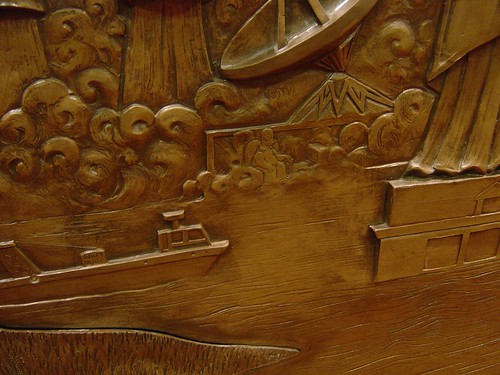
One amusing piece of trivia:  John's son Ian Maxtone-Graham is one of the brains behind the TV series The Simpsons, and--hidden among the details of a faux-bronze relief along a companionway on the QM2's lounge deck--the sharp-eyed can spot Homer among the mythological figures and wonders of creation.

Homer Simpson hidden in the Queen Mary 2 (QM2) Hallway Panels
HOMER SIMPSON AMONG THE MARVELS OF THE EARTH ON A FAUX-BRONZE RELIEF
ABOARD THE RMS QUEEN MARY 2.
PHOTO CREDIT: GARY BEMBRIDGE.  USED UNDER CREATIVE COMMONS LICENSE.

While the movie Titanic takes some credit for the renewed interest in the golden era of ocean liner (which spanned from roughly 1890 til 1960, when jets began carrying the majority of passengers across the Atlantic) it is writers and historians like John who make sure this unique era is thoroughly and engagingly documented for generations to come.

Sunday, October 26, 2014

And All This Time the River Flowed

Yesterday, I was privileged to see a performance of Sting's new musical The Last Ship, currently in previews on Broadway.  A project that had been in the works since 2010, the production follows a concept album in 2013 last year (from which only some tracks made it to the score as presented to us) and a short run in Chicago.

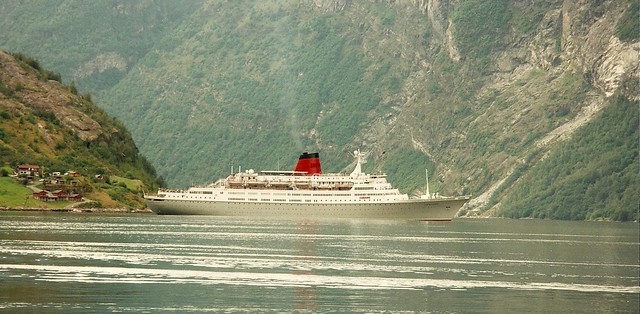
Set in the village of Wallsend-on-Tyne in northeastern England, the show is a stylized account of the conclusion in 2007 of shipbuilding activity by Swan-Hunter, whose accomplishments include the legendary Cunarders RMS Mauretania (holder of the transatlantic speed record) and Carpathia (rescuer of the RMS Titanic survivors). Wallsend produced the last passenger liner built in the United Kingdom (the MS Vistafjord for Norwegian America Line, which later also sailed for Cunard as Caronia) in 1973.

MS Vistafjord
MS Vistafjord, the last liner built in the UK, shown here in Cunard colors at anchor in
Geirangerfjord, Norway in 1993 PHOTO CREDIT: flickr.com/aah-yeah Used under Creative
Commons. 
Some rights reserved.

The show begins with a flashback of sorts, as Joe Fletcher (Jamie Jackson) is injured on the job and wants his son Gideon (Montclair's own Collin Kelly-Sordelet) to assume his place as breadwinner by becoming an apprentice at the yard.  Gideon rejects this idea and instead signs on as a merchant mariner, promising girlfriend Meg (Rachel Tucker) he will be back for her.

Returning fifteen years later upon the news of his father's death, Gideon (played as an adult by Michael Esper) learns that the yard is to be closed for lack of any further work. This is semi-factual: Following delays and cost overruns, the still-incomplete HMS Lyme Bay, the last vessel to be laid down at Wallsend, was towed in 2006 to a competing yard and Swan Hunter was barred from further naval contracts, ending 130 years of shipbuilding on the Tyne.

Gideon seeks out Meg and discovers she is less than receptive to a reconciliation, her feelings complicated by a teenage son Tom (also portrayed by Kelly-Sordelet) and another man, Arthur (Aaron Lazar), who wants to marry her.  Arthur (also a former shipbuilder) has taken a job with a company that wants to see the yard sold and used for shipbreaking and scrapping, an idea the workers find repulsive and insulting.

Encouraged by the parish priest (brilliantly wrought by Fred Applegate... if ever there was a right priest for a particular congregation, Fr. James O'Brien is it!), the workers, including Gideon and Tom, defiantly embark -- against all odds -- on one more project, which symbolizes their collective well-being and pride.


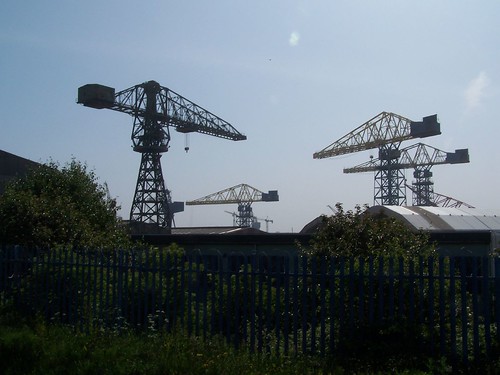
Taking down the cranes
In 2007 the Wallsend cranes, which had dominated the skyline for generations , were dismantled and
shipped to India. 
PHOTO CREDIT: Mick Gallagher. Used under Creative Commons license. Some rights reserved
I will not spoil with more details of the plot.  I have read that the show is semi-autobiographical, which leads me to wonder what Sting's upbringing was like. There is no mother in the play, and the relationship between Gideon and Joe is clearly freighted, with allusions to abuse.  The singer's parents died of cancer within months of each other in 1987 and he explained in a 1996 interview with Q that he declined to attend their funerals, and later regretted it.  A period of writer's block followed, and it was not until he released The Soul Cages in 1991 that he felt properly able to mourn.

"My father was... snatched away from me at the wrong time. For me and for him. It was just at the point when I was beginning to make my journey home and understand my parents more - the decisions they made,"  Sting observed.  "Having written the songs, what I learnt was to forgive myself for my part in it and forgive my father and my mother for what they did that hurt me."

In parallel, Gideon misses Jim's funeral by mere days and is forced to work through unrequited feelings as the story unfolds.  Two tracks from The Soul Cages, "Island of Souls" and "All this Time", accompany original songs in the show.

The play gives you a lot to chew on.  The theme is one that has repeated itself many times, some of them in places a lot closer to home, as traditional ways of earning a living handed down by generations give way to technology and globalization.

Layer that with the complex relationships between the players as they make difficult choices, and a cast that does well to get you invested as if this was really happening around you. Musically, Sting's influence is heavy, but he draws well from the history of the area, particularly for the company pieces.

The Last Ship is in previews at the Neil Simon Theater.