I'D LOVE TO HEAR FROM YOU

Comments, criticisms, or (one can hope) compliments are more than welcome! Please let me know what you think, tell me I'm crazy (I suspect this) or what you'd like to hear about. Comments are screened before publication, so if you want to share something with me only, just put that in the comment and I'll keep it to myself.

THANK YOU FOR VISITING!
Showing posts with label growing up. Show all posts

Saturday, December 1, 2018

I'm No Hero; That's Understood | All the Redemption I Can Offer is Beneath This Dirty Hood

Charles de Foucald - Monastic & Martyr (1916)

This week I read an interview in Esquire with Bruce Springsteen, in which the iconic rocker describes his mental health journey as well as his lifelong struggle to process his complex relationship with his father. A remote, hard-edged drinker, the elder Springsteen was enraged by what he saw as the weaker facets of his son's character.  It wasn't until he was near death that he tacitly, sparingly acknowledged Bruce's better points, saying only "You've been good to us."
“All I do know is as we age, the weight of our unsorted baggage becomes heavier . . . much heavier. With each passing year, the price of our refusal to do that sorting rises higher and higher. . . . Long ago, the defenses I built to withstand the stress of my childhood, to save what I had of myself, outlived their usefulness, and I’ve become an abuser of their once lifesaving powers. I relied on them wrongly to isolate myself, seal my alienation, cut me off from life, control others, and contain my emotions to a damaging degree. Now the bill collector is knocking, and his payment’ll be in tears.”
That constant, unfulfilled quest for validation took its toll, and the rocker described two breakdowns, the more recent just ten years ago, and credited decades of therapy and the unwavering support of wife Patty Scafila with his survival.
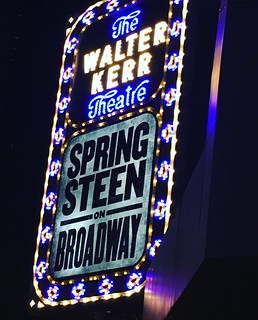
Springsteen on Broadway
I could say more about that, but the interview tells it far better than I could, and you could find more detail in his autobiography.  Later this month, his Broadway stage show, an abridged version of the book interspersed with a dozen or so of his songs, will air on Netflix.  

Having learned these things about him, a man whose music has contributed so much of the soundtrack of my own life, brought back many of the same feelings I wrote about earlier this year. 

As an ardent music fan, I've realized I have a tendency to fill in the blanks in what I know about artists' lives; their characters get shaped in my mind by their lyrics, their stage banter, and whatever they choose to share with the media.  When they do or say something that departs from who I've decided they are, it's jarring.  The rash of premature deaths in the past year notwithstanding, this happens in smaller ways more often by the occasional revelation, misplaced statement, or decision.

Something like this happened this week.  I learned something about another artist whose music I love, which suggests that we'd be in a pretty fundamental conflict on certain social issues if we actually knew each other, which we clearly don't.

And I don't know what to do about it. Unlike some artists, this person's convictions are not widely known, and thus I have little to go on other than scant facts and assumptions you can draw by association. I don't know enough about the situation to decide if it changes how I feel about this individual as a person. If it did, it would change my relationship to the music, which felt yesterday like a house that had been robbed. That would have a follow-on effect on how and with whom I spend my time, especially over the past year.

Part of me wants to go hardcore, only because of the time I spent fighting on this particular issue and in this particular space.  On the flip, I'm reminding myself that no promises were made or broken here.  We are not friends; I do not have the right to expect my values to be shared or my allegiance to be reciprocated.  The music is out there, take it or leave it; anthems by flawed heroes for flawed fans, maybe that much sweeter because of the wrinkles and scars we can compare to our own.

Friday, June 17, 2016

Say Their Names / Digan Sus Nombres

I woke up to one of those emails you aren't really prepared for in the pre-caffeine haze; the "I'm going to need for you to act like a grown-up today" kind of request that always manages to come when you're feeling least equipped to do so.

My initial reaction was, "Oh no, I couldn't possibly." I had been on an emotional skating rink ever since we learned on Sunday that 49 revelers at Orlando's Pulse nightclub had been mercilessly gunned down.  The idea of getting up in front of a church full of strangers and honoring them by reading their names aloud without going completely to pieces felt far beyond me.  I replied, vaguely, to my friend and frequent spiritual guide, indicating my concern and looking for tips on how to hold it together.

She should know: in her role as priest and rector of a congregation as well as chaplain at a nearby university, she is called upon repeatedly to be strong; to put her own emotions carefully aside and be a steadying force for families grieving a loved one, communities facing adversity, and myriad other human challenges that pockmark the territory of pastoral care.

Part of me hoped she would share some trade secrets on how to partition your own feelings, at least long enough to get through the service. Part of me hoped she might reply, "Oh, it's okay; if you don't feel comfortable I'll ask someone else."

Instead, she said nothing. I knew she had plenty on her plate without coddling me right now.

Not knowing what else to do, I "vaguebooked" that I had been challenged to do something difficult but important, and asked for prayers. The response was overwhelming: Over the course of the day, over 1/10 of my fairly substantial "friends list" chimed in with encouragement and promises of supplication. People I hadn't heard from in ages, whom I was pretty sure had long since "unfollowed" my endless string of arcane cyber-babbling, cheered me on. An actual celebrity I follow, whom I wasn't even sure manages his own feed said "You got this."

I did tell a handful of folks what I had been asked to do, and my fears. A few gave me permission to go with whatever emotion I felt at the time, one saying "If you go to pieces, it will be an honorable and truthful tribute to them."  Another suggested "Let the Lord do the work with you tonight. It's not about performing, it's about witnessing. You can be a witness tonight."

At eleven a.m., the draft program was sent over. I scrolled to the list of names and studied it. Were I to do this, I wanted to be ready to pronounce each one respectfully. The vast majority of victims were Hispanic. How could I, in my raised-in-the-woods Euro-ness, possibly do right by them? I only sort of speak Spanish, and I didn't want to sound like Peggy Hill up there, so I got some guidance from native speakers and looked up some names I didn't know how to say, but I still felt inadequate.

To my disgust, in the research process I discovered there are already "truthers" making videos claiming the massacre was staged (as was, apparently, Newtown). Yes, because this is what we do: we fake mass murders, and get the cops, first responders, doctors and nurses to help us. I'm not sure how these people would explain where the victims are now, or where the dozens of corpses came from. In the wake of this attack, jetBlue gave away free tickets to family members needing to get to Orlando. I wonder if we should round up the "truthers" and bring them there, too, so they could explain themselves to the survivors.

Part of me wanted to spend more time on each person... connect their name to their picture and understand who they were. But I was afraid to: not yet. I knew getting to "know them" was not going to help me to remain intelligible thorough this; it would likely do the opposite. But I will do that now that the service is done.

Various friends suggested--with varying degrees of seriousness--herbal tea, a nap, a joint. I had work to do, so none of that was going to happen, and in the end I just stayed distracted until it was time.

The woman reading the other half of the names is a "P-FLAG Mom", a colleague from my activist days. (Oh, that's the other thing. I was listed as "an activist" in the leaflet. I've been shamefully inactive these past few years.)  We strategized briefly about how we would walk, where we would stand, and who would read what. Having her there was comforting: I know she was ready to jump in for me if I needed her to, and vice-versa.

The service was well-planned and well-attended. We heard from an imam, a rabbi and several Christian pastors. There were songs and prayers, and then it was time. Stepping into the aisle, I waited for my P-FLAG Mom and we walked to the front. Looking over the room from the pulpit, I took a deep breath, and started reading.

And it was fine. I was a little shaky for the first group of seven, but I thought about all my cyber-cheerleaders, and hunkered down. I said seven names, she said seven, a bell rang, and we kept going. It was over quickly, and we took our seats.

Writing this, I know I probably made a lot more of it than I should have. But it was incredibly important to me that I get it right; that my reaction not detract from what anybody else needed from the service. I knew that--at something like this--one person falling apart could trigger a chain reaction, which I guess would be okay if it was meant to happen. But I didn't want to be the one to cause it.

For the last part of the service, we gathered on the labyrinth in the back of the church, around a giant sculpture, a stylized swan. We were directed to use Post-It notes to share our feelings and reactions to the event.  Holding candles we joined in a few verses of Holly Near's "Fighting For Our Lives".

And then we went home.


Say their names:
Stanley Almodovar III, 23
Amanda Alvear, 25
Oscar A. Aracena-Montero, 26
Rodolfo Ayala-Ayala, 33
Antonio Davon Brown, 29
Darryl Roman Burt II, 29
Angel L. Candelario-Padro, 28
Juan Chevez-Martinez, 25
Luis Daniel Conde, 39
Cory James Connell, 21
Tevin Eugene Crosby, 25
Deonka Deidra Drayton, 32
Simon Adrian Carrillo Fernandez, 31
Leroy Valentin Fernandez, 25
Mercedez Marisol Flores, 26
Peter O. Gonzalez-Cruz, 22
Juan Ramon Guerrero, 22
Paul Terrell Henry, 41
Frank Hernandez, 27
Miguel Angel Honorato, 30
Javier Jorge-Reyes, 40
Jason Benjamin Josaphat, 19
Eddie Jamoldroy Justice, 30
Anthony Luis Laureano-Disla, 25
Christopher Andrew Leinonen, 32
Alejandro Barrios Martinez, 21
Brenda Lee Marquez McCool, 49
Gilberto Ramon Silva Menendez, 25
Kimberly Morris, 37
Akyra Monet Murray, 18
Luis Omar Ocasio-Capo, 20
Eric Ivan Ortiz-Rivera, 36
Joel Rayon Paniagua, 32
Jean Carlos Mendez Perez, 35
Enrique L. Rios, Jr., 25
Jean C. Nives Rodriguez, 27
Christopher Joseph Sanfeliz, 24
Xavier Emmanuel Serrano Rosado, 35
Edward Sotomayor Jr., 34
Yilmary Rodriguez Sulivan, 24
Shane Evan Tomlinson, 33
Martin Benitez Torres, 33
Jonathan Antonio Camuy Vega, 24
Franky Jimmy Dejesus Velazquez, 50
Juan P. Rivera Velazquez, 37
Luis S. Vielma, 22
Luis Daniel Wilson-Leon, 37
Jerald Arthur Wright, 31

Tuesday, December 1, 2015

I Will Not Forget

Nicholas Ferrar - Deacon (1637)
[Charles de Foucauld - Hermit & Servant of the Poor (1916)]
World AIDS Day

“There's a sadness, written on her pretty face
A sadness all her own, 
from which no man can keep Candy safe”

- SPRINGSTEEN

Jimmy loved junk food.

He could put away whole boxes of Hostess cakes, although you wouldn't know it to look at him. I don't remember why I know that; he must have told me at some point.  I used to flirt with him at our local bar, where we were both regulars.  He was a cutey, after all, but he always had a little bit of a sad edge to his smile. I wish I had a picture of him. We had no interaction outside of the bar, and I just stopped seeing him there at some point.

Jimmy died 20 years ago. He couldn't have been more than 30 or so, maybe younger. I can't find any record of his funeral, but I see his parents and his only brother all died since then and his death is noted in their obituaries.  I know where they were buried so maybe I'll go sometime and see if he's there, too.

Gaston had no such sadness about him: he was full of energy.  A wrestler in high school, he still lifted weights and looked it. When he was not DJing at that same bar, he also helped renovate it.  My love affair with Jeep Wranglers began with him: he had a nice blue one with all kinds of mods. I got to ride in it once: he took me to a Marky Mark concert after I won the tickets on the radio. I was afraid to drive in the city then, and still don't like to.

Gaston disappeared, too, but that happens in a bar. I found out later through a friend that he was also gone. He did have a picture of him for me, though, in his graduation suit.   I still have it.

The bar used to have plaques on the wall for a bartender who kept working there long after he he'd been diagnosed with cancer, and one of the drag performers who also died a few years ago.  I asked if Gaston would ever get one, but it was so long ago, there are probably few people still there who would recognize him.

For years I have helped a dear friend of mine borrow and display some panels from the quilt.  Not enough people were coming to see it, though, and people in the place where we hung it said it made them sad to look at it, especially at Christmastime.  My friend bore the expense single-handedly, and it was a lot of work for us and another friend of his to go get the panels out of the chilly storage facility where they live most of the time, put them up and take them down, so we didn't do it this year. But we would still do it, somewhere, if people would come see.

Last year, I resolved to make, or--more accurately--commission, a quilt panel for Gaston. I know he doesn't have one, because you can check.  As it happens, a year later, I haven't gotten anywhere with that.  I feel bad about it, and I still want to do it.

I don't know enough about Jimmy to make one for him, really.  Not yet, but I'll keep trying to find someone who does. I don't think he wants to be remembered by a box of Ho-Hos, although I could always get to see that smile by teasing him about it.

A young guy told me today that World AIDS Day doesn't really speak to him "just because I'm gay" and pointed out that men like him are no longer the largest group of new infections. I know this is thanks in part to the drugs, but I wish the pharma companies didn't make it sound in their commercials like HIV was reduced to a minor inconvenience for those lucky enough to afford their products.

I didn't argue with my young friend. He didn't know guys like Gaston and Jimmy, and he didn't live with the fear that we did.  Because of them, we got tested.  Because of them, we stopped taking chances.  Because of them, we're here.

So because of them, I will not forget.

Monday, June 15, 2015

Dear Eighteen-Year-Old-Me


This was part of a suggested exercise in response to a piece called "Letter to My 18-Year-Old Self" by Brita James, published in baristanet.com guru Debbie Galant's Mid-Century Modern blog on medium.com

Dear 18-Year-Old Me:

Greetings from the Future! I realize that I (45-Year-Old You) am still not on speaking terms with 16-Year-Old-Me for not lifting weights instead of taking gym class whenever you had the chance. For the record, we’re still thudding three miles around the track everyday trying to get rid of that Burger King sandwich you just ate.

However, since New Jersey is in the midst of celebrating Pride, I’m feeling benevolent. I realize you don’t yet know what that is, sheltered little Catholic School graduate that you are. But someday you will not only come to terms with the way you feel about some of the guys you know, but there will be guys who feel the same way back, and you will no longer think you are some kind of alien species with crossed wires.

Speaking of which, not three months ago, two of those boys in your high school class, who weren’t always the nicest to you, manned up and apologized for the way that they acted, completely unbidden. I know it’s hard to believe now, but 45-Year-Old-You wasn’t even overwhelmed with surprise at this development. People change and grow, and — if you have any kind of conscience at all — it seems to be human nature to carry around those little hurts that you cause, like pebbles in your shoes. Redemption — when you find it — can feel be a relief, and 45-Year-Old-You was actually glad to be a part of that exchange.


We’re not supposed to give spoilers, but you’ve seemed kind of in the dumps lately, so I’ll throw you one. Breathe a word of it and I’ll deny everything, mind you, but listen: Right now, in a house not that far from your freshman dorm room with the roommates you’re afraid of, a ten-year-old boy is growing up fast. Years from now, when you’re both what you currently consider ancient (don’t think I didn’t hear that!), he will cross your path and catch your eye. In a church, no less. Yes, I know a church just told you to take a hike, but God won’t give up on you just because that nun did, and when it’s time, you’ll grudgingly come around.

A few years after that (I should warn you, they keep going by faster, like some crazy carnival ride) you and he will be the proud uncles of nine (count them, nine) beautiful and intelligent nieces and nephews, and each of your families will treat you like there’s nothing wrong with you being together. Because there isn’t.

So hang in there, 18-Year-Old Me. The best is yet to be.

Knowing what you do now, what would you tell your eighteen-year-old-self? Keep the party going by replying to Brita's original letter, and/or using the hashtag #Dear18YOMe.

Wednesday, July 30, 2014

Hurt People Hurt People

Mary, Martha, and Lazarus of Bethany - Companions of Our Lord     

It's been over a decade since I found a home in the Episcopal Church and -- almost immediately thereafter -- got involved in ministry with LGBT people. As society's attitudes about sexuality have evolved and congregations have become more willing to acknowledge the diversity in their midst, this has shifted from providing "safe spaces" off to the side for our folks to pray and socialize as their whole, authentic selves, to actually getting whole faith communities to weave universal welcome into their mission and identity.

What I haven't yet offered up here is how I came to be an Episcopalian in the first place. At the tender age of 18, I was a member of the Antioch young adult group at a Roman Catholic parish. Caught up in the emotion of a retreat, I shared with a trusted friend, and a priest, the secret that I was experiencing same-gender attraction. Despite being assured that this would be kept confidential, I got a phone call (from a nun, no less!) several weeks later saying it would be "better for the others" if I wasn't around. "Some of the parents have concerns," she explained, without elaborating.

I did not actively attend church again for over ten years. I was in church, because I worked as a paid musician here and there, but it felt like a job and I was an outsider there to perform a service, not a member of the community.

At some point, I went to hear my friend Jennifer sing at St. George’s Episcopal Church in Maplewood, N.J. The denomination meant nothing to me at the time. We were both raised in the days of the Baltimore Catechism, and my CCD classes left me with the kind of "us-and-them" mentality that meant there were only two kinds of churches you needed to worry about: the Roman Catholic Church and Everybody Else. But that visit -- where the Right Rev. John Shelby Spong preached about the nuances of sin in a way I had never heard -- set me on a new course. When 9/11 devastated our area, I found myself delivering donations to another Episcopal parish, with a partnered gay priest. Okay, I get it. I said grudgingly. I went back a few times, ended up on a committee or two, and was received (a service for converts, very similar to confirmation, where you formally commit yourself as an adult member of the church) a few years later.


It should not be a surprise that my area of ministry quickly ended up being to other LGBT people. I have now worked in diocesan ministry for nigh unto ten years, and on the national level for about four. The most profound thing I have learned is -- as traumatic as my own experience was -- it was peanuts compared to what some of my brothers and sisters have experienced at the hands of the church. And, in the ecclesiastical equivalent of PTSD, the collateral damage of all those individual little wars reveals itself on a regular basis, even (aye, maybe especially) among leaders of the movement.

I have witnessed spectacular displays of distrust and hostility (some of it richly deserved) leveled at institutional religion, and sometimes laser-aimed at the unfortunate soul who naively identified as a member. In my official capacity, I attended a memorial for a man I had never met, and my expression of gratitude for his decades of service was lost when a complete stranger, learning what group I was there to represent, proceeded to publicly lambaste me for ten minutes about events that took place in that organization while I was many miles away attending grammar school.

I have also seen it -- heartbreakingly often -- among our own: we shoot accusations like arrows from the safety of our Facebook chairs, far enough away to avoid getting splattered with the mess. Too often, people all theoretically working for the same cause fall into predictable opposing teams, mess with one of us, you've messed with all of us, or something like that. Simply disagreeing with a person’s ideas or interpretation of an event is immediately labeled as bullying, slander or worse, and decades of toxic history are dragged out yet again like some kind of dystopian yearbook to prove... what exactly?

It is contagious, this; I have been guilty of it myself, which I deeply regret. I can get caught up in the need to avenge wrongs that had nothing to do with me. I have walked away from conversations and shut myself off from further contact with people who seem to be repeated triggers. And I have, truth be told, contemplated frequently whether the rate of progress, which feels downright glacial at times, is worth the emotional toll. Maybe I should just fold my tent quietly, dust myself off, and walk away. What’s another ten years in the desert?

In trying to atone for and heal from my own contribution to this malaise, I keep coming back to a conversation I had with a friend about her troubled son, whose treatment of her ricochets between intense devotion and blinding rage. The words that entered my head, which I wrote on a napkin while she was describing one such encounter, was:

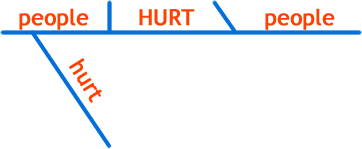
HURT PEOPLE
HURT PEOPLE

Now if you are not "hearing" that in your head, maybe you recall seventh-grade English and how much fun it was to diagram sentences:

Or, to put it another way: "Hurt (adj.) people HURT (verb) people."

The one thing LGBT people almost universally have in common is that we have all been -- at one time or another -- treated badly. As children, we got mocked for being different or strange; for not liking dolls when we should, or walking funny. Later, we may have been rejected by family members, passed over for jobs, kicked out of churches, or accused of being immoral and a danger to children simply because the gender that turns our head, or that we claim as our own, is not what others expected it be. I have yet to meet the person who avoided it totally, although it is getting better, thanks be to God!

The Velveteen Rabbit
illustration by William Nicholson
Public Domain (1922)
Those of us who are doing inclusion work are -- by definition -- revisiting those old personal hurts, over and over again; either by talking other people through them, or trying to explain to potential allies how it feels to be a person like us. We don't have the luxury of shutting those bad memories in a box and celebrating the happy, well-adjusted person we became, safe to pursue career and relationship goals by nature of the progress the church and the state have made. Like the Velveteen Rabbit, it is our scars that will make us “real” to those wounded hearts whose trust we must carefully earn.

Perhaps this is the gift that we carry to the altar. Maybe we sacrifice "moving on" in order to build the church and the world where others may someday do so undamaged. If that is so, then we must acknowledge what that costs, and the attendant dangers.

This means we can, if we're not careful, see our present circumstances only through the scratched lenses and battered, taped, frames of the past. We are liable to interpret the words and actions of others as if we were back in that awful place we fought so hard to overcome, particularly when we find ourselves under stress. In that dark world, allies can easily be mistaken for tormentors, and that puts us at a higher risk of inflicting further wounds on them, if we can’t see their vulnerable spots past the scales on our own eyes. Trust me, I know there are some people who just manage to push your buttons, but in the heat of the moment it is easy to confuse the person and the issue; what is really their damage and what is just our own stuff, coming back to haunt us.

It also means we can become so used to victimhood that it has become too comfortable, or too scary, to give up. We have fought hard to achieve wider acceptance, but with equal rights comes equal responsibility. It is good that we are different, and it is important and wonderful that we are survivors, but it doesn’t make us "special" in the sense that we should continually expect to get a pass for bad behavior because of it. We find it exhausting when others do it; we should learn to recognize it in ourselves.

With the bread we need for today, feed us.
In the hurts we absorb from one another, forgive us.
In times of temptation and testing, strengthen us.
From trials too great to endure, spare us.
From the grip of all that is evil, free us.

For you reign in the glory of the power that is love, now and forever. Amen.


So what next?

As a souvenir of that fateful weekend, I have -- shoved into the top of a closet -- a grocery bag full of palancas, letters of affirmation from other Antioch members, parishioners and others that I received on the retreat. The word palanca is Spanish for "lever" and the purpose is to give someone a spiritual "boost" through prayer or encouragement. So this is my palanca for you, 21st-century style:

If any of this struck a chord with you, I invite you to play the video below, eyes closed if you want, and think about your own experience while you listen. Hold up the hurts you’ve endured, and the hurts you’ve caused, and allow yourself to feel forgiveness, given and received. Think about what you might say or do differently next time. What if you shared one of these vulnerabilities with the person who causes you the most angst, and asked them to share one of theirs with you? What would your relationship be like after that?


That song was composed by Gregory Norbet, a former member of the Benedictine monastery at Weston, Vermont. It is a working farm in a rustically beautiful setting, particularly in autumn, and has been a "go-to" place of refuge for my entire life.

The pond at Weston Priory
We can… you and I can… build that place of sanctuary for each other. We can learn to help each other heal from what has happened to us, and be the palanca, the lever, that helps them accomplish what they otherwise could not. We can have the grace to ask for forgiveness when we screw up (and we will screw up… I know I will) and know that it is offered with sincerity. We can know that it is okay not to always be perfect, and not always be right, and not always have the last word.

We can do this, aye, we have to do this. We are called to be a force of good in the world, are we not? How can we take that on with so much distrust and resentment underfoot? We need each other on this road, flaws and all, and we can get there much quicker if we learn how to bring out the best in one another, instead of the worst.

“Jesus Consoles the Women”
 from Clarence Enzler’s Everyone’s Way of the Cross

Christ Speaks:

How often had I longed to take the children of Jerusalem and gather them to me. But they refused. But now these women weep for me, and my heart mourns for them-- mourns for their sorrows that will come.

I comfort those who seek to solace me.

How gentle can you be, my other self? How kind?

I Reply:

My Jesus, your compassion in your passion is beyond compare. Lord, teach me,help me learn. When I would snap at those who hurt me with their ridicule, those who misunderstand, or hinder me with some misguided helpfulness,those who intrude upon my privacy – then help me curb my tongue.


May gentleness become my cloak.

Lord, make me kind like you.

--

Adaptions of this post:

Saturday, July 31, 2010

The Hardest to Learn is the Least Complicated

Ignatius of Loyola - Founder of the Jesuits (1556)

Tonight a group of us attended the Lilith Fair. In case you're not familiar, it's a concert tour created by Sarah McLachlan featuring female performers at various levels of commercial success. The lineup changes a bit over the course of the tour, but this year's biggest performers (besides McLachlan) herself were the Indigo Girls. Performing together under that name since 1985, Amy Ray and Emily Saliers are both lesbians, but have never been romantically involved in spite of (or perhaps resulting in) their longtime musical partnership.

My own history with their music goes back nearly to the beginning, when they collaborated with Michael Stipe from INXS and Hothouse Flowers on songs like "Closer to Fine" and "Kid Fears" which still get the fans to their feet today.

But the song of theirs that resonates with me the most from those days is "Least Complicated" written by Saliers for the 1994 release Swamp Ophelia. It tells the story of a shy kid who develops a crush on someone from the "in-crowd" and impulsively makes these feelings known via a touching but inappropriate gesture, only to learn that the feelings are in all likelihood unrequited, thus further cementing the isolation.


I always liked this song, despite the lack of a happy ending, because I feel like all of us are -- at any stage of life -- that little kid at times. Not necessarily in a romantic setting, but just prone to occasionally misread a social situation or maybe just give someone a little more credit than they deserved. And we withdraw the slapped hand, maybe get a little cynical, but hopefully we don't give up. Despite the somewhat melancholy subject matter, the melody to this song is catchy and upbeat, and the oft-repeated chorus is one the crowd joins in with relish every time I hear the song performed live. I like to think that each one of those people singing is thinking something along the lines of "Yeah, I get that. I can be a goofball like that too sometimes." And maybe we go home promising to be a little easier on ourselves, and try to handle it with a little more grace when someone enthusiastically presents us with some awkward token of misplaced affection.

"Least Complicated"
Words & Music by Emily Saliers, from the Indigo Girls' 1994 Album Swamp Ophelia

I sit two stories above the street
It's awful quiet here since love fell asleep
There's life down below me though the kids are walking home from school

So long ago when we were taught
That for whatever kind of puzzle you got
You just stick the right formula in a solution for every fool

I remember the time when I came so close to you
Sent me skipping my class and running from school
And I bought you that ring cause I never was cool

What makes me think I can start clean-slated?
The hardest to learn was the least complicated

So I just sit up in the house and resist
And not be seen until I cease to exist
A kind of conscientious objection a kind of dodging the draft

Boy and girl are holding hands in the street
And I don't want to but I'll think you just wait
It's more than just eye to eye learn things I could never apply

I remember the time I came so close with you
I let everything go it seemed the only truth
And I bought you that ring it seemed the thing to do

What makes me think I can start clean-slated?
The hardest to learn was the least complicated
What makes me think I can start clean-slated?
The hardest to learn was the least complicated

Oh I'm just a mirror of a mirror of myself
All the things I do
And the next time I fall I'm going to have to recall
It isn't love it's only something new

I sit two stories above the street
It's awful quiet here since love fell asleep
There's life down below me though the kids are walking home from school

I remember the time I came so close to you
Sent me skipping my class and running from school
And I bought you that ring cause I never was cool

What makes me think I can start clean-slated?
The hardest to learn was the least complicated