I'D LOVE TO HEAR FROM YOU

Comments, criticisms, or (one can hope) compliments are more than welcome! Please let me know what you think, tell me I'm crazy (I suspect this) or what you'd like to hear about. Comments are screened before publication, so if you want to share something with me only, just put that in the comment and I'll keep it to myself.

THANK YOU FOR VISITING!

Friday, February 18, 2011

City Visit

Martin Luther - Educator and Translator (1546)

Singer
Singer, by shiftynj
(C) All rights reserved
I spent a warm Friday afternoon in the city with friends , celebrating my 20th anniversary with my employer. We had lunch at Salam in Chelsea, then walked through the Meat-Packing District (Gaansevort) and on the High Line, an elevated railroad trestle, long unused, which has been re-crafted into a wonderful park. 

One of the distractions in the park is a changing collection of art. The acoustics where it passes through a building are utilized to enhance a project called "A Bell for Every Minute" where -- once a minute -- a simulation of a bell somewhere in the city can be heard.

On the way home, we encountered another friend who is a student at General Theological Seminary, and he gave us a quick tour of the campus chapel. Then we saw Ethan Hawke on the street with his family.  Unfortunately by that time my camera had died. I hope to get back there soon and join them for Evening Prayer.

We were grateful for the unusually warm day.  More pictures in the gallery 20th Anniversary Lunch on Flickr.

Monday, February 14, 2011

Leave Your Preconceptions at the Door

Cyril and Methodius - Missionaries to the Slavs (869)

Those of us who are deep enough in the world of religious geekdom to be aware of the Ship of Fools live in mild trepidation of the possibility our place of worship will be a port of call for that phantom menace, the Mystery Worshiper.  You never know that a visitation has taken place until (s)he leaves the trademark calling card: literally, a card in the collection plate.  Of course, everybody from the altar guild to the homilist fears such a guest will come on the day we are least prepared to impress, and the reviews, while taking into account a congregation's resources or lack thereof, make no bones about elements of the service they find less-than-heavenly.

 My own congregation has yet to be paid such a visit, but my previous one has been.  And -- while a few of the comments were beyond argument -- it's one of those things where it's okay for us to say it, but when you hear it from an outsider, well, ouch.

Animal
Thus, it was with some interest that I learned about a blog project underway called "Who are the Churches in Your Neighborhood?"  If that sounds like the name of a song from Sesame Street, that's not an accident.  In fact, the writer adopted as a pseudonym "Bob McGrath" after the actor who gave voice to the puppet character with the same first name.  His reasons for anonymity are similar to those of the Mystery Worshiper: he wants to experience congregations as they really are, not when they're putting on a show.

However, while I've deduced that the purpose of the Mystery Worshiper is to gently and humorously show us how we are perceived by others , Mr. McGrath's intentions seem purely introspective.  He decided to -- over the course of a year -- visit the 50 houses of worship closest to his home, simply "because they're there." He knows that his understanding of the various faith communities around him are shaped by everything except what they should be: direct contact with the people inside.  Thus the one person he expects to be changed by this experience is the one person who should be: himself.

This is not to say that he is not observant of what he's taking in, and sometimes it is delivered with the same biting humor favored by the crew of the Ship of Fools:

"I was intrigued to see that they had built an enclosed cage for the drummer. I thought it was probably needed to mute the clanging cymbals in the acoustically challenged room, but when I saw that the drummer actually looked like Animal from the Muppet Show, I wondered if the box was for safety reasons."

Of course the article through which I stumbled into this project is the one where he visits "the gay church" aka the local Metropolitan Community Church.  Founded in the late 1960s by a defrocked Pentecostal minister, The Rev. Elder Troy Perry, the MCC has emerged into a worldwide Christian denomination whose 250 congregations are majority-LGBT.

Mr. McGrath's account of his visit to the MCC church near him is three-quarters about what was going through his mind as he approached, entered and participated in the service, and very little about the service itself, much less detail than he gave to the megachurch the week before.  I think that's because what struck him about it was not how "different" it was, but how different it wasn't.  I'm not going to deconstruct every line, instead I invite you to read it for yourself.  However, I was struck by his honesty about what was in his head going towards that visit, and what he took from it.

Wednesday, February 9, 2011

Leonardo Slept Here

Back before the events of the world made it such a cauldron of suspicion and fear, I used to spend more time than most people would consider normal at New York's biggest airport.  Despite passing three other airports to get there, JFK had a unique appeal for me and my similar plane-geek friends.  Part of that is the international stew that passes through it (over 90 carriers call there, albeit many of them only a few flights a week).  But another aspect is its unique layout.  In the 1950s and 60s, the developers of the airport only constructed one terminal on their own, which served mainly the aforementioned overseas carriers who had a small presence.  The major players at the time (American, BOAC, Eastern, National, Pan Am, TWA, and United) were each allocated land to design and build their own facilities. Northwest Orient, Braniff and Northeast Airlines opting to share one building that later became home to Delta Air Lines.

Pan Am Worldport
Gottscho-Schleisner, Inc., photographer
in the Public Domain
Of particular architectural interest were the facilities operated by Pan Am and TWA.  The former, once known as the Worldport, is an oval capped by a four-acre cantilevered  roof which allowed passengers to enter and leave aircraft while sheltered from the weather. Expanded in 1970 to accommodate Boeing 747s, it was for a time the largest passenger terminal in the world.

The TWA Flight Center, designed by Eero Saarinen, still stuns visitors with its unique profile.  A thin-shell concrete structure which evokes a bird in flight.  Opened in 1963, it introduced travelers to such niceties as the Jetway boarding bridge, a central PA system, and an electronic flight display board.

By the early 1990s these buildings were all bursting at the seams and barely able to cope with the volume of traffic passing through them.  Piecemeal renovations occurred on each facility.  Used by Delta since Pan Am's demise, the Worldport is often compared unfavorably to terminals in the developing world. It is  slated to be demolished by 2014.  A consortium of airlines replaced the Eastern terminal with a state-of-the-art facility that can accommodate the superjumbo A380.  American built a giant new structure and leveled both its original building (which included destroying the world's largest stained-glass window) and that of United, whose presence at JFK has been reduced to just a handful of flights now operating out of the British Airways facility.  I.M. Pei's glass-curtained "Sundrome," which housed jetBlue until a few years ago, is also slated to come down to make room for that carrier's future expansion.

The main terminal has also been replaced, and will be expanded to accommodate Delta over the next few years, thus vacating the Worldport.

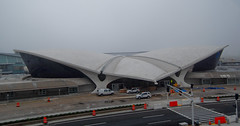
TWA Flight Center
TWA Flight Center by Eric Alix Rogers 2009

The TWA Flight Center is now on the National Register of Historic Places.  Its unique shape and the inability to alter it made it impractical for today's requirements.  When American Airlines consumed TWA in 2001, the terminal was closed.  

Since then jetBlue built a new facility partially surrounding it on the airside, which required demolition of the two gate satellites, but the two buildings are joined by the two original ovid walkways in which we see Leonardo DeCaprio, in character as master con artist Frank Abagnale, Jr. in Catch Me if You Can.

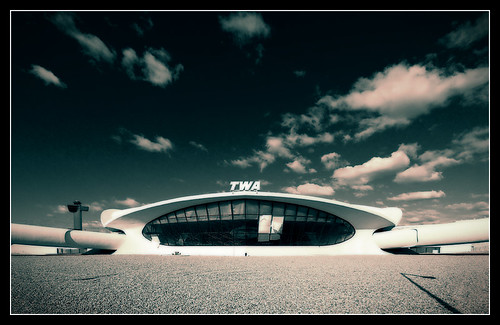
TWA_1
Airside of the TWA Flight Center
by Timothy Vogel (Vogelium on flickr.com)
Used by Creative Commons License
Since then, nobody has quite figured out what to do with this very cool, but not particularly useful building.  As we have learned the hard way, airports don't make the best museums.  Part of the attraction for us (besides the bar, natch) of this space was the view of the tarmac, which has since been obstructed by the construction of the new jetBlue terminal. 
  
The latest proposal is to construct a boutique-sized hotel (approximately 150 rooms) in the space between the old and new buildings.  I'm not sure how they plan to accomplish this without further compromising the setting of the Saarinen structure.  The airside is currently a gravel field, but at least that admits daylight into the cavernous waiting area.  Sticking another building in there would gobble up even more of the already-limited atmosphere.  A hotel on the airport property would be a good thing (the vaguely prisonlike Ramada Plaza out by the Belt Parkway closed several years ago) but I'm not sure wedging it into this  space is the best plan, and I'm not alone.

Thursday, February 3, 2011

Creating Change, Part 1: Bury My Heart at Marquette III

Dorchester Chaplains - (1943)


"We had the gold rush wars
Why didn’t we learn to crawl?
And now our history gets written in a liar’s scrawl
They tell me, 'Don’t be so uptight!
I mean, honey, you can still be an Indian
Down at the Y on Saturday night.'"


BUFFY ST. MARIE


This weekend I join 2500 or so others in Minneapolis for an event called "Creating Change".  Organized by the National Gay and Lesbian Task Force (the nation's oldest LGBT organization), it is the largest conference of LGBT community organizers in the nation.

This year, for the first time, there is a "concentration" within the larger conference of religious folk. Entitled "Practice Spirit, Do Justice" it was focused on providing faith leaders with more specific networking opportunities and tools for promoting LGBT rights goals within the religious space.

"Big Pilot" by Chris Murphy
Used under Creative Commons license
Due to the latest in a line of "snowmageddon" experiences this winter hath wrought, my original flight on Wednesday was cancelled and I was re-accommodated on a 6:15 a.m. nonstop on one of the little tinker toys that are seemingly becoming the mainstay of the domestic airline fleet.  Thus I was fairly groggy when I bumbled through the wonderful second-story Habitrail that protects the public from Minneapolis's winter weather, negotiated the registration materials, and found my first session.

The first event for me was organized by the First Nations Two-Spirit Collective.  "First Nations" is a term coined in Canada to more accurately describe what are otherwise known as "native American" or "American Indian" tribes.  "Two Spirit" is, as explained by group member Coya Artichoker, a modern blanket term that evokes the tradition within several tribal cultures that LGBT people possess both a male and female identity.

The group led us through an exercise in which we were asked to record values we considered important on squares of paper.  This took a while as there were over 100 people in the room.  These were collected and read out loud under some general categories to save time.  Then they were symbolically "taken away".

Next we were asked to self-identify by ethnic or cultural background.  Little by little, everybody except the first nations folks were herded into one corner of the room.  Gradually, using a rope, we were corralled into a smaller and smaller space, getting closer and closer to strangers. Attempts at personal space or staying with your friends fell by the wayside.  The meaning became clear. It was awkward, and, menacing, and sad.

"Heart of Wounded Knee" by Jonathan Hamner
Used under Creative Commons license
All of this was meant to symbolize the systematic destruction of tribal cultures, traditions and homelands by the incoming European population.  In addition to being driven from their lands, first nations people were forbidden to practice many aspects of their own cultures, including religion, and forced to adopt Christianity and Western dress.  Resistance to this compulsive assimilation culminated in the spread of the Ghost Dance movement among numerous western tribes, as well as the Wounded Knee massacre, both in the 1890s.  The Wounded Knee incident, in which over 150 Lakota were killed by U.S. soldiers, helped begin turn the tide of white America's attitude toward tribal people, albeit after the damage had been done.

The exercise was definitely an attempt to "afflict the comfortable" and ... at least in my case... it worked.  As we stood there, awkwardly close, one of them began singing and plunged into the knot of "captives", walking among us.  The words were not English, but -- as her compatriots demonstrated -- it was clearly a form of call-and-response.  The rest of us listened, unsure of what was going to happen next.  The leader, sensing our confusion, commanded softly, "If you wanna get out of here, you better start dancing."  One by one, people hesitantly joined the impromptu "conga line" and the song, mumbling at first at the unfamiliar syllables, then more confidently.

Gradually the captives became marchers, and soon the line snaked around the ballroom.  A smudge pot of sorts, wafting some kind of fragrant spicy incense, was borne around the room by one of the leaders, and each of us was offered the chance to wave some of the smoke over us.  Nobody refused.  I was worried that someone would express affront or anger at being "cornered" as we were, but it appeared everybody "got it" and -- as people shared their reactions -- it was clear that people felt closer, not alienated.  Any "white liberal guilt" we felt was our own; these folks were actually giving us a gift by, gently but frankly, letting us experience part of our common history and see things from a perspective from which our own culture and education has largely "spared" us.

Sunday, January 23, 2011

Gonna Fly Now

THIRD SUNDAY AFTER THE EPIPHANY

I didn't know Maurice, but I've seen Rocky, his horse.

Horses are (or were) a dime a dozen where I grew up, but -- unless you go looking for them -- you don't expect to see one in somebody's yard in the busy, densely-packed suburbs where I live now.  Thus Rocky caught my eye on a couple of occasions when making my way through the back streets of Montclair, but I never learned the circumstances of how he came to be there until this week.

Besides the prize-fighter portrayed so prolifically by Sly Stallone, Rocky was also the nickname of another odds-beating dude: a young California man named Rocky Dennis who led a short but rich life despite the effects of a rare disease that eventually disfigured his face, affected his hearing and vision, and gave him crippling headaches. His life is loosely portrayed in the film Mask, directed by Peter Bogdanovich.  As deftly depicted by a  young Eric Stoltz, Rocky maintains a sense of humor and grace that wins him the respect of not only his biker/addict mom (whose portrayal by Cher won her Best Actress at Cannes in 1985) but his formerly-cruel classmates and misguided principal.  Without necessarily trying to do so, Rocky taught those around him quite a bit about life, and about themselves.

Rocky the horse belonged to another young man, the aforementioned Maurice.  Maurice was born a year to the day before 9/11 in Washington D.C.  His mother was also addicted to drugs, and was HIV-positive.  Both Maurice and his twin sister Michelle were born with a host of physical and developmental problems, and she died before her second birthday.

Maurice's prognosis was not much better.  When he was three, two men named Tim came into his life.  They were intent on giving Maurice a home, despite being told by doctors that he was unlikely to live much longer.  It took another three years to negotiate the red tape, during which time the Tims continued to care for Maurice, and he responded by growing stronger and healthier.  A year after they adopted Maurice, big brother Kindoo joined the family and they moved to Montclair shortly thereafter.

Maurice loved horses, and -- although it was certainly not the norm  -- the family's new house had enough property, so they surprised him one Christmas with a horse of his own.  Thus Rocky came to town.

I didn't know Maurice, but I know how kids act around somebody who is different.  We've all seen it, and we know that no amount of us telling them not to prevents prying questions, cruel comments, taunts. In fact, if kids get the idea that the adults treat you "special" it can just make things worse.  Sadly, adults who should know better do it, too, and there's a whole element of our entertainment culture that encourages this survival-of-the-meanest mentality.

Ultimately it is up to the individual to claim his place, assert his right to participate, and earn the respect of the group.  What kind of support the child gets at home is key here, because a kid who has been taught to believe he has worth is far better equipped to handle this kind of flack.

I didn't know Maurice, but I can tell from reading about him that he had that kind of home.  Two people who could have spent their disposable income on circuit parties and mid-century tchotchke  instead reached out to a baby the world had already decided wouldn't make it, and gave him the best life they could, and -- in their care -- he thrived despite his shaky health and accomplished quite a bit: earning a black belt, graduating from high school and volunteering to serve the poor at St. Luke's Episcopal Church.  When their own relationship didn't survive, they did the best they could to make sure Maurice and Kindoo still had a stable home with two parents who loved them.   He had goals for himself, including living independently and teaching kids with special needs. 

Maurice died this week after a sudden illness.  He was 20.  The New York Times describes him here and includes a photo of a handsome and confident young guy astride his horse. To read about and look at him, this would not be a kid that you would pity.  This was a kid that you could (and should) learn from.  I can't say more about the man he grew to be, because I didn't know him.

That is my loss.
Thursday, January 20, 2011

An Hour (And Halfway Around the World) Away

Last month, a Certain Party and I -- along with some friends and (briefly) my mom -- spent some time in Florida.  The beginning of the trip was our annual week on the beach on Captiva Island, and this year, for variety we drove across the state to visit a former co-worker and her husband near Palm Beach, then up to Orlando for a few days in the theme parks.

Our route, skirting the southern and eastern edges of Lake Okeechobee, took us through orange and sugar country, a part of Florida most visitors never see.  We had lunch in Clewiston, a busy if not thriving town with a big K-Mart and a Goodwill store, and shared the restaurant with a cluster of Mennonites, their traditional dress incongruous with the brightly colored Formica and florescent lights. 

We made a wrong turn in Pahokee, whose nickname "the muck" was aptly chosen; it is surrounded by thousands of acres of soggy fields.  Once a thriving center of commerce, big agribusiness has left Pahokee chewed up in its wake.  Most of the businesses have closed, and the 6,000-odd residents were left without much opportunity or hope, as President Obama learned when interviewed by town resident Damon Weaver, then 10.  Many residents seemed to be just hanging around, waiting for something -- anything -- to happen.  The only other ticket out seems to be football, as this tiny town has sent at least seven players to the NFL.
Pahokee 4, by Christopher Dick 2006.  Series on Flickr.
Used under Creative Commons License


From there, it was only about an hour to Hobe Sound, where our friends live.  The acres of fields and weathered shacks abruptly give way to gated driveways, manicured lawns, faux-Spanish patio homes and lush  non-native vegetation. An hour away, but it could have been halfway around the world as we chased alligators on golf carts and enjoyed drinks by the pool. 

As kids we visited Florida a number of times, always driving down.  I remember only snippets of those trips, but I'm old enough that overt signs of institutionalized racism were likely quite evident to someone who knew to look for them.  Now, as so many of America's towns have been pounded into corporate cookie-cutter sameness, it's harder to get a sense of what was, and easy to forget how badly we acted, not very long ago.  But you only have to look at the differences between places like Hobe Sound or even Clewiston and Pahokee to see that -- while some of us have been lucky enough to enjoy the fruits of progress -- there are still plenty of us who have been left behind. Those distinctions are not always drawn on racial lines, but the pattern of boxes you check still makes a big difference in how big your slice of American Pie will be.

Thus I was glad to hear that the Cathedral Church of St. Peter & St. Paul in Washington DC (known by most as the National Cathedral) is in the process of installing a bust of Rosa Parks above a doorway.  I learned recently that it was at the pulpit in this same church where the Rev. Dr. Martin Luther King, Jr., delivered the last Sunday sermon, entitled "Remaining Awake Through a Great Revolution"  before his assassination in 1968.

Wednesday, January 19, 2011

Buyer Beware! The Episcopal Church is "No Longer Christian"

Did you get the memo to take the cross down?

In today's edition of Fundies Behaving Badly, one Michael Youssef of "Leading the Way Ministries" and the Evangelical Anglican Church of the Apostles in Atlanta (Both? Ambitious guy!) opined in an American Family Association newsletter that the Episcopal Church became officially "no longer Christian" when the Right Rev. M. Thomas Shaw, Bishop of Massachusetts, witnessed the marriage of Katherine Hancock Ragsdale (dean and president of Episcopal Divinity School) and Mally Lloyd (Shaw's Canon to the Ordinary) at St. Paul's Cathedral in Boston, an action which Youssef describes as a "defiance of church cannons" (sic). Right Wing Watch has the full story.

I always thought of 'piskies as peacenicks, actually, and thus was surprised to learn that we had cannons. Nevertheless, if we do, then it was rather brave of these folks to stand up to them.  Assuming he meant canons, at the most recent General Convention in 2009, the decision he refers to -- which we were pressured into by Canterbury -- was reversed and bishops were given "generous discretion" to meet the pastoral needs of their constituents.

Meanwhile, in the business world, a splinter church like this that used the word "Episcopal" or "Anglican" in its name could be sued for trademark infringement on the grounds that the public could get confused into thinking the defendant was an agent of the larger organization publicly associated with those words.  I'm fairly certain no formal communion exists between Mr. Youssef and the Present Occupant at Lambeth, nor our own Presiding Bishop and Flying Ace.  If the famous clothier could make an (ultimately unsuccessful) case of deliberate deception against aberzombie.com, surely the same is true here.

Watch out for those cannons!

Thursday, January 13, 2011

When the Ship Comes In

Hilary of Poitiers - Bishop & Doctor

Okay well it has been an embarrassing amount of time since I have posted anything here.  My friend David described this in a similarly apologetic post as having "gone galt" so then of course I had to go see what that meant, and another ten minutes were lost.

So, what's been happening?  Well right after Thanksgiving, we went to Florida, which was fun although really cold (for Florida) which meant we had a great time in the theme parks because there weren't any lines to speak of.

We got to visit a co-worker from years back and her husband, ride round on golf carts and see alligators.

Then there was Christmas, and a ridiculous snowstorm or three.   We're in the thick of winter here, now, but as someone pointed out earlier, it was still light enough to see at 5 o'clock, so the days are starting to get noticeably longer again.

We did have a rather unfortunate experience on New Years' Eve at a restaurant in Montclair called Costanera.

Queen Elizabeth 2 in 2008
There is an interesting maritime event unfolding in New York Harbor as we speak, although I am unfortunately not participating.  All three ships of the storied Cunard Line are berthed in the city at the same time: The Queen Mary 2 at the Brooklyn Cruise Terminal, and the quasi-sisters Queen Victoria and the new Queen Elizabeth at the Passenger Ship Terminal on Manhattan's west side, the latter having just completed her maiden transatlantic crossing.  My friend Doug Newman was aboard, and you can read his account on his blog.

This is is only the second time the entire fleet has been together in the port, which speaks as much about the modern need for marketing pomp as it does the state of the company's affairs: in the 1950s they operated over fifty vessels, now they have just three.

Queen Victoria at the Passenger Ship Terminal
The first was three years ago, for the Victoria's maiden arrival.  At that point the legendary QE2 was still in service, and a friend and I took a boat trip out into the Upper  Bay to watch  as the the three ships preened in front of the Statue of Liberty under a fireworks display.

I was also on hand for the mammoth Queen Mary 2's first visit to the city; in fact my dad and I were aboard, having made the maiden crossing from Southampton in April of 2004.