I'D LOVE TO HEAR FROM YOU

Comments, criticisms, or (one can hope) compliments are more than welcome! Please let me know what you think, tell me I'm crazy (I suspect this) or what you'd like to hear about. Comments are screened before publication, so if you want to share something with me only, just put that in the comment and I'll keep it to myself.

THANK YOU FOR VISITING!

Wednesday, March 5, 2014

Find the Cost of Freedom

ASH WEDNESDAY

“Hey, are you Polish?”

The question, though incongruous from a stranger as my two friends descended a busy staircase into the West 4th Street subway station, seemed innocent enough, and -- in fact -- one of them is.

The next question was even more out of place, although the intent was not immediately clear: “Are you faggots?”

My friends report that at first they thought the stranger was kidding around; an inside joke on the gayest corner of the gayest city east of Mrs. Madrigal. There has been much debate in the “community” over whether we should neutralize the venom of that word by playfully throwing it around, much as another two-syllable word has been co-opted by some of those against whom it was used. We know people who do that, with that word. The stranger had an accent, and sometimes people from other places use words differently than we do, and they were a little buzzed (they were, after all, celebrating their tenth anniversary). In a city they know well, and -- a mere block from Stonewall on a Saturday night -- they had no reason to be particularly wary.

So they said yes.

What followed happened so quickly that they struggled to recall it in detail… to the doctors, to the cops, and then to me. In a nutshell, the stranger did not like that answer, and he made that brutally and physically clear, while a station platform full of people fixed their eyes back on their phones and did nothing, said nothing. The birds are angry. Can you blame them?

Eighteen hours later, my friends finally made it home, having been up almost all night retracing their steps, paging through mugshots. One of them required stitches near his eye and may need surgery for facial fractures. They are both stunned, angry and sad. The city whose welcome we have come to take for granted now feels like a house that had been robbed.

mark_carson_protest_DSC_0209
Protest in Greenwich Village after Mark Carson's murder

PHOTO CREDIT: Michael Fleshman
Used under Creative Commons License
Even as crime drops precipitously in the city and marriage equality comes to a new state seemingly every other week, two groups of people have increasingly found themselves the targets of violence and rage: gay men and transgender women. We are not just being called names or getting black eyes. In May of last year, a young man named Mark Carson was shot dead just blocks from where my friends were attacked. In August, an aspiring fashion designer named Islan Nettles was beaten on a Harlem street, right across from a police station, later dying from her injuries. Although multiple people identified her attacker, the charges were later dropped. Another man was attacked in an East Village subway station just three weeks ago. In all these cases, the perpetrator hurled homophobic and transphobic remarks at his victim.

My friends know they are lucky that what happened to them wasn’t worse. They are home eating soft foods because it hurts to chew, but they are alive. The police and doctors took their report seriously and told them they had done nothing wrong. We can be grateful: this would not have been the case thirty years ago.

As I write this, an invitation to a male couple’s wedding, which will be valid in the eyes of the church and the state, sits on top of today’s mail. My straight friends treat my partner and me like members of their families, and their kids say “uncle and uncle” without even puzzling at that idea. I think they would find a rotary phone more confusing.

It is clear, however, that some around us remain so threatened by the evolution of our rights and the normalizing of our place in the culture that the only way they can reassure themselves of their power is by lashing out: with words, with fists, with bullets. The rash of Jim Crow-evoking legislation that popped up around the country in recent weeks, was -- while failing to become law -- still successful at reinforcing the us-and-them mentality that drives such paranoia in some quarters. We can celebrate how far we’ve come, but if we let ourselves believe for a minute that the struggle is over, it is at our peril.

“It's unfair to be called a faggot your entire life; however, the slur becomes most dangerous when you let it no longer faze you.”
- PAUL FLORES

Wednesday, January 1, 2014

Saving the iGays

"For it was you who formed my inward parts; you knit me together in my mother’s womb. I praise you, for I am fearfully and wonderfully made. Wonderful are your works; that I know very well. My frame was not hidden from you, when I was being made in secret, intricately woven in the depths of the earth. Your eyes beheld my unformed substance. In your book were written all the days that were formed for me, when none of them as yet existed."
 - PSALM 139: 13-16

 FEAST OF THE HOLY NAME OF JESUS

I have been fussing at my better half for the past week that we do not have exciting New Years' plans.  We will be ringing it in at his brother's house, on the couch with Ryan Seacrest while our nephew shows off his Christmas loot.

There is nothing wrong with this, of course.  We are generally not "partiers" these days, and New Years in a bar (or -- as my friend Tony called it -- "amateur night") is frequently overpriced and generally populated by people who are trying too hard to convince themselves and those around them they're having an amazing time.

However, my observation from astride a bigger elephant in a smaller room, which is that -- for a certain wedge of the gay male culture pie -- every Saturday night is New Years' Eve. I get weekly email invites from every DJ and promoter I ever met, trying to convince me that their venue is the place to be.  There are people whose job it is to go around and photograph people at these weekly parties and post them online and in Time Out and free bar magazines like Next.  You are of course supposed to be sought out to pose for these photographs (what my friend John, who records/performs club music as Jipsta, calls "giving red carpet") and there are men who scan these pictures eagerly over brunch the next day to see if they or their friends made the cut.
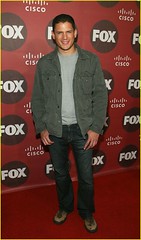
Wentworth Miller - Michael Scotfield
Wentworth Miller gives red carpet
I was never more than at the fringes of this world. You only have to look at the images that it produces to know that there is a pecking order, and that you need to look a certain way to be taken seriously.  I learned the truth at seventeen: You can gym up, wear the "right" clothes of the moment, and raise your stature a little bit, but if your physical dimensions and the shape and placement of your facial features are not within a few millimeters of the airbrushed "ideals" set by the likes of Wentworth Miller, there is an inner circle of fabulosity that will forever remain out of reach. In the event that you mistakenly cross the class boundaries, this world is populated with enough young men who fancy themselves as an extra from Mean Girls, who will helpfully direct you back to your rightful place. Further, the mandatory retirement age is distressingly young, although I know men who have resorted to Botox, hormone therapy and other means to stay "in the game" a bit longer. 

This is, of course, not new: the Village Voice personals in the 1980s could be pretty specific. In his 1983 novel I've A Feeling We're Not in Kansas Anymore, author Ethan Mordden creates a character named Harvey Jonas, whose raucous public persona is -- he reveals -- a mask behind which he hides a deep loneliness, brought about by a keen understanding of the looks hierarchy.
"Everybody talks about power, but everyone wants beauty.  It's sad, because you can acquire power, but you can't acquire beauty. Do you know why everybody wants beauty?  Because beauty is the only thing in the world that isn't a lie."
What is new, and somewhat disturbing, is the way that technology has impacted the gay male social scene, and it is enough to make me glad to be out of the dating game.  Traditional matchmaking strategies, and -- to a certain extent -- even the bar scene have been largely supplanted by smart phone applications which enable men to -- by means of GPS -- locate potential mates in their immediate proximity, with only a photo and a handful of characteristics and preferences to differentiate themselves.

“We are an un-community. We have become a consumer product. We are the iGays. We have lost our souls. And we don’t even know it.”
- ANONYMOUS
What was once at least a perfunctory opportunity to get acquainted has now been reduced to a quick scan of acronyms and statistics.   One quickly learns you need to be "VGL" (very good looking) and "Masc." (figure it out) and be able to prove it to even get a reply to your hello. Exacting standards of age, ethnicity, body dimensions, quantity and placement of body hair all help weed out undesirables.  Intimacy becomes a transaction from which you can be excluded simply for not filling out the paperwork properly.

We do like convenience, however, and the popularity of these applications is evident by their prominence in media and culture.  A recent meningitis scare in New York was cited to be largely spread by contact with others met via smart phone "hookup".  They have also played a factor in the decline in the number and quality of places for gay men to meet in person and actually socialize.  And what men are still going out do so with phones in hand, in case Mr.-Right-Now isn't in this bar, but the one next door.

Not everybody is happy about it. An Australian man who blogs anonymously writes:
"I came out in 1993, in Sydney, to a gay scene that was vibrant, colourful, out and proud. Here I sit not twenty years later, and the community has been decimated by the Internet. Completely, utterly decimated. As a whole, gays everywhere have become a sick group of animals who have completely lost their ability to interact on any authentic level, who have fearfully squashed themselves into simplified categories of drop-down boxes, and who banish entire groups of their own kind based purely on unwanted physical characteristics that do not fit the Gay-For-Pay Porn Model Image. We demand equal rights, but treat each other like sub-human animals, and worship the Straight Man as God-King."
For those of us mere mortals who don't get chased through the mall by modeling school reps, the odds are not good. Any endearing personal characteristics one might have -- a charming laugh, graceful conversation skills, a subtle or biting wit -- never get the chance to be experienced because the unseen panel of judges has already dismissed you on a technicality like the "wrong" eye color or the five extra pounds that came from binge-watching Orange is the New Black the same week that Starbucks brought back the pumpkin spice latte.  And even if you do actually get to meet in person, don't count on a second date.  "NSA" (no strings attached) is generally the intent.

The psychological effects on an already fragile population are not surprising. Our blogger laments:
"I have never felt more ugly, unworthy, and disgusting as I feel now. I have become so acutely self-conscious and lacking in esteem that if I actually venture out (despite this having become a pointless expedition of being ignored and judged, and watching small groups of gay males ignoring other small groups of gay males), I’m too uncomfortable to even dance anymore. I have no joy left in my life, because I have lost hope that I will ever share my life with another person."
He is, as it happens, an atheist.  From his biography, I suspect that any suggestion that he is loveable and beautiful in the eyes of God will be met with a dismissive eyeroll emoticon, and a chiding about invisible-man-in-the-sky fantasies to which we're already accustomed.  Which is a shame, because he is part of a population that desperately needs to hear they are in fact worthy of love.  Our tradition is full of flawed, neurotic men with questionable style and grooming habits who somehow managed to find companionship, fight injustice... even save nations.  Surely we have room for a few more! Our congregations can and should be communities where LGBT men (and women, although this looks-above-all nihilism appears to be a principally male trait) of all descriptions can be reassured of their worth in a world that frequently tells them otherwise, and where the opportunity is there for healthy, mutually-sustaining relationships of substance to form.

The church saved me in this way.  It was through seeing LGBT people, few of them actual supermodels, being uplifted by their parishes at a time when few others in society were doing so, that I knew it was possible that I was home, and I subsequently met my partner through the church. Ten years in, our extended "family" has seen us through joy and loss, and I was recently privileged to stand up for the wedding of another couple who have become dear friends. 

For the most part I have left the party world behind, and that is okay. Yes, I may have groused about not going out on New Years' Eve, but I love what my life has become, and I want that same feeling of belonging for my brothers out there in the dark, staring at their phones.

Seacrest out.

Monday, December 23, 2013

Walking on Water

So Peter got out of the boat, started walking on the water, and came toward Jesus. But when he noticed the strong wind, he became frightened, and beginning to sink, he cried out, “Lord, save me!” Jesus immediately reached out his hand and caught him, saying to him, “You of little faith, why did you doubt?” When they got into the boat, the wind ceased. And those in the boat worshiped him, saying, “Truly you are the Son of God.”
MATT. 14:29-33

We spend most of our Florida vacation within site of the Gulf of Mexico, but -- with the exception of our eight-year-old traveling companion -- most us us limit our actual immersion to splashing around right in the fairly miniscule waves.  

Last winter, the proprietors of a surf shop a few blocks from our rented house caught my attention with a strange contraption that looked like a cross between a surfboard and a kayak.  You stand on it like a surfboard, but -- rather than skimming on the crest of a wave, you paddle it like a boat.  Though I am about as graceful as a drunken giraffe during an earthquake, it looked like fun, and I wanted to try it. By the time I got the nerve to talk to them about it towards the end of our stay, the wind and currents had picked up and made conditions unsafe for a beginner.

That's me!
Since then, I found out this "has been a thing" since 2005 when it came over from Hawaii, but really took off in the past year or so.  Several friends have used them on northern New Jersey's lakes. People's little kids were doing it. A senior citizen with an enviable torso glided past us on one right near the water's edge during one of our daily walks. I was not going to miss the opportunity again this year!

So midway through our trip, I marched myself over to the languid youth guarding the pile of  equipment on the beach.  He has a cake job at this time of year, before the snowbirds and college kids arrive, we shared the beach with only a few other people so he mostly has to sit there and hope someone wants to rent something.

There were no lessons... after about a five-minute description of what to do, he dragged one of the boards into the water and guided it past the breaking waves.  I flopped onto it, managing not to go off the other side, and followed his advice to start out kneeling until I got more confident with my balance.  After five or ten minutes, I tentatively got to my feet and lasted a few minutes before flying off into the drink.

Unperturbed and glad I had not yet made it to where my friend Linda was waiting with a camera, I scrabbled back onto the board and tried again.  Before long, I was standing more than kneeling, and getting used to the sensation of trying to balance on top of a giant pan of Jell-O.  I am proud to say I didn't fall again, and made my way slowly up and down the beach, hoping the wake from a passing speedboat wouldn't send me flying right when I was in range of my intrepid news photographer.

By the time my rental hour was over, my quads were like rubber bands, but I was hooked.  I can understand how this is the Outdoor Industry Association's reported #1 new sports activity for 2013.  I also think it will help me in the gym, since it requires constant engagement of your core muscles and awareness of how you are distributing your weight.

Speaking of weight, I cringed when I saw the photos. I hate pictures of myself to begin with, let alone shirtless ones, and studying for the Project Management Professional exam plus some medical issues meant it was not a very outdoorsy summer for me! Hopefully I can find more chances to "SUP" next summer which will help counteract too much computer time.

"I feel pretty, o so pretty"
At the end of our week on the beach, we headed to Busch Gardens in Tampa for a day before flying home.  I was kind of amazed how in-your-face Christian the Christmas (clearly not Happy Holidays here!) decorations and music were.  But my point (yes, there was one!) of mentioning our visit there was that we saw a hippopotamus swimming underwater.  This huge animal, which lumbered slowly around its enclosure on land, was positively as graceful as a dancer as it moved through the tiny fish and plants that surrounded it.  Similarly, as uncomfortable as I was with the sight of my pale, flabby self, there was none of that while I was actually cruising, albeit slowly, on top of the waves.


Sunday, December 1, 2013

Maybe it's a Cloudbust

Ignatius of Antioch - Bishop & Martyr (107)

Last week -- after a very long wait -- we screened Cloudburst, a 2011 film of which Netflix apparently has one copy.

In my book, this film had three things going for it: Olympia Dukakis (playing gay, no less), Nova Scotia (playing itself), and a hot guy (Ryan Doucette).  How can you go wrong?

(from left) Olympia Dukakis, Ryan Doucette, Brenda Fricker
I wanted to see it at the Montclair Film Festival (especially because Dukakis was present for the screening) and wasn't able to get a ticket (probably because Dukakis was present at the screening).  She is a heroine in the town where she once lived and operated the Blooming Grove Theater Company.

The premise is as follows:  Stella (Dukakis) and her partner Dot (Brenda Fricker) have lived together for decades, but are being separated by Dot's granddaughter Molly (Kristin Booth) who is convinced that Dot's failing eyesight means Stella is incapable of caring for her, and she resorts to trickery and the fact that her husband is a cop (maybe the only cop in their small town) to get Dot away from Stella and into the rural Maine version of Shady Pines.

Emboldened by tequila, Stella hatches a plan to spring Dot, and they head off to Canada, with the idea of getting married.  Along the way, they pick up a hitch-hiker with the unlikely name of Prentice (Doucette).  Prentice is, inexplicably, almost always half-naked.  I have been to Maine and Nova Scotia:  It is not that hot, even in the summer. 

Prentice's story is that he left his dancing (modern, not exotic!) gig in NYC when he heard his mother was dying.  He's hitching his way back to Lower Economy (not be confused with Upper Economy) to see her.  He's a little nervous about exposing his parents to a lesbian couple, particularly since Stella has no filters and is regularly mistaken for a man.

When they arrive, Stella is sequestered in the truck, but Dot needs the rest room. Prentice gets her in the door and then apparently forgets about her as he sits eating cereal and talking to his mother (who -- other than a hacking cough -- seems well enough, and offers no explanation as to why Prentice was summoned home).  They quickly agree that he can't stay there (apparently they just had extra Cheerios they needed to finish). Dot gets herself into a bit of trouble I will not describe, which hastens their departure and leads to possibly the strangest scene in the movie.  Sufficient to say, we see more of the native twigs and berries than was really necessary.

Having given up his job to see his mother for ten minutes, Prentice seems remarkably calm about being homeless, unemployed, and having no plan for the future.  He agrees to accompany Dot and Stella into Canada and witness their wedding, perhaps in part for lack of anything better to do, but (I like to think) also out of a genuine desire to help them. He reveals a level of intelligence and complexity behind his initial trashy opportunism over the course of the film, as the couple's situation sparks some innate compassion and perhaps a sense of belonging he hasn't felt at home in a long time.

Of course things do not go entirely as planned.  They make it across the border with Prentice's dignity being about the only casualty, but cold feet lead to the seemingly counterproductive summoning of Molly, who tries once again to assert her will to keep the women apart.  The skirmish that follows leads to Dot finally getting to the root of what is driving Molly's behavior.  I will not spoil the ending, but it's not exactly happily-ever-after.

This quirky film kept me engaged, but the characters' seemingly self-defeating behavior both endeared them to me and made me want to understand their motives better than the film allowed.

Thursday, November 7, 2013

Things That Go Bump in the Night

William Temple - Archbishop of Canterbury (1944)

I admitted on Facebook last week, not without some trepidation, that I am not, nor have I ever been, a Halloween person.  Don't get me wrong; I like candy as much as the next person, and don't mind a clever, cute or sexy costume (my co-worker and her husband outdo themselves each year with a punny. costume-for-two (think "the fork in the road" or "deer in the headlights") that is an institution in their lake community.  It's the creepy-crawly-undead stuff I can do without.  I know I am squarely in the minority in this, considering that Americans reportedly spent $6.9 billion on candy, costumes and giant inflatable spiders this year.

It's part of a pattern: I don't like horror movies, I follow a proud family tradition of steering clear of the biology lab on dissection day (well, except for mom, who earned a nursing degree!), and I try to avoid "dressing up as" anything that involves makeup or a wig.  Hell, my "dressed up" look tends to skip right to the end of the wedding, with collar open and tie askew, but that's a shortcoming for another day.

I struck gold with the Archwarden in this regard, because every year he amasses a lot of candy and then no kids come to the door, which may be because he has all the lights off and the shutters closed, but we're not sure.  He's even less inclined to make a spectacle of himself than I am, so I don't have to worry about him asking me to fill out the back half of a horse costume anytime soon.

Yeah, not gonna happen.
This year was typical in our non-observance: I uncharacteristically declined an invitation to spend a beautiful Saturday on the Asbury Park boardwalk, mostly because I would have been sharing it with 9,252 zombies.  They were able to break the Guinness Book record for such events without my assistance, thank you very much.  I went to the beach the next day instead when all the ghoulies were cleaned up and attending brunch.

I did, however, take advantage of the fact that the Most Rev. Dr. Katharine Jefferts Schori, Presiding Bishop of the Episcopal Church, was the celebrant and preacher for All Saints Sunday at the beautiful and historic Church of St. Luke in the Fields in New York's West Village. In her sermon, which you can read here, she touches on the origins of Halloween, which was once called All Hallows' (saints') Eve.  All Saints' Day is officially November 1st (the next day) and she explained how the two events fit together:
"Lots of people have forgotten, or maybe never knew, that All Hallows Eve, the night before the Feast of All Saints, is a deeply Christian observance.  It’s not only about celebrating all the saints and [All Souls] those who’ve died in the last year, but it’s about what we do with scary things, including the bad dreams that wake us in the middle of the night or the reality that confronts us outside our front doors.  That what the ancient prayer is about, 'and from ghoulies and ghosties and long-leggedy beasties, and things that go bump in the night, good Lord, deliver us.'"
I suppose that -- by making light of death, decay and all things possessed -- we could be coping with our anxieties about the things that keep us up at night.  For me, I don't need such additional stimuli: the real world and the stuff I churn up in my head is plenty. 

Add to this that I have not been able to lift weights, my normal means of tiring myself out enough to sleep soundly, since prior to my recent surgery.  That restriction was lifted Monday, to my great relief, and I was in the gym when I head the news of the latest gun-related incident to dominate the national news, and this one was right nearby.  A lone (or was it two? or five? the eyewitness reports varied widely) gunman walked into the Garden State Plaza, New Jersey's largest shopping mall, and fired several shots before disappearing somewhere inside (or outside... it was hours before anybody knew).

So much for sleeping! The mall is about 20 minutes from us and someone we know lives right on its perimeter in a ground floor apartment. Did she have her windows open?  We recently got a security system, but of course I could still speculate about how someone could defeat it and get in our house... and so it goes.

The mayhem that followed continued long into the night.  Police escorted terrified shoppers and employees outside while searching the giant facility room-by-room.  Some people were trapped in stockrooms and kitchens until early the next morning.

“Your fears they grew into a mountain
Where you're freezing alone at the top
Still I'll wait everyday at the bottom
Just to catch you the second you drop”

AM TAXI - "Tanner Boyle vs. the Seventh Grade"
It was 3:30 a.m. before the shooter was found dead by his own hand in a darkened storage area. As it turned out, he was not an Al-Qaeda wannabe or disgruntled ex-Abercrombie greeter dismissed because his waist size went up.  Instead, he was a 20-year-old pizza driver and aspiring model from a nearby town named Richard Shoop, who left no clear indication why he chose to take his own life, or why he chose to do it in such a dramatic way.  The gun belonged to his brother Kevin, who looked for it after discovering a note from Richard entitled "my will" and hearing reports of a shooting on the news.  When he confirmed the gun was missing, Kevin connected the dots and headed to the mall to warn police.

After the initial relief that we were not, in fact, under some kind of siege, my meant went back to Richard who - although I quite possibly bought a slice from him at some point in the past - would have probably never crossed my radar had he not seized the headlines. Despite being no stranger to post-adolescent angst, I could not help but wonder what inner demons would have driven him to such a desperate act.  As his friends gathered with candles and photos last night on Cedar Lane (Teaneck's Main Street) to remember him, I recalled Sunday's reading from Daniel and what the Presiding Bishop said about the monsters that inhabited his world, and ours:
"When Jesus says, “blessed are you poor, for yours is the kingdom of God,” he’s talking about that kind of home.  That irrevocable condition, that God-given birthright, is open to all, but we only find it by embracing and yearning for it.  Daniel’s demanding and destroying monsters aren’t likely to find it.  All the blessings Jesus spells out are about the road that takes us homeward, and the woes are about choosing paths that lead only to isolation and self-exclusion, and cutting ourselves off from that blessing.  Those blessings and woes are the story of the prodigal, who leaves home and discovers only mere existence."
May God rest Richard's troubled soul and bring comfort to those affected by his actions: his family and friends, the people caught in the mall, and all the public safety officials who walked unflinchingly into a very unclear situation to assist them.

Friday, November 1, 2013

An Unlikely Angel

I have been wrestling with this topic for a while.  I think today is the day to post.

ALL SAINTS' DAY

Fifteen years ago this week, the world watched as a grisly story unfolded in southeastern Wyoming.  A gay college student, Matthew Aaron Shephard, was found -- beaten and left tied to a remote fencepost -- by a bicyclist who initially mistook him for a scarecrow.  Shepard died October 12th in a Colorado hospital.

Two young men, with whom Shepard had last been seen the night of October 6th at a Laramie bar, were charged and subsequently convicted of the crime.  One, Russell Henderson, pled guilty and testified against the other (Aaron McKinney) in exchange for avoiding the death penalty. McKinney's life was spared by Shepard's parents, who agreed to two life sentences with no chance of parole.

“But there was something about Matt that caused the giant, callous machine that is America to take its foot off the gas, if only for a relative moment, and maybe, just maybe, start to think it was possible that gay men were not all sick predators. Maybe we were actual people, who could and did feel pain.”
As we mark a decade and a half since Shepard's death, he is again in the virtual limelight.  A new film, entitled Matthew Shepard is a Friend of Mine, premiered on both coasts last weekend. One venue was the Cathedral Church of St. Peter & St. Paul in Washington D.C.  The Very Rev. Gary Hall, Dean of the Cathedral, used his sermon this past Sunday to remember Matthew and Rutgers University student Tyler Clementi, who committed suicide in 2010 after learning his time alone with a male friend had been secretly recorded and broadcast on the Internet by his roommate.  The mothers of both young men participated in a forum after the service.  You can read and watch videos of both the sermon and the forum using the links above.

Though I was not yet an Episcopalian (and in fact in a state of cold war with the church, more on that another day!) in 1998, I found myself with 1,000 others at the Cathedral Church of St. John the Divine in New York, attending a memorial for a person I knew nothing about, other than that he was gay like me, and that he was brutally, gruesomely dead.  I didn't know it at the time, but this struck a particular chord within the Episcopal Church, perhaps because Matt was one of us, a member of St. Mark's: Casper and an acolyte.

Even before Shepard died, there was something about this attack, amongst all the others against LGBT people that occurred before and since, that was different. I don't know if it was because he was a slightly-built guy with youthful features, who looked in the photos that were everywhere in those days to be incapable of hurting a fly.  I don't know if it was the way he was found hanging pitifully from that fence, which for Christians could conjure up one image and one image only.  But there was something about Matt that caused the giant, callous machine that is America to take its foot off the gas, if only for a relative moment, and maybe, just maybe start to think it was possible that gay men were not all sick predators.  Maybe we were actual people, who could and did feel pain.

As a result, it felt natural to accept that the murder was an anti-gay hate crime.  After all, the perpetrators initially claimed as much, saying Shepard had been targeted because of his sexuality, and that they pretended to be sexually interested in him to gain his trust, so as to get him alone and rob him.  What they didn't explain is why they couldn't just rob him as planned, instead of beating him to a pulp.

But the murder had set wheels into motion.  Misanthropic quasi-Christians aside, the general consensus was that this was going to be -- like Lawrence vs. Kansas -- a case that changed everything.  It took over a decade, but the names of Shepard and James Byrd, an African-American man who was savagely killed the same year by white supremacists, grace the bill -- passed in 2009 -- that added sexual orientation and gender identity (real or perceived) to the nation's hate crimes law and expanded it past federally-protected activities like voting or attending school.


The narrative around Shepard's story is not homogenous, however, and it does not arouse compassionate impulses in everyone.  A recent University of Mississippi production of Moises Kaufman's The Laramie Project (a re-enactment of Shepard's murder and the events that followed based on interviews with townspeople who were involved) was disrupted by homophobic jeers from the audience.  Students, including approximately 20 members of the Ole Miss Rebels football team, had been compelled by the administration to attend the play.  In the absence of anyone taking responsibility, the school announced since that all students who were present will be required to participate in a discussion about the incident.


Separately, a gay freelance journalist named Stephen Jimenez has just written a book which stands the public understanding of the case on its ear.  Quoting sources who claimed friendship with them both, The Book of Matt posits that Shepard not only knew his attackers, but that he and Henderson had been sexually intimate in the past. McKinney, Jimenez claims, worked as a prostitute and enjoyed sex with gay men.  He claims that all three men used and sold crystal meth, and that it was more likely that the attack was a drug deal gone bad than an anti-gay hate crime.

In an award-winning 1999 essay for Harper's, JoAnn Wypijewski unpacked the intricacies of the world the three men inhabited, in an attempt to understand how the pieces that led to the murder fell into place.  By her account, Henderson and McKinney were both on a week long meth binge, and bore no more hatred of the gay Shepard than the other men, ostensibly straight, that they beat up later that night.  Of the media's reaction after, she wrote, "Press crews who had never before and have not since lingered over gruesome murders of homosexuals came out in force, reporting their brush with a bigotry so poisonous it could scarcely be imagined."  In her opinion, it was decided that Shepard was to be the poster child of the hate crime lobby, and any attempt to derail that was squashed.  My initial reaction was that she must be the new Anne Coulter, 'til I dug a bit and discovered she worked for a decade at Mother Jones.  Socially progressive generally, she doesn't agree with the idea of hate crime laws, arguing that putting people in different categories implies one person's murder is worse than another's. 

Wypijewski wrote about the case again in 2004 after a 20/20 piece (which Jimenez also helped produce) exploring the drug angle drew outrage by LGBT groups and Shepard's family.  She called the way the story had been framed in the public consciousness the "second tragedy" to occur at Laramie.  The third, a year after Shepard died, was the death of Russell Henderson's mother Cindy Dixon, who had been raped, beaten, and left to die in the snow. There were no hate crime laws to protect her, Wypijewski asserts.  Her well-known problems “with the drinking, and the men” led locals to write off her death as practically inevitable, and the perpetrator of a crime similar to that against Shepard got off with a manslaughter charge and is already out of jail. 

A piece by Aaron Hicklin in the Advocate suggests that -- even if there is truth to Jimenez's view of the story -- it doesn't make Shepard's death any less awful or undeserved.  He argues that there is a time and place for different versions of narrative. "There are valuable reasons for telling certain stories in a certain way at pivotal times, but that doesn’t mean we have to hold on to them once they’ve outlived their usefulness," Hicklin writes.  He goes back to the Lawrence vs. Texas case, which unraveled sodomy laws nationwide after (we were told) two men were arrested for having consensual sex in their own house.  Except that -- if you actually read the details -- they weren't a couple, and they weren't even having sex. 

Those of us who are LGBT must reconcile the fact that we collectively benefited from the public's response to this story as it was told them.  If any of Jimenez's version is true -- and we may never know if it is -- it messes with the imagery we have collectively built around the diminutive figure whose death galvanized a movement. Reports that Shepard was depressed and possibly engaging in harmful behavior are not new, but they were never the focus of the narrative.  Unsurprisingly, conservative voices are playing this up as evidence of why hate crime laws are bad, and progressives are pushing back, pointing out holes in Jimenez' story, most importantly the unreliability of his star witness (Henderson) and Jimenez's own connections with the defense attorney in the case. 

I found the whole controversy unsettling, but I also grew up among journalists, and -- in the process of writing this -- found myself digging deeper, wanting to understand the situation and thus make peace with it, even in a place of continued uncertainty.  I have dear friends who are furious at the idea that anyone is trying to change the public's perception of who Shepard was, especially if it appears to be for some personal motive.  Maybe Kaufman's portayal is closer to the truth, maybe Jimenez's is, but I'm not sure it matters.  Nobody deserves to suffer as Shepard did, and many LGBT people do, ever year.

Within the Episcopal church, we  seek to be inspired by those whose lives and deaths touch us is reflected in our calendar of  "saints" as documented in the book Holy Women, Holy Men.  We expect no miracles of our saints, and in fact some of them were known to struggle with deep flaws.  In the case of Matthew Shepard (who is not in the aforementioned book), I think it's important to remember that he never signed up to become an icon for LGBT rights, nor the public scrutiny that goes with it.  His death made many people think about gay people (and -- sorry -- gay men in particular) differently, but it was one death in many.  LGBT people continue to be killed, even in enlightened places like Seattle and New York, their names sadly unknown to but a handful. If the randomness of Shepard's genetics or the horrible, crucifixion-like manner in which he died meant enough hearts were changed that we could spur the progress we have made since, is that miracle enough?
.

Saturday, October 5, 2013

Remove the Scales From Our Eyes

Francis of Assisi - Friar (4 Oct 1226)

Now that it's done, I will share that I have been dealing with a degradation in my vision since about the beginning of the year.  Most alarmingly, as I approached bright lights from a distance, I saw three of them , arranged in a triangle, which would gradually converge as I approached.   Those newfangled LED signs were also especially vexing, because the letters were offset just enough to make the words impossible to read, reducing the whole affair to a blindingly bright mess.  How was I to know if the 1997 Mercury Capri to my left contained a kidnapped child or disoriented senior citizen?  I can make light of it now, but I took this impairment seriously and curtailed my driving to familiar roads in the daytime.  I felt confident enough in my ability to assess traffic and avoid obstacles, but not being able to easily see signs wasn't funny.

Because the unholy trinity described above was getting further apart and not closer together as time went on, I knew it was not something that was going to go away on its own. After a few attempts to deal with the problem, my regular optometrist referred me to the surgeon who repaired my retina in 2009.  I was rapidly diagnosed with cataracts, which is unusual but not unheard of for someone my age.

A cataract was not -- as I imagined -- a scratch or crater, so much as a build-up of crud.  The more it accumulates, the harder it is to see. So, over the past few weeks, I had minor surgery on both eyes which basically replaced the dirty lens with a clean one, which (bonus!) is also shaped to correct my extreme near-sightedness.  A new technique, being used by my surgeon only since July, also addressed my astigmatism, which means that - at least for distance - I won't need glasses!  Considering I have sported them since I was five, I am pretty excited about that part. Paradoxically, I jumped the line for being totally dependent on reading glasses, which means my trademark move of squinting at my phone five inches from my face will be retired from my act... once i remember it no longer works!

The amazing aspect of all this is how easy it all was. I was in the surgical center for no more than three hours each time, and part of that was spent waiting my turn.  The procedure itself was a few minutes, and within a few hours of getting home, I was unbandaged, looking no scarier than normal, and in only minor discomfort.  The follow-up amounts to some drops, three times a day, for the next week, and I have to be super-diligent about wearing sunglasses and hats because the fake lenses do not offer the same UV protection your body's do.

The cost of all this was not insignificant.  I am keenly aware how lucky I am to have insurance through my employer, which -- although my contribution has grown over the past few years -- still absorbed the lion's share of the bill.  The laser "upgrade" was out-of-pocket because it is not considered medically necessary, but I hate the idea that a person would forgo treating a problem like this -- which can literally affect your and others' safety -- because they couldn't pay for it.  As our government continues to use the AFA as a political football, I'm grateful to be seeing the world through new eyes, and wondering who around me is squinting, or suffering, as a result of our leaders' inability to work together. I hope my "new eyes" make me that much more aware of my tendency toward indifference, and willing to seize the opportunity to do good.

Grant, O Father, that your loving kindness in causing my own lines to fall in
pleasant places may not  make me less sensitive to the needs of others less privileged,
but rather more incline me to lay their burdens upon my own heart.  And if any
adversity should befall myself, then let me not brood upon my own sorrows, as if I
alone in the world were suffering, but rather let me busy myself in the  compassionate
service of those who need my help.  Then let the power of my Lord Jesus Christ
be strong within me, and His peace invade my spirit.  Amen.

- JOHN BAILLIE

Saturday, September 14, 2013

Closer and Closer All the Time

Feast of the Holy Cross

Last night, a small group of us gathered in the social hall at St. John's to watch a favorite movie from my childhood, Lerner & Loewe's musical adaption of the classic Antoine de Saint-Exupéry  novella The Little Prince

The story recounts the literal and metaphorical journey of a pilot (portrayed by Richard Kiley the Man of La Mancha) who meets a sweet but strange little boy (Steven Warner) after being forced to land his plane in the midst of the Sahara Desert.  

The pilot, who had turned to the skies a cynical loner after his early human engagements proved unsatisfying, is at first impatient with the quixotic child's questions and demands ("please draw me a sheep!") that distract him from his frantic attempts to repair the plane before meager supplies of food and water run out. However, the prince's sketchy details of his own circumstances compel the child inside the adult to unravel this mystery.  His own early artistic attempts having been stifled by the adults around him, the pilot, finally with an appreciative audience, concedes to produce picture after picture, his skill improving along the way, as a means of drawing out the Prince's story. 

We move through the drawings into a combination of early 1970s camera tricks and animation to recollect the Prince's travels from his own small planet (with three knee-high volcanoes, please clean daily) and a single, self-absorbed rose (Donna McKechnie) in an attempt to understand, what else, the meaning of life.  Along the way his encounters with "the grown ups" prove just as frustrating as the pilot's had been.  He finally alights on Earth, and his first interaction -- with a snake, amusingly portrayed by choreographer Bob Fosse -- leads him to speculate that all earthlings might be snakes.  When he recounts this aloud, the pilot says nothing, but his expression speaks volumes.  The older man is concerned by the prince's vocal contemplation of an offer the snake made of a "quick trip" home again, by nature of a sting.

It is the Prince's next encounter, with a fox (Gene Wilder is brilliantly cast) that teaches him what he needs to know. Shy and wary at first, but desperate for companionship, the fox explains (and acts out) what they will need to do in order to build trust of one another.  By this act of "taming" one another, we become "unique in all the world" because we matter to and are responsible for another person.  

The prince, thinking guiltily of his rose, whom he had been disappointed to learn was not as extraordinary as she had claimed, is drawn inexorably back to the snake and his promise of a means to return to his little planet.  The pilot, having become quite "tamed" himself by this maddening but beguiling little boy, races after him in a panic, but is too late.  In a reversal of roles, the Prince becomes the calm teacher and comforts his grieving friend with the advice that -- because he won't know which star is the Prince's --  he should associate them all with him, to always feel his presence.

There is much going on here.  Saint-Exupéry was himself a pilot, and I wonder how much of the portrayal of the narrator is autobiographical.  I know I could go look that up, right now, but I am content to wonder.  I hadn't seen this movie in decades, and watching it again was like discovering a forgotten photo album, because as each conversation or musical number unfolded, I remember us watching it as kids and romping around the living room to the lively soundtrack.  

It was interesting to share the experience with a room of mostly strangers (besides the Archwarden, I was delighted when a high school friend unexpectedly turned up after seeing the event on Facebook) in a church setting.  Other than a passing reference to "the Lord" by Fosse, there is no overt scriptural context, but it is easy to draw parallels to another young man who baffled and infuriated "the grown-ups" during his brief sojourn on Earth, and left us forever changed when he accepted his fate with surprising resolve, and departed with a similar promise that he is always with us.