I'D LOVE TO HEAR FROM YOU

Comments, criticisms, or (one can hope) compliments are more than welcome! Please let me know what you think, tell me I'm crazy (I suspect this) or what you'd like to hear about. Comments are screened before publication, so if you want to share something with me only, just put that in the comment and I'll keep it to myself.

THANK YOU FOR VISITING!

Wednesday, June 11, 2014

Where the Day Takes You

BARNABAS THE APOSTLE

Recently I returned to San Francisco after a long absence.  It was my third time in the city, the first being an idyllic sojourn at the Fairmont on Nob Hill at age 14, when my mom and I accompanied my dad on a business trip. I remember being told with great politeness that the man who played the piano in the cocktail bar was very particular about who else touched it, and then being presented with another instrument (Steinway grand, natch!) in a disused conference room with the invitation to enjoy it for the rest of my stay.

My second visit was in 1991 with my then-roommate Glenn.  In our early 20s, we were traveling on a budget and relied on the Hotel/Motel Red Book  for our choice of accommodations sight-unseen in those pre-Trip Advisor days.

Our first hotel looked as if it survived the Great Fire of 1906, but just barely.  If there was an actual fire, other guests on the floor were instructed by a large sticker to break the painted-over glass in the door to our room to access the fire escape.  We decided to leave before one of them decided to try.

Our next place of residence, the Leland, was -- unknown to us until we had arrived -- not exactly a tourist hotspot either. Most of its guests were either more permanent, or just there for an hour or so.  We stuck it out for our few remaining days in town, but the Fairmont it was not, and I was not surprised to learn that it suffered a major fire a few years later, displacing 60 people who called it home.

Polk Street was at that time in its last throes as a former gay mecca that pre-dated the Castro.  By the 1990s, in a city decimated by AIDS, the once-vibrant scene was pretty downbeat. We were largely surrounded by sex workers and those whom they attracted, as well as many young people who were -- as the Brits say -- "living rough" on the streets of the Tenderloin.  Both were surprisingly engaging and we had a number of exchanges, some humorous, some heartbreaking.  At a luncheonette, for example, I learned that you could eat three-quarters of a meal before pretending to find glass in it and walking out in a manufactured huff.

Everybody had a story: Going to be an actor, going back to school, just here 'til I turn 18. They accepted our presence without question; thrown -- if anything -- by the fact that we were neither buying nor selling, and really only interested in conversation. By and large, they took it in stride.  I -- on the other hand -- had my world rocked. I grew up in the woods in what I now understand to be a life of great privilege compared to how most of the world lives.  We understood such things as poverty mainly in the abstract: we knew that it was important to care for those who had less than you, but we rarely encountered the kind of gritty reality in which my friend and I found ourselves.

The following year saw the release of Where the Day Takes You, a film portraying the lives of a group of young people on the streets of Los Angeles.  It marked the feature debut of Will Smith (as a double amputee, no less), but also featured such names as Dermot Mulroney, Ricki Lake, Kyle McLaughlan and David Arquette which would later become household words.  Their daily routines of trying to score food, money, drugs, a place to sleep, were starkly similar to what we witnessed first hand in the Tenderloin, and both have haunted me ever since. Below is a montage of scenes from the film, set to "Precious Pain" one of several songs by Melissa Etheridge that appear in the soundtrack.

"Empty and cold, but it keeps me alive
I gave it my soul, so that I could survive
Keeping me safe in these chains, precious pain"

- MELISSA ETHERIDGE


There are approximately half a million homeless young people in the United States, with just 4,000 shelter beds designated for this age group.  Depending on whom you ask, between 20-40% of them identify as LGBT (compared to 10% of the general population).  These young people are twice as likely as their straight/cisgender peers to have experienced sexual victimization (60% vs 30%) and seven times more likely to experience sexual violence, and most have either been thrown out of their homes or fled for their own safety.  A crushing 62% of them commit suicide.*  In the movie, Lil-J, portrayed by Balthazar Getty, resists and then ultimately resorts to sex work, only to be traumatized by a flashback of being molested by an uncle.  Young people who experience gender variance are at particular risk, frequently being denied access to shelters or encountering violence.
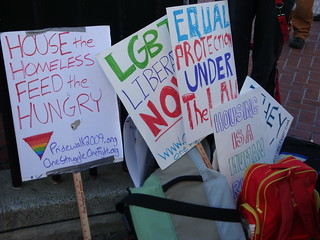
Signs at San Francisco Shine
Signs at San Francisco Shine 2009
PHOTO CREDIT: LarryBobSF flickr.com/larrybob
Some Rights Reserved
Used under Creative Commons License.
In a country that views the homeless as "a problem" and will spend money to install spikes in the sidewalk so they can't find a place to rest instead of offering them food, shelter or counseling, runaway/throwaway LGBT youth and young adults are near the bottom of an already-low pile.  Struggling young mothers and their children garner much of the limited sympathy the public can muster.

Fortunately, at least in some places, this unique need is being met in specific and appropriate ways:
  • The Church of St. Luke in the Fields is located just off Christopher Street in New York's West Village, where many young people (a large number of them either homeless or housing-insecure) gather every weekend.  The congregation responded by creating an event each Saturday night known simply as "the church" which provides a meal, programming, and access to counselors and doctors.  The church would like to expand the mission to a 24/7 drop-in center but is meeting stiff resistance from some of its neighbors.  
  • Another youth center which intentionally engages LGBT youth (although not exclusively) is The Door, which provides a host of counseling, education, and social opportunities in a positive, affirming environment.
  • The Hetrick-Martin Institute, which helped open the Harvey Milk High School in 1985 as a place of refuge for LGBT students to learn in safety, recently added an after-school drop-in center in Newark.
  • In addition, the Ali Forney Center operates a network of shelters and temporary residences, while providing access to health care and counseling. Residents are encouraged to continue their education and secure employment, with the goal of preparing them for an independent and stable future.  Their "get help" page lists resources in many other states.  Several of their facilities were badly damaged during Hurricane Sandy. 

Contributions and other support for all of these projects are always welcomed, and -- in some cases -- sorely needed.

I am mystified and saddened that parents could reject their own offspring on the basis of something as innate as attractional orientation or gender identity, but -- given what our society prioritizes and glorifies -- I suppose I shouldn't be.  In a place where a person can say gays deserve death by stoning and still get elected to statewide office, there are clearly people who agree.  It is equally sad, but unsurprising, that there appears to be a strong correlation between identification as "strongly religious" and rejecting your kids.

In the years since I last visited, the Tenderloin has -- like Times Square -- been sanitized and gentrified.  The coffee shop where we conversed with those young survivors is now part of a trendy chain, and there was scarce evidence of the area's former population.  However, they're still around. A recent article estimated there are 1,000 teens and young adults squatting in abandoned buildings, couch-surfing, or camping in the city's parks.  The Homeless Youth Alliance focuses its efforts on the Haight-Ashbury neighborhood, and acknowledges that the city has long been a mecca for young people seeking an escape.

I will go to bed tonight in a house my great-grandfather built, doubly grateful for a family who has accepted me as I am.  I pray for those who are not so fortunate.

NOTE: Statistics from a 2009 survey by the National Coalition for the Homeless

Thursday, June 5, 2014

Sorry Seems to Be the Easiest Word

I live under a pop-culture rock, and it is only because of his inner-orbit position on the Six Degrees of Channing Tatum that I even know Jonah Hill’s name. But his recent run-in with a paparazzo, culminating in his angrily calling the man a derogatory term for a gay man and commanding him to perform a particular sex act, to me is less about who he is than what he said, the public’s response, and his later reaction to his own behavior.

Hill appeared both on The Howard Stern Show and The Tonight Show with Jimmy Fallon to apologize for his outburst. Calling himself a lifelong supporter of LGBT people, he first claimed that he “didn’t mean it in a homophobic way” but then refused to give himself that pass, saying “I think that doesn’t matter how you mean things... Words have weight and meaning, and the word I chose was grotesque and no one deserves to say or hear words like that.”


The first part is old hat. We have all heard “that’s so gay” as a synonym for “stupid” or “lame” … it gets thrown around quite casually, and -- when challenged -- the default response is “that isn’t how I meant it,” in a tone that suggests that this should just be okay with you.

More extreme epithets like the one Hill used are tossed around by alpha-males like a football in their understanding of good humor, but emerge for others only at moments of anger or stress. He attempted to explain to Fallon’s audience that his behavior was triggered by a prolonged bout of harassment by the cameraman, who was hurling insults at him and his family. He seemed almost shocked, however, by his own choice of words, as if he didn’t know he was capable of saying such things. Either he’s a better actor than 22 Jump Street gives him room to demonstrate, or he genuinely regrets that we all know this about him and was somewhat stunned to learn it about himself.

What I think bears reflection, however, is why is this where (generally male, but not always) people’s brains go in that moment. Hill told Fallon “I wanted to hurt (him) back, I wanted… the most hurtful word I could think of at that moment.” Hill assumed his antagonist was heterosexual, and thus the go-to insult would be to not only imply otherwise, but to immediately then direct him to a passive role, asserting Hill’s superiority over him.

The day after this all happened, The OASIS, the LGBT ministry of the Episcopal Diocese of Newark, marked 25 years since it became the first such outreach authorized by a Christian bishop. The project, established at All Saints Church in Hoboken, N.J. in 1989 by the Right Rev. John Shelby Spong, provided a “safe space” for gay men and lesbians (bisexual and transgender folks were added to the equation later) to worship with their whole selves at a time when this was largely impossible even in a comparatively progressive church.

In his sermon at the event , the Rev. Harry Knox invited the participants to unpack a very similar theme, which is that endemic misogyny is at the root of homophobia and transphobia. If one starts out with the premise that it’s just a little bit better to be male than female, then logically one will look with disdain on a man who seems to reject this privilege by assuming a role and mannerisms you associate with women. And a woman who dares to assert herself and claim authority reserved in one’s psyche for men will be perceived as a threat. Even the gay male community has bought into it, with personal ads peppered with “masc. only” or even “straight-acting” as a selling point.

We can claim to have evolved as a society, and in fact on paper we have. New laws giving LGBT people various rights and protections are passing at a rate which has triggered resignation and even backlash from those who feel threatened by the loss of privilege the status quo might have given them. In many social settings, it is no longer okay to make racist, sexist, or homo- or trans-phobic comments and one can be expect to be challenged for it. There is noise from some quarters that this has gone so far that our collective sense of humor has been lost as a result. I think it is healthy to be able to laugh at ourselves and a little irreverence does help keep things in perspective.

That is different, however, from using words as weapons. Hill claims he regrets his actions, and many of the on-line commenters seem willing to forgive him. I have no reason to doubt his sincerity, but this accomplishes little unless he does the extra homework to examine why, as a self-proclaimed friend of our community, he immediately defaulted back to asserting his hetero-male privilege when the chips were down. If I call someone the name that he did and acknowledge I did so as an act of aggression, that means I have -- somewhere in my psyche -- bought into the idea that this is a bad thing to be, and less than me. And -- unlike what I might say during a carefully-scripted talk show interview -- what I say in the heat of a stressful encounter is raw and pure, closer to the heart.  If I were Mr. Hill, I’d be spending some time with that.

As Luke’s Gospel tells us, “Therefore whatever you have said in the dark will be heard in the light, and what you have whispered behind closed doors will be proclaimed from the housetops.” What we say impulsively lends more insight to what’s really going on inside us than the lines we get time to rehearse.

----
Adaptions of this post were published by:

Saturday, May 31, 2014

For Those in Peril on the Sea

MEMORIAL DAY

The RMS Queen Mary
After a two-day meeting in Pasadena, my friend Matt and I got a lift down to Long Beach for a visit to one of my favorite places, the former Cunard ocean liner RMS Queen Mary, which has served since 1967 as a static attraction and hotel. 

The Queen Mary along with her running-mate* the RMS Queen Elizabeth were laid down in the 1930s with the goal of a two-ship service across the Atlantic.  Since they could make the crossing in 4 1/2 days, it was possible to have a departure in each direction every week.

In practice, it would take another 15 years for this to be realized.  Construction on the Mary was interrupted by the Great Depression for several years, and she finally entered service in 1936, only to be requisitioned by the military when World War II broke out.  The Elizabeth was nearing completion in 1939 when fighting broke out, and her first function was as a troopship.  Capable of moving 15,000 men at a time, the two liners were credited with shortening the war by a year or more.

The ships' role in the war effort is documented as part of the walking tour which is included in the cost of an overnight hotel stay.  They often sailed alone as few vessels could keep up with them.  In 1942, the Mary accidentally struck and sank one of her escort vessels, the HMS Curacoa, with the loss of over 200 men.  She was directed to keep moving, rather than risk far more lives.

In 1948, the ships were returned to Cunard and refitted.  The goal of a weekly express service was finally realized, and the Mary and Elizabeth allowed the line to dominate the transatlantic passenger trade until the advent of the jet airliner led to its decline.  The two ships were replaced by the smaller RMS Queen Elizabeth 2 (herself now also retired) in 1969.  That ship operated alone, spending much of the year off the transatlantic run to perform cruises, and it was assumed for decades that she would be the last liner.  However, a resurgence in interest (brought about in large part, ironically enough, by James Cameron's depiction of the sinking of the RMS Titanic) in ocean travel for its own sake led cruise giant Carnival to purchase the ailing Cunard Line and construct the RMS Queen Mary 2, the largest liner and for a time the largest passenger ship ever built.  My dad and I were aboard in 2004 for one of her first crossings.

The original Queen Elizabeth was briefly targeted to become a hotel in Florida, but was subsequently purchased by Chinese shipping magnate C. Y. Tung and renamed Seawise University (Sea-Wise, C.Y.'s, get it?)  In the process of refit in Hong Kong harbor in 1972, several fires broke out simultaneously and she was destroyed.

The Mary however, was purchased by the City of Long Beach and -- after an epic final voyage around the horn of South America -- arrived at her current home.  Her success in this role has been somewhat checkered, I believe in large part because she is berthed in a remote industrial area which is not walkable from the city itself.

On this particular weekend, however, she was bustling.  Her convention space, carved from what had been the cheaper passenger accommodations and forward engine rooms on the lower decks, was the venue for at least one high school formal, and we encountered bridal parties and business gatherings in addition to what appeared to be a healthy amount of tourists there for the ship herself.

Artwork in the former First Class Restaurant aboard the
Queen Mary.  Crystal models of the Mary and her
running-mate RMS Queen Elizabeth were moved along a
track to show their relative positions as they cris-crossed
the North Atlantic.
There is a good deal of controversy about the steps her various operators have taken to realize a profit.  Only her first class spaces were preserved, and much of her original furnishings are apparently piled up in areas that are not accessible to the public. Since she has now been at Long Beach for longer than she operated as a ship, the accumulated attempts to keep people interested and visiting have led to a number of arguably regrettable choices, such as the "ghost tour" and the fact that there is now a Starbucks on the Promenade Deck.  The thinnest of threads links some of the attractions to the ship's own story (example: the current Lady Diana exhibit).

Among the spaces that retain their grandeur are the Observation Bar, which overlooks the bow, and the First Class ballroom and dining room.  Since these bigger rooms are rented out for private events, it is only by dumb luck that regular hotel guests are able to see them.  Fortunately, on Sundays the latter is used for a ($50!) champagne brunch, and we were able to sneak in as it was winding down and grab some photos.

The Immortal Chaplains


Stained glass window depicting the Immortal
Chaplains, aboard the RMS Queen Mary
One area that is easily missed, but deserves to be seen, is the Immortal Chaplains.  This ersatz chapel was created on A Deck forward by survivors of the sinking of the USAT Dorchester.  This cruise ship-turned-troop transport was torpedoed off the coast of Greenland on February 3, 1943.  Of the 900 men on board, only 230 survived.

The chapel was created to honor the four clergymen who -- after comforting others and helping them to safety -- surrendered their own life jackets and went down with the ship, praying and singing together.

I wondered at first what this had to do with the Queen Mary, and learned that among those who contributed to the chapel's creation were two crew members from the German U-boat that sank the Dorchester.  They were transported to the United States aboard the Mary a year later, and the sub's first officer later said "We, the sailors of U-boat 223, regret the deep sorrow and pain caused by our torpedo.  Never again should be such a murderous war.  We should all live as these immortal four chaplains... to love where others hate."

NOTE: The Mary and Elizabeth are frequently referred to as "sister ships" which is technically incorrect.  This term is only used for ships built off the same plans.  The Elizabeth had two smokestacks instead of three and was slightly larger (and holds the record of the largest riveted vessel ever constructed), but the Mary was faster and always slightly more popular.

Wednesday, April 30, 2014

"... Then You Have No Share With Me"

"I hate, I despise your festivals,
and I take no delight in your solemn assemblies.
Even though you offer me your burnt-offerings and grain-offerings,
I will not accept them;
and the offerings of well-being of your fatted animals
I will not look upon.
Take away from me the noise of your songs;
I will not listen to the melody of your harps.
But let justice roll down like waters,
and righteousness like an ever-flowing stream."
- AMOS 5:21-24

It's days like this that it's embarrassing to be a Christian.

How am I supposed to be a proud member of the institution whose ranks include a woman who compares waterboarding (a brutal form of torture), to baptism, our most sacred and widely-recognized sacrament? 

How am I supposed to seek unity or concord with a self-proclaimed archbishop in our own "civilized" country who -- when pressed -- refused to condemn the draconian new laws in Africa and Nigeria that not only make the simple condition of being gay (which is not something one chooses) a criminal offense punishable by arrest, abuse and (in some places) death, but compels the entire populace to take part in a witch hunt against the same, or face similar mob justice?  

How do I accept the leadership of the titular head of my own church, who would use very shaky evidence of a connection between mass murder in a country torn by civil war and the progress western churches have made on sexual and gender justice, as a rationale for keeping his own province in the past as the country around them moves forward, further cementing its increasing irrelevance?  

How do I explain this to the people I encounter (either LGBT themselves or just  believing in equal rights) who have a deep (and deserved) distrust of religious institutions in general and the church in particular?

The simple answer is, I can't.

I hereby declare myself "out of communion" with those who would use Christ and the Bible as a weapon against those around them. I concede that what is broken between us cannot be fixed. You can't be taken seriously when using "Biblical authority" as a rationale for endorsing continued persecution and murder.   If you don't see the defense of one vulnerable member of the human family as equally important to another, then -- frankly -- I'm not sure what Gospel you're reading, but it's not the one I know. 

Your "Christian cred" is hereby null and void here at the Church of Me if you think sinking to the level of torture is the way to make terrorism stop, and then glorify it by comparing it to the joyful initiation into the Body of Christ.  You cannot wash away another's sins while there is blood on your hands.

I cannot control what my denomination or the communion of which it is part does or says, or fails to.  Archbishop Welby claims that Christians might suffer at the hands of the intolerant if the church continues to move forward.  I fail to recall an instance where Christ promised the road of discipleship would be an easy one.  I am blessed to live in a place where we have grown so used to feeling included that we take it for granted, and a large part of the conversation is reminding those who "got theirs" that there is still work to be done.  I urge my similarly comfortable brothers and sisters to look at the world and the church outside your doors, pick up the rope and help us soldier on.

I only know that -- for me -- I can no longer be at peace with the notion that others identify me as part of an institution that is capable of what I've seen done in its name. I will continue to bore and annoy people by talking about it as long as I have a voice. I wish our leaders would put the radical inclusion that Christ preached ahead of politics and the facade of unity, an altar at which fairness and progress have been sacrificed so many times. I thank God for the opportunity to break bread with prophetic voices like the Rev. Winnie Varghese, the Rev. Canon Susan Russell, Louie Crew-Clay, and Jim Naughton, who have spoken truth to power many times when it was inconvenient or even dangerous to do so.  They are the reason I have found it possible to stay at the table when my head and my heart have told me to walk away.

We have much to be grateful for, and I know on one level that what we are seeing is the inevitable "growing paints" of progress.  But for today, I can't help but believe that the Almighty looks down at our folderol, especially at this time of year, and shakes his head, wondering, "when will they ever learn?"

Friday, April 4, 2014

Where is the Lamb for the Sacrifice?

Martin Luther King - Civil Rights Leader (1968)

I have had a volatile relationship with the See of Canterbury since I joined the Anglican fold some twelve years ago.  Those in my first congregation were no fans of Lord Carey, and thus the election of a Welsh poet to replace him filled this new adherent with enough hope to compose a Mass setting for the Sunday of his coronation.  It is probably terrible, has never been performed again, and -- as one whose "manner of life" apparently posed a challenge for His Grace -- my enthusiasm for Archbishop Williams' circuitous shepherding lasted just about as long, reaching a nadir when he appeared at our own church's convention to strong-arm us into a three-year moratorium on ordaining any further gay or lesbian bishops.  Thankfully, three years later, we remembered we don't actually have a Pope, and went about our business, electing Mary Glasspool.

Thus I greeted the Current Occupant, the Most Rev. Justin Welby, with no particular relish, especially given his corporate background and evangelical ties.  I watched his installation anyway (pleased that he eschewed the term "coronation") and learned a new hymn in the process.

While the Church of England struggles to come to grips with concepts we in the Episcopal Church have (for the most part) put to rest, society in the Kingdom is moving along without them.  Last week, civil marriage equality became the law of the land in England and Wales.  Even Her Majesty has gotten in on the fun, and the church -- somewhat grudgingly, I suspect -- issued a statement dropping resistance to the inevitable.

So I was somewhat knocked over today when I learned from the President of Integrity (the LGBT ministry of the Episcopal Church, of which I am a board member)  that his Grace, in the midst of a radio interview, basically said the CofE can't move ahead on LGBT issues because -- if they did -- African Christians would die.


"Scapegoat at Holy Trinity: Southport"

PHOTO CREDIT:  Julia (flickr.com/loscuadernosdejulia)
Used under Creative Commons License
In response to a listener's question about the Church of England's reluctance to allow its clergy to exercise their consciences on blessing same-sex relationships, the Archbishop cited the impact on the church's decisions on Christians in other parts of the world. He went on to describe standing at a mass grave in South Sudan earlier this year and being told that the victims were killed "because of something that happened in America."

While the Archbishop did not elaborate, in the context of the conversation it is difficult to imagine that "something" as anything besides the progress that American churches, and ours in particular, have made in the inclusion of LGBT people and recognizing their relationships.

In the absence of any clear evidence of a direct connection, it strikes me as irresponsible at best and dangerous at worst for a religious leader to link this tragedy and the actions of a relatively small church on the far side of the globe, amid a civil war, sectarian violence and other local perils, and use it as precedent to deny the church's blessing to the faithful same-gender couples who seek it. 

My particular mission is to minister to and protect the lesbian, gay, bisexual and transgender people, both those within the church and those who need its care. Thus I feel compelled to remind the Archbishop and the church that – even if this vague correlation is based on fact – anti-LGBT violence directed at non-LGBT people is still anti-LGBT violence, and it is still wrong. If we capitulate to it by denying rights to LGBT people in other places, the violence will not go away. Instead, we send the message to the church and the world that if you bully us, we will back down, thus inviting more of the same.

This whole event comes shortly after two African countries in which the Anglicsn church has a strong presence (Nigeria and Uganda) passed draconian new laws  which criminalize those known or suspected to be gay, as well as those who fail to turn them in.  The Archbishop's alarmist statement today comes in the wake of a far more muted one when his peers in those countries expressed enthusiastic support of the new laws, despite reports that LGBT people were already being subjected to violence. 

I remembered -- guiltily -- well past cocktail time that today is the feast of Dr. King (we observe our "saints" principally on the anniversaries of their deaths).  If I know one thing about his work, it is this: When you take a stand against the status quo, someone -- generally the person who is benefiting from the status quo -- is going to make noise.  They may threaten, they may even harm.  But that risk cannot be enough to make us fail to stand up for what we believe in.

Dr. Welby would apparently have the LGBT members of his own church give up their own full participation therein at the altar of a great and unproven "what if." I learned there was only one sacrificial lamb in our theology, and that part has been spoken for.

In the 150 egg-faced  years since we -- by and large -- sat shamefully by and watched emancipation happen around us, it seems my church has learned a few things about justice and equality. I wish I could say the same for our friends across the pond.

Wednesday, March 5, 2014

Find the Cost of Freedom

ASH WEDNESDAY

“Hey, are you Polish?”

The question, though incongruous from a stranger as my two friends descended a busy staircase into the West 4th Street subway station, seemed innocent enough, and -- in fact -- one of them is.

The next question was even more out of place, although the intent was not immediately clear: “Are you faggots?”

My friends report that at first they thought the stranger was kidding around; an inside joke on the gayest corner of the gayest city east of Mrs. Madrigal. There has been much debate in the “community” over whether we should neutralize the venom of that word by playfully throwing it around, much as another two-syllable word has been co-opted by some of those against whom it was used. We know people who do that, with that word. The stranger had an accent, and sometimes people from other places use words differently than we do, and they were a little buzzed (they were, after all, celebrating their tenth anniversary). In a city they know well, and -- a mere block from Stonewall on a Saturday night -- they had no reason to be particularly wary.

So they said yes.

What followed happened so quickly that they struggled to recall it in detail… to the doctors, to the cops, and then to me. In a nutshell, the stranger did not like that answer, and he made that brutally and physically clear, while a station platform full of people fixed their eyes back on their phones and did nothing, said nothing. The birds are angry. Can you blame them?

Eighteen hours later, my friends finally made it home, having been up almost all night retracing their steps, paging through mugshots. One of them required stitches near his eye and may need surgery for facial fractures. They are both stunned, angry and sad. The city whose welcome we have come to take for granted now feels like a house that had been robbed.

mark_carson_protest_DSC_0209
Protest in Greenwich Village after Mark Carson's murder

PHOTO CREDIT: Michael Fleshman
Used under Creative Commons License
Even as crime drops precipitously in the city and marriage equality comes to a new state seemingly every other week, two groups of people have increasingly found themselves the targets of violence and rage: gay men and transgender women. We are not just being called names or getting black eyes. In May of last year, a young man named Mark Carson was shot dead just blocks from where my friends were attacked. In August, an aspiring fashion designer named Islan Nettles was beaten on a Harlem street, right across from a police station, later dying from her injuries. Although multiple people identified her attacker, the charges were later dropped. Another man was attacked in an East Village subway station just three weeks ago. In all these cases, the perpetrator hurled homophobic and transphobic remarks at his victim.

My friends know they are lucky that what happened to them wasn’t worse. They are home eating soft foods because it hurts to chew, but they are alive. The police and doctors took their report seriously and told them they had done nothing wrong. We can be grateful: this would not have been the case thirty years ago.

As I write this, an invitation to a male couple’s wedding, which will be valid in the eyes of the church and the state, sits on top of today’s mail. My straight friends treat my partner and me like members of their families, and their kids say “uncle and uncle” without even puzzling at that idea. I think they would find a rotary phone more confusing.

It is clear, however, that some around us remain so threatened by the evolution of our rights and the normalizing of our place in the culture that the only way they can reassure themselves of their power is by lashing out: with words, with fists, with bullets. The rash of Jim Crow-evoking legislation that popped up around the country in recent weeks, was -- while failing to become law -- still successful at reinforcing the us-and-them mentality that drives such paranoia in some quarters. We can celebrate how far we’ve come, but if we let ourselves believe for a minute that the struggle is over, it is at our peril.

“It's unfair to be called a faggot your entire life; however, the slur becomes most dangerous when you let it no longer faze you.”
- PAUL FLORES

Wednesday, January 1, 2014

Saving the iGays

"For it was you who formed my inward parts; you knit me together in my mother’s womb. I praise you, for I am fearfully and wonderfully made. Wonderful are your works; that I know very well. My frame was not hidden from you, when I was being made in secret, intricately woven in the depths of the earth. Your eyes beheld my unformed substance. In your book were written all the days that were formed for me, when none of them as yet existed."
 - PSALM 139: 13-16

 FEAST OF THE HOLY NAME OF JESUS

I have been fussing at my better half for the past week that we do not have exciting New Years' plans.  We will be ringing it in at his brother's house, on the couch with Ryan Seacrest while our nephew shows off his Christmas loot.

There is nothing wrong with this, of course.  We are generally not "partiers" these days, and New Years in a bar (or -- as my friend Tony called it -- "amateur night") is frequently overpriced and generally populated by people who are trying too hard to convince themselves and those around them they're having an amazing time.

However, my observation from astride a bigger elephant in a smaller room, which is that -- for a certain wedge of the gay male culture pie -- every Saturday night is New Years' Eve. I get weekly email invites from every DJ and promoter I ever met, trying to convince me that their venue is the place to be.  There are people whose job it is to go around and photograph people at these weekly parties and post them online and in Time Out and free bar magazines like Next.  You are of course supposed to be sought out to pose for these photographs (what my friend John, who records/performs club music as Jipsta, calls "giving red carpet") and there are men who scan these pictures eagerly over brunch the next day to see if they or their friends made the cut.

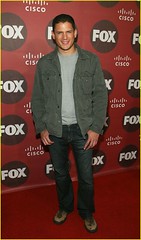
Wentworth Miller - Michael Scotfield
Wentworth Miller gives red carpet
I was never more than at the fringes of this world. You only have to look at the images that it produces to know that there is a pecking order, and that you need to look a certain way to be taken seriously.  I learned the truth at seventeen: You can gym up, wear the "right" clothes of the moment, and raise your stature a little bit, but if your physical dimensions and the shape and placement of your facial features are not within a few millimeters of the airbrushed "ideals" set by the likes of Wentworth Miller, there is an inner circle of fabulosity that will forever remain out of reach. In the event that you mistakenly cross the class boundaries, this world is populated with enough young men who fancy themselves as an extra from Mean Girls, who will helpfully direct you back to your rightful place. Further, the mandatory retirement age is distressingly young, although I know men who have resorted to Botox, hormone therapy and other means to stay "in the game" a bit longer. 

This is, of course, not new: the Village Voice personals in the 1980s could be pretty specific. In his 1983 novel I've A Feeling We're Not in Kansas Anymore, author Ethan Mordden creates a character named Harvey Jonas, whose raucous public persona is -- he reveals -- a mask behind which he hides a deep loneliness, brought about by a keen understanding of the looks hierarchy.
"Everybody talks about power, but everyone wants beauty.  It's sad, because you can acquire power, but you can't acquire beauty. Do you know why everybody wants beauty?  Because beauty is the only thing in the world that isn't a lie."
What is new, and somewhat disturbing, is the way that technology has impacted the gay male social scene, and it is enough to make me glad to be out of the dating game.  Traditional matchmaking strategies, and -- to a certain extent -- even the bar scene have been largely supplanted by smart phone applications which enable men to -- by means of GPS -- locate potential mates in their immediate proximity, with only a photo and a handful of characteristics and preferences to differentiate themselves.

“We are an un-community. We have become a consumer product. We are the iGays. We have lost our souls. And we don’t even know it.”
- ANONYMOUS
What was once at least a perfunctory opportunity to get acquainted has now been reduced to a quick scan of acronyms and statistics.   One quickly learns you need to be "VGL" (very good looking) and "Masc." (figure it out) and be able to prove it to even get a reply to your hello. Exacting standards of age, ethnicity, body dimensions, quantity and placement of body hair all help weed out undesirables.  Intimacy becomes a transaction from which you can be excluded simply for not filling out the paperwork properly.

We do like convenience, however, and the popularity of these applications is evident by their prominence in media and culture.  A recent meningitis scare in New York was cited to be largely spread by contact with others met via smart phone "hookup".  They have also played a factor in the decline in the number and quality of places for gay men to meet in person and actually socialize.  And what men are still going out do so with phones in hand, in case Mr.-Right-Now isn't in this bar, but the one next door.

Not everybody is happy about it. An Australian man who blogs anonymously writes:
"I came out in 1993, in Sydney, to a gay scene that was vibrant, colourful, out and proud. Here I sit not twenty years later, and the community has been decimated by the Internet. Completely, utterly decimated. As a whole, gays everywhere have become a sick group of animals who have completely lost their ability to interact on any authentic level, who have fearfully squashed themselves into simplified categories of drop-down boxes, and who banish entire groups of their own kind based purely on unwanted physical characteristics that do not fit the Gay-For-Pay Porn Model Image. We demand equal rights, but treat each other like sub-human animals, and worship the Straight Man as God-King."
For those of us mere mortals who don't get chased through the mall by modeling school reps, the odds are not good. Any endearing personal characteristics one might have -- a charming laugh, graceful conversation skills, a subtle or biting wit -- never get the chance to be experienced because the unseen panel of judges has already dismissed you on a technicality like the "wrong" eye color or the five extra pounds that came from binge-watching Orange is the New Black the same week that Starbucks brought back the pumpkin spice latte.  And even if you do actually get to meet in person, don't count on a second date.  "NSA" (no strings attached) is generally the intent.

The psychological effects on an already fragile population are not surprising. Our blogger laments:
"I have never felt more ugly, unworthy, and disgusting as I feel now. I have become so acutely self-conscious and lacking in esteem that if I actually venture out (despite this having become a pointless expedition of being ignored and judged, and watching small groups of gay males ignoring other small groups of gay males), I’m too uncomfortable to even dance anymore. I have no joy left in my life, because I have lost hope that I will ever share my life with another person."
He is, as it happens, an atheist.  From his biography, I suspect that any suggestion that he is loveable and beautiful in the eyes of God will be met with a dismissive eyeroll emoticon, and a chiding about invisible-man-in-the-sky fantasies to which we're already accustomed.  Which is a shame, because he is part of a population that desperately needs to hear they are in fact worthy of love.  Our tradition is full of flawed, neurotic men with questionable style and grooming habits who somehow managed to find companionship, fight injustice... even save nations.  Surely we have room for a few more! Our congregations can and should be communities where LGBT men (and women, although this looks-above-all nihilism appears to be a principally male trait) of all descriptions can be reassured of their worth in a world that frequently tells them otherwise, and where the opportunity is there for healthy, mutually-sustaining relationships of substance to form.

The church saved me in this way.  It was through seeing LGBT people, few of them actual supermodels, being uplifted by their parishes at a time when few others in society were doing so, that I knew it was possible that I was home, and I subsequently met my partner through the church. Ten years in, our extended "family" has seen us through joy and loss, and I was recently privileged to stand up for the wedding of another couple who have become dear friends. 

For the most part I have left the party world behind, and that is okay. Yes, I may have groused about not going out on New Years' Eve, but I love what my life has become, and I want that same feeling of belonging for my brothers out there in the dark, staring at their phones.

Seacrest out.

Monday, December 23, 2013

Walking on Water

So Peter got out of the boat, started walking on the water, and came toward Jesus. But when he noticed the strong wind, he became frightened, and beginning to sink, he cried out, “Lord, save me!” Jesus immediately reached out his hand and caught him, saying to him, “You of little faith, why did you doubt?” When they got into the boat, the wind ceased. And those in the boat worshiped him, saying, “Truly you are the Son of God.”
MATT. 14:29-33

We spend most of our Florida vacation within site of the Gulf of Mexico, but -- with the exception of our eight-year-old traveling companion -- most us us limit our actual immersion to splashing around right in the fairly miniscule waves.  

Last winter, the proprietors of a surf shop a few blocks from our rented house caught my attention with a strange contraption that looked like a cross between a surfboard and a kayak.  You stand on it like a surfboard, but -- rather than skimming on the crest of a wave, you paddle it like a boat.  Though I am about as graceful as a drunken giraffe during an earthquake, it looked like fun, and I wanted to try it. By the time I got the nerve to talk to them about it towards the end of our stay, the wind and currents had picked up and made conditions unsafe for a beginner.

That's me!
Since then, I found out this "has been a thing" since 2005 when it came over from Hawaii, but really took off in the past year or so.  Several friends have used them on northern New Jersey's lakes. People's little kids were doing it. A senior citizen with an enviable torso glided past us on one right near the water's edge during one of our daily walks. I was not going to miss the opportunity again this year!

So midway through our trip, I marched myself over to the languid youth guarding the pile of  equipment on the beach.  He has a cake job at this time of year, before the snowbirds and college kids arrive, we shared the beach with only a few other people so he mostly has to sit there and hope someone wants to rent something.

There were no lessons... after about a five-minute description of what to do, he dragged one of the boards into the water and guided it past the breaking waves.  I flopped onto it, managing not to go off the other side, and followed his advice to start out kneeling until I got more confident with my balance.  After five or ten minutes, I tentatively got to my feet and lasted a few minutes before flying off into the drink.

Unperturbed and glad I had not yet made it to where my friend Linda was waiting with a camera, I scrabbled back onto the board and tried again.  Before long, I was standing more than kneeling, and getting used to the sensation of trying to balance on top of a giant pan of Jell-O.  I am proud to say I didn't fall again, and made my way slowly up and down the beach, hoping the wake from a passing speedboat wouldn't send me flying right when I was in range of my intrepid news photographer.

By the time my rental hour was over, my quads were like rubber bands, but I was hooked.  I can understand how this is the Outdoor Industry Association's reported #1 new sports activity for 2013.  I also think it will help me in the gym, since it requires constant engagement of your core muscles and awareness of how you are distributing your weight.

Speaking of weight, I cringed when I saw the photos. I hate pictures of myself to begin with, let alone shirtless ones, and studying for the Project Management Professional exam plus some medical issues meant it was not a very outdoorsy summer for me! Hopefully I can find more chances to "SUP" next summer which will help counteract too much computer time.

"I feel pretty, o so pretty"
At the end of our week on the beach, we headed to Busch Gardens in Tampa for a day before flying home.  I was kind of amazed how in-your-face Christian the Christmas (clearly not Happy Holidays here!) decorations and music were.  But my point (yes, there was one!) of mentioning our visit there was that we saw a hippopotamus swimming underwater.  This huge animal, which lumbered slowly around its enclosure on land, was positively as graceful as a dancer as it moved through the tiny fish and plants that surrounded it.  Similarly, as uncomfortable as I was with the sight of my pale, flabby self, there was none of that while I was actually cruising, albeit slowly, on top of the waves.