I'D LOVE TO HEAR FROM YOU

Comments, criticisms, or (one can hope) compliments are more than welcome! Please let me know what you think, tell me I'm crazy (I suspect this) or what you'd like to hear about. Comments are screened before publication, so if you want to share something with me only, just put that in the comment and I'll keep it to myself.

THANK YOU FOR VISITING!

Wednesday, November 11, 2015

Holocaust Survivor Helen Paktor: "I Wanted to Live."

Twenty Fourth Sunday After Pentecost
Kristallnacht (1938)

This was a weekend of broken glass.

On Friday, one of my friends made us a wonderful dinner. Roast chicken, haricorts verts sauteed with garlic and lime, and a whole tray of yams baked over shredded coconut. He treats us to feasts like this quite often, as do many of the gifted cooks we know, probably because they know we are not that handy in the kitchen. 

As he was cleaning up, the pan, slick with sweet syrup, slipped from his hands and crashed to their new tile floor, exploding into a million pieces.  The floor survived, but I wasn't sure if I was sadder about: the pan or the loss of those leftover yams!  We hurried to clean it up before their dog accidentally stepped on some glass or--worse--tried to lick up the mess.

Yesterday, another celebration, other friends' son turned ten, and a houseful of people with more food and drink than we could safely consume. "I always have nightmares that there won't be enough," she once confided in me. Later in the evening, while a few of us were making some music, someone accidentally dropped a drink. CRASH! More shards everywhere, and a puddle to clean up.

Today, however, the broken glass existed only in the abstract.  My friends at St. Peter's Episcopal Church in Clifton, N.J. chose the 77th anniversary of Kristallnacht "the night of broken glass" to observe their annual remembrance of the victims of the Holocaust by inviting Helen Paktor, who survived that experience, to speak to us.
Helen Paktor (right) with her daughter
Jeanette Mahler and Dr. Jacob Lindenthal
PHOTO CREDIT: Dr. Jacob Lindenthal

The talk was introduced by Dr. Jacob Lindenthal, who serves a professor in the Department of Psychiatry at Rutgers New Jersey Medical School in Newark.  Dr. Lindenthal interpreted for us a series of photographs he took at Auschwitz.  Coming from a family who lost loved ones in the camps, he recalled shaking with emotion when seeing the railroad tracks leading into it, to the point where he dropped one of his cameras, a vintage Leica.  He described meeting Helen Paktor, the guest of honor, during the last year and developing a strong kinship based on their mutual experience of loss.

Helen Paktor was born in Tarnow, Poland, in 1925.  Her parents worked in the dressmaking industry for which the area was known. She was 14 when German troops invaded her town, rounding up her family among the other local Jews and herding them into the city's ghetto, where they were subjected to forced labor and unprovoked violence, while their homes were pillaged. Her father  was killed, and she and her mother were separated from her brother and sent to the first of three concentration camps.

Helen told us matter-of-factly about how the prisoners were treated. Brutality was a daily occurrence, and there was the constant white smoke from the crematoriums.  They were forced to work 10-12 hour days on just crumbs of bread and "soup" that was little more than hot water. Helen and her mother were lucky to be together, as they helped one another survive. She told us of sleeping top-to-toe so they could warm one another's frostbitten feet under their arms.  On their third encounter with "Doctor Death" Josef Mangele, who personally inspected prisoners' left arms to see if they retained enough muscle tone to be fit for work, Helen was worried her frail-looking mother would be singled out for execution, so--by prior arrangement--she "stumbled" forward and pushed her mother, creating a distraction. 

The ploy worked, and both women lived to see the day Soviet troops liberated the camp. The guards had actually abandoned it ahead of the advancing army, but electrified the gates to prevent the prisoners from escaping.

Helen and her mother returned to their hometown and she tried for years to locate her brother, traveling as far as Italy, only to discover that he, too, had been killed.  They emigrated to America in the 1950s, her mother first, then Helen a year later.  She married and had two children, and lives in Livingston today.

The range of questions people ask Helen is amazing, and unfortunately in some cases reveals the ignorance that many Americans have about this dark period in human history. She does not mince words in her replies.  When asked how she responds when she learns about Holocaust deniers, Helen pointed at the numbers tattooed on her arm and asked "Why would any sane person do this to herself?"  A young man once asked if that was to help her remember her address.  She said no, it was to help him remember what the Nazis had done.  She was also asked if she'd consider having the tattoo removed since it was a constant reminder of the horrors she had witnessed and endured. "As if I needed a visual to be reminded."  Someone else asked, "Did you ever consider suicide in the camps?" She looked us for a long moment before replying firmly, "No. I wanted to live."

Understandably, there is still much anger in Helen's voice when she talks about the Nazis. She testified at a trial in Munich for some camp officials, but said very little was done to punish them.  According to Lawrence Rees, author of Auschwitz, A New History (2005) only 12% of the camp's 7,500 staff were ever brought to justice, and many of the sentences were trivial.

Helen brightens when discussing the heritage and contributions of the Jewish people. She shared that--despite being about 1% of the world population--Jews have won 22% of all Nobel Prizes. It is important to her that this history and heritage is passed down.  She  spent time last year with a young man named Andy Antiles as part of his preparation for Bar Mitvah. Andy writes about his experience here.  

Helen's daughter Jeanette was with her at today's event, and they both expressed profound gratitude for the expression of humanity offered by the people of St. Peter's. They were  moved to tears by the choir chanting the ancient Hebrew prayer "Ani Ma-Amin" ("I Believe") during the morning's Eucharist, which was Helen's first time attending a worship service in other than a synagogue.

In conclusion, Helen read aloud from an essay "Concerning the Jews" written by Mark Twain and published in Harper's in 1897. Twain who--having just spent time in Austria--perhaps saw the signs of what was to come.

"The Egyptian, the Babylonian, and the Persian rose, filled the planet with sound and splendor, then faded to dream-stuff and passed away; the Greek and the Roman followed, and made a vast noise, and they are gone; other peoples have sprung up and held their torch high for a time, but it burned out, and they sit in twilight now, or have vanished. The Jew saw them all, beat them all, and is now what he always was, exhibiting no decadence, no infirmities of age, no weakening of his parts, no slowing of his energies, no dulling of his alert and aggressive mind. All things are mortal but the Jew; all other forces pass, but he remains. What is the secret of his immortality?"
At age 90, Helen's continued strength of spirit is a clue to that secret.

Abridged versions of this post were republished in the Voice of the Episcopal Diocese of Newark, and in the December 2015 edition of The Episcopal Journal.

Monday, November 9, 2015

Keeping Persecution in Perspective

Kristallnacht (1938)

This morning's groggy scan of the Face-space feed revealed that the annual "Keep-My-Christ-in-Your-Christmas" sanctimony has--like the onslaught of reminders to get out there and shop--crept yet earlier. I'm convinced that in my lifetime we will start seeing ads for next Christmas before this Christmas is over.  Of course the important season of Advent gets completely lost in the tide, but that's a rant for another day.

This time the outrage de l'année is because That Omnipresent Coffee Company -- having dispensed its last not-actually-pumpkin spice latte for the year--has gone with a plain red motif for its disposable cups during not-really-peppermint season.  That's right! No Santa Claus, no tree, and, shamefully, no Baby Jesus, surrounded by adoring animals.  So you must boycott, and you must tell everyone.  Because this is a Christian country, by golly, and we've got to make sure nobody forgets!

The irony that this is being held up as an example of "religious persecution" on the 77th anniversary of Kristallnacht simply cannot be overstated.  More on that later today.

The fact that this is getting any traction whatsoever suggests American Christians as a group have become so warped by privilege, that we confuse any thwarted attempt to impose our beliefs on the greater society as "persecution".  And let's be clear. It's not like Allyourbucks used to have Christian images on their cups and abruptly took them away.  If you want to be outraged at them, why not check out their resistance to label GMO ingredients on their products, or the fact that we're still using so many throw-away cups at all?

The Rev. Emily C. Heath summed up my reaction so well that I was hesitant to write about this topic at all:
"Do you think Jesus would rather we remember his birthday by putting it on a coffee cup that’s going in the trash? Or would he rather we remember it by no longer treating one another as disposable?"
I could not say that any better, and I commend her entire post to you. I actually lament the commercial bonanza that Christmas has become, and the fact that--to get us in the mood to spend--we're surrounded by saccharine schlock so early so that we're sick of it by the time the actually holiday  arrives. But any one of us could choose to walk away from all that and observe the season--or don't--however we please.

I did, however, resort to arcane sacristy-rat humor to further point out just how ridiculous this whole manufactured snub truly is:

A Proclamation to the Outraged:
The Feast of Christ the King not being for several weeks, and thusly the season of Advent to follow, any talk of red cups (other than for the movable feast of Beer Pong) is verily premature.

Ye are reminded that the acceptable and orthodox cup choice of the day remains consistent with the weeks After Pentecost, known by our Roman friends as Ordinary Time.

This message (was not) brought to you by the Homer Laughlin China Company, manufacturers of Fiestaware. With Fiestaware, there's no excuse for sloppy orthodoxy on your table!

Friday, September 18, 2015

Whoever has ears to hear, let them hear

I was struck this week by two passages we read in my Education for Ministry seminar, both quotes of Lloyd Steffen, Chaplain at Lehigh University in Philadelphia.

The first is to do with listening.  How often have we been speaking to someone and realized from their body language or their response that they were not so much listening as waiting for their turn to talk? How often have we realized someone has asked us something and we don't know what it was because our mind was somewhere else?  Steffen suggests there is more to this than laziness or narcissism:
“The ability to listen depends not in the first place on any particular skill or technique, but on a fundamental respect for one’s partner in conversation. Listening is thus a moral act. Listening is an act of attending to the other that discloses the strangeness of otherness, disrupting our comfortable self-images and threatening to undo our everyday experience of ourselves (and others) as familiar and basically unified personalities. Not listening becomes a way of securing ourselves from encounter with the mystery of otherness. Listening exposes us to our own desires not to want to share of ourselves. Listeners are required not only to welcome the strangeness of the other but to risk self-disclosure in the act of listening, for the listener must at some point recognize and then expose to the other his or her own strangeness—and not only to the other but to one’s own self.”
This can be damaging enough on the interpersonal level, but what about what is going on in the universal church? The recent discourse around what constitutes "religious freedom" in a pluralistic society demonstrates what happens when Christians can no longer count on the privilege of assuming the political and social norms are in line with their own... or even that their fellow Christians will agree with them on what those norms should be.  How do we find a way forward when we can't even hear one another above the noise in our own heads?
“We are in need of a theology of listening, for a willingness to listen ultimately expresses an attitude of love. Christians believe that Jesus listened to God and to those he encountered in his daily life. We do neither. If we listened to one another we should be inviting one another into new forms of relationship based on openness and respect and a willingness to share ourselves. If we listened for God, we should spend our time not praying for ourselves but listening to our prayers to see what we are saying not to God but to ourselves. The heart is a great mystery. Christians believe that God knows the human heart (and we do not), for that heart is where God’s omniscience lies. God does not need to be informed about our wants and needs. It is we who need to know what we want, what we fear, what we love.
The bolded bits struck me particularly. We have all been the recipient of mass prayer requests for this or that cause, generally with a specific requested outcome. Pope Francis recently decried the notion of God as magician... how is one left to feel when one's request is not granted?

When you agree to pray for a third party, what are you really doing beyond repeating the obvious desired result (wellness, a job offer, etc.)? Is it like opening multiple trouble tickets for the same problem, where your wish might get granted because it seems to be popular?  If non-believers see our notion of God as a cosmic suggestion box, for which we'd have only ourselves to blame, it is small wonder that they don't take people of faith seriously; it would be a very simplistic, childish view of a god, and difficult to defend when things don't turn out according to the script.

So should we stop praying for those people?  Certainly not. We agreed that a more beneficial form of prayer is to reflect on the situation and our own response to it... how can we "be Christ" in the situation for the people affected?  Knowing that giant unseen cheering squad is out there certainly can have a positive effect on a person's state of mind, the impact of which in situations requiring confidence and healing should not be understated.

If nothing else, we can pray to become better listeners.

Tuesday, July 7, 2015

Requiescat in Pace: John Maxtone-Graham

JOHN MAXTONE-GRAHAM LECTURES
ABOARD QM2 IN HIS TRADEMARK KILT
(MY PHOTO, ALL RIGHTS RESERVED)
I was saddened to learn yesterday of the passing of maritime historian and author John Maxtone-Graham, many of whose books about passenger ships are in my collection.  Peter Knego, who operates the popular site Maritime Matters, said in his obituary that "Mr. Maxtone-Graham’s poetic style of writing and his charismatic onstage manner were an inspiration to generations of fans of ships and the sea.  His breakthrough The Only Way To Cross, when published in 1972, was one of the first non-Titanic books to capture the essence of the ocean liner."

John possessed an encyclopedic knowledge of ocean liners and cruise ships, and delivered it--both in writing and at speaking engagements--with grace and humor.

One of my favorite of his tales describes an incident one night aboard the Bergensfjord of the Norske Amerikalinje (Norwegian America Line) in the 1960s, captured in his 1985 book Liners to the Sun

A woman, after having caught several garments on a protruding screw in her cabin panelling and forgetting to tell the steward about it, decided to fix it herself.  She couldn't get the screw in any further, so she took it out instead.  Just as she removed it from the wall, the Bergensfjord was struck by a tsunami and heeled violently to port, throwing people and contents to the deck.  Until she learned the cause of the accident, she was secretly terrified that her meddling with the ship's infrastructure had somehow triggered it.

John and wife Mary were frequent passengers as he was often called upon to give lectures on board, particularly for maiden voyages and others of historic significance. Whether in suit and tie or his trademark kilt, he struck a distinguished and gallant figure.

My father and I had the privilege to hear John speak several times as the RMS Queen Mary 2, flagship of the storied Cunard Line, made her inaugural crossing from Southampton, England, to New York in 2004. Despite the number of ship enthusiasts and industry names on board, I somehow ranked to have breakfast with him, and he patiently endured a tour of the amateurish design I had created for a ship like the QM2 before Cunard had the funds or the will to do so themselves.  My copy of his coffee-table book about that ship bears both an inscription (in which he amusingly took the heat for smudging his own signature) and a stamp commemorating the fact that our encounter took place during that historic voyage.

MY MEMORABILIA FROM THAT VOYAGE INCLUDES JOHN'S INSCRIPTION IN
THE COMMEMORATIVE BOOK, AND HIS APOLOGY FOR SMUDGING IT.
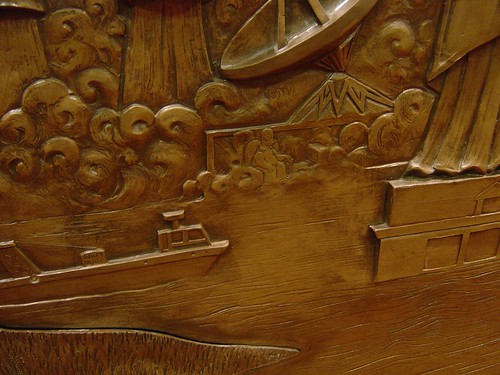
One amusing piece of trivia:  John's son Ian Maxtone-Graham is one of the brains behind the TV series The Simpsons, and--hidden among the details of a faux-bronze relief along a companionway on the QM2's lounge deck--the sharp-eyed can spot Homer among the mythological figures and wonders of creation.

Homer Simpson hidden in the Queen Mary 2 (QM2) Hallway Panels
HOMER SIMPSON AMONG THE MARVELS OF THE EARTH ON A FAUX-BRONZE RELIEF
ABOARD THE RMS QUEEN MARY 2.
PHOTO CREDIT: GARY BEMBRIDGE.  USED UNDER CREATIVE COMMONS LICENSE.

While the movie Titanic takes some credit for the renewed interest in the golden era of ocean liner (which spanned from roughly 1890 til 1960, when jets began carrying the majority of passengers across the Atlantic) it is writers and historians like John who make sure this unique era is thoroughly and engagingly documented for generations to come.

Friday, June 19, 2015

Charleston

Thus says the Lord:
"A voice is heard in Ramah,
lamentation and bitter weeping.
Rachel is weeping for her children;
she refuses to be comforted for her children,
because they are no more."
Thus says the Lord:
"Keep your voice from weeping,
and your eyes from tears;
for there is a reward for your work."

Says the Lord:
"they shall come back from the land of the enemy;
there is hope for your future."
Says the Lord:
"Your children shall come back to their own country."

- JER. 31:15-17


I'm hesitant to even comment on last night's news that nine members of a A.M.E. church in Charleston, S.C., were shot by a 21 year-old man who spent an hour participating in their prayer meeting before pulling out a gun and opening fire, reloading several times and continuing to shoot people despite pleas from the crowd to stop.

I have no business saying anything. I don't live there. I don't know these people. I can't pretend to know what it's like to be subjected to the kinds of subtle and overt aggression that people of color face, particularly in a state where symbols of a time when enslaving other people was acceptable are displayed on public buildings as a reminder that there are people among them, including people in positions of power, who wish it was still the case.

And yet I will.

I will because--if it was me--I would want to know that others felt devastated, too.

I will because it will never, ever be okay with me that my actions, or lack of actions, contribute to a society where one group of people is "more equal than others".  The older I get, the less comfortable I am with the idea that I can manipulate how I am treated by my appearance in a way that others cannot, and that assumptions will be accordingly made, privileges granted, opportunities extended.

I will because, despite that, I know all too well how it feels to have adjectives applied to you that you didn't choose, other assumptions made, and privileges withheld, because of a biological trait over which you have no control, but for which you should have absolutely no reason to feel ashamed.

I will because we all bleed red, and whether you are Caucasoid or Afro-Caribbean or Hmong or Coeur d'Alene, you are entitled to feel safe in your house, at your place of worship if you have one, or on any street in America, because your kin fought and died for that just as mine did, and I have no more right to that feeling than you do.

I will because I, and my sisters and brothers around the planet, meet in places very much like Emanuel with people we don't know, and offer them whatever comfort we can with the thought too frequently in our minds that something like this can happen.  And yet we do it anyway, because can you imagine what kind of a world it would be if we gave into our fear, and stopped?

I will because there are people whom I love who work in law enforcement, and i want desperately for the things I believed about members of law enforcement as a child to be, without exception, safe things for a child of any color or upbringing to believe. I am grateful for the men and women in blue, along with civilians, who put their lives on the line to swiftly apprehend this shooter.

As old as I am, I am still naively optimistic on most days that these things are possible and we will someday reach that promised land.  There is an expression I love, whose rightful authorship I have not been able to pin down: "We ain't what we could be, we ain't what we gonna be, but at least we ain't what we was."  I believe that, and I have to believe the arc of history will continue to lead us forward.

But today I'm just heartbroken.

Tuesday, June 16, 2015

Too Many Flags to Fit

 “A boy like that will kill your brother
Forget that boy, and find another
One of your own kind, stick with your own kind”
- WEST SIDE STORY

This Sunday was Flag Day in the U.S. We have an enclosed porch with the ability to fly eight flags, which I do only on special occasions. Besides the American and Episcopal Church flags, which I fly on most nice days, I have a bunch of others, representing my partner’s and my varied ethnicity, places we’ve been, and some (like Wales) that I just have because visually it’s a cool flag. I have a vague sense of the major holidays in these various countries, as well as seasonal fillers to trot out when appropriate. We may the only people in New Jersey with Mardi Gras flags, for example, but I have attended the real thing in Louisiana many times and think observing it with gusto is a great way to usher in Lent.


Since my youngest sister married, it occurred to me that — just among my siblings and our partners — we now don’t have enough spaces to represent everybody’s background completely. Besides our own Italian, Lebanese, and Polish roots, some of which our spouses share, we have connections to Germany, Peru, and various British isles. I guess we can’t have everybody over at once, or someone’s going to feel slighted when they pull up to the house.

With that in mind, I saw with pleasure that a blogger whom I discovered recently, Joe Kay, had a piece from last year republished today by Sojourners. From This Day Forward… or Backward” starts out by describing the pressure Kay experienced from his family to marry someone just like them: Eastern European and Catholic. There was a tremendous fear that “the old ways” would be lost if this purity was not preserved. As he put it:
“To so many people, my relationship wasn’t about finding someone who fit me — it was more about me finding someone who fit them.”
My family has one pretty homogeneous narrative: my mother’s mother’s mother came from Poland as a teenager, quickly married a Polish man, and lived for most of her life in Greenpoint, Brooklyn, where it was (and may well still be) possible to get by while speaking and reading only Polish. When my grandmother was of age, she also married a Pole, and her two siblings who married did likewise (in fact their spouses were also siblings, children of another family from the neighborhood).

My dad’s background is somewhat different. When my Italian-American grandfather brought his Lebanese-American wife to live with his Italian-immigrant parents above their grocery store, the two women both continued to do what they did best: cook amazing meals, each in her own kitchen. In fact, my grandmother was among the few people whose cooking my great-grandmother would eat besides her own.

There was some initial resistance, however, on her folks’ part: Italians, in that age of Mussolini, were viewed with an extra layer of the suspicion that most immigrant groups faced, and the Lebanese compensated for their share of discrimination by playing up their political and cultural association with the French. Once they proved themselves, however, both my grandfather and my cousin’s husband (also Italian) were adopted as part of the tribe.

My parents’ disparate backgrounds did not, as far as I know, cause any strife for their respective families , and neither did they impose any such restrictions on us (our mindset is pretty much Hey, another food to try!). As fate would have it, my sisters still all married Catholic men, two of whom are at least part Polish.

I guess by choosing another dude (and a WASP, to boot!) I wandered furthest from the field of what anybody might have expected from me, but I am grateful to say none of this has been an issue for anybody in my extended clan, including that same Polish grandmother, who is now 94. Thus I had tremendous sympathy for what Kay experienced.

This kind of concern still exists, even in the ethnic soup that is New Jersey. Some cultures prefer to associate only with their own, and to not do so can trigger suspicion and displeasure. An Indian friend’s family took a long time to get used to the idea that his lovely wife, also Indian, was not of their religious tradition; and a young Italian guy I dated briefly told me that if were to ever meet his family, I should not disclose my mixed heritage, the fact that I grew up in another town, or that I was no longer Catholic. And that was just to describe me as “a friend”! I never did end up meeting his family, as there was no way I was going to keep up that charade.

On June 12, we recalled a milestone in our collective recovery from such fear: 48 years ago, the Supreme Court ruled in Loving v. Virginia that the state had no interest in preventing people of different races from marrying. Since 2003, the precedent this ruling set has been employed in the case for marriage equality for same-gender couples. As we approach the expected ruling that may finally put that struggle to rest (at least on paper) I’m grateful to my kin for embracing the relatively newfangled idea that a relationship is primarily for the people who are in it. As Kay said it:
“If someone really cares about you, they’re going to want to know whether this other person makes you laugh, helps you feel loved, brings out the best in you, and challenges you to grow. Does being with them bring you joy? Does your relationship bring you a deep experience of love? It does? Great! Congratulations! I am so happy for you! You are truly blessed.”
Would that it doesn’t take another 48 years before same-gender couples achieve the same degree of normalcy those of mixed race, ethnicity or religion are at least starting to achieve. In the meantime, as I look forward to empanadas joining the pierogi, insalata caprese, and tabbouleh on the table at family gatherings, I am glad that there is always room on my family’s mental porch for another flag, even if the real one can’t hold it.

Monday, June 15, 2015

Dear Eighteen-Year-Old-Me


This was part of a suggested exercise in response to a piece called "Letter to My 18-Year-Old Self" by Brita James, published in baristanet.com guru Debbie Galant's Mid-Century Modern blog on medium.com

Dear 18-Year-Old Me:

Greetings from the Future! I realize that I (45-Year-Old You) am still not on speaking terms with 16-Year-Old-Me for not lifting weights instead of taking gym class whenever you had the chance. For the record, we’re still thudding three miles around the track everyday trying to get rid of that Burger King sandwich you just ate.

However, since New Jersey is in the midst of celebrating Pride, I’m feeling benevolent. I realize you don’t yet know what that is, sheltered little Catholic School graduate that you are. But someday you will not only come to terms with the way you feel about some of the guys you know, but there will be guys who feel the same way back, and you will no longer think you are some kind of alien species with crossed wires.

Speaking of which, not three months ago, two of those boys in your high school class, who weren’t always the nicest to you, manned up and apologized for the way that they acted, completely unbidden. I know it’s hard to believe now, but 45-Year-Old-You wasn’t even overwhelmed with surprise at this development. People change and grow, and — if you have any kind of conscience at all — it seems to be human nature to carry around those little hurts that you cause, like pebbles in your shoes. Redemption — when you find it — can feel be a relief, and 45-Year-Old-You was actually glad to be a part of that exchange.


We’re not supposed to give spoilers, but you’ve seemed kind of in the dumps lately, so I’ll throw you one. Breathe a word of it and I’ll deny everything, mind you, but listen: Right now, in a house not that far from your freshman dorm room with the roommates you’re afraid of, a ten-year-old boy is growing up fast. Years from now, when you’re both what you currently consider ancient (don’t think I didn’t hear that!), he will cross your path and catch your eye. In a church, no less. Yes, I know a church just told you to take a hike, but God won’t give up on you just because that nun did, and when it’s time, you’ll grudgingly come around.

A few years after that (I should warn you, they keep going by faster, like some crazy carnival ride) you and he will be the proud uncles of nine (count them, nine) beautiful and intelligent nieces and nephews, and each of your families will treat you like there’s nothing wrong with you being together. Because there isn’t.

So hang in there, 18-Year-Old Me. The best is yet to be.

Knowing what you do now, what would you tell your eighteen-year-old-self? Keep the party going by replying to Brita's original letter, and/or using the hashtag #Dear18YOMe.

Thursday, June 11, 2015

More Than a Handsome Face: Model/Singer Kerry Degman Draws Eyes to Military Suicide Prevention


It is not every day that someone you once admired (or envied) on a purely aesthetic level fleshes out to be a real person who not only responds graciously to fans, but devotes a considerable amount of his time and energy helping others.

I’m speaking of Kerry Degman, who has since 2007 plied the wares of Abercrombie & Fitch, Braun shavers, and other products, but has more recently demonstrated formidable chops as a country singer, and put both good genes and musical talent to work to raise money and attention for the issue of military suicide.

A few years ago, I commented on something he posted on social media, not really expecting a response, but ended up having a fulfilling, if sporadic, exchange about spirituality and other matters that continues to this day. A recent interview reveals a young man who remains thoughtful and grounded despite being a household face, if not always name (yet).

Degman’s solo debut Red Light, available on iTunes and other outlets, features a cover of the John Denver classic "Take Me Home, Country Roads", but is mostly original material, including the title track, the nostalgic "Home-Grown Tomatoes" and the infectious (pun fully intended) “Stuck In Your Head” (video below):


The album also features a track called “Pray for a Soldier in Pain” which Degman wrote after learning some troubling statistics about suicide among both active duty military and veterans: The Department of Defense reported there were over 100 active duty and reservists who took their own lives in the first quarter of 2014 alone, and veterans kill themselves at a staggering rate of 22 per day.

Degman and Columbus Blue Jackets’ forward Cam Atkinson are the public face of a new (as of this past Friday) nonprofit organization, the Force Network Fund, which promotes public awareness of this issue and funnels donations to thirteen established charities who care for soldiers, veterans, first-response personnel, and their families.

How to Help

If you are in a position to help financially, please check out Kerry's page (). There are give-aways and prizes for various contribution levels.

Beyond donations, everyone can help get the word out about FNF and the issue of military/veteran suicide. Degman has a call out to other artists to cover “Soldier in Pain” and repost with the hashtag #sing2serve. Atkinson is challenging other professional athletes, fans, and friends to take and post a patriotic “selfie” on Instagram, tag @camatkinson and use the hashtag #americam.

And of course if you or someone you encounter is experiencing suicidal thoughts, get help! A national hotline 800–273–8255 is one of many resources available.