Random patter from one easily amused and more easily confused.
I'D LOVE TO HEAR FROM YOU
Comments, criticisms, or (one can hope) compliments are more than welcome! Please let me know what you think, tell me I'm crazy (I suspect this) or what you'd like to hear about. Comments are screened before publication, so if you want to share something with me only, just put that in the comment and I'll keep it to myself.
On Thursday, February 4th, the SS United States
Conservancy stunned the preservationist community by announcing that the
much-ballyhooed plans for the ship were not to redevelop it as a static
public attraction in New York as rumored, but in fact that a cruise
line was interested in purchasing it for return to revenue service!
The liner, which holds the transatlantic speed record, was laid up in
1969 and has been idle ever since, her mid-century interiors long since
stripped away and sold at auction. For the past 20 years, she has been
berthed in south Philadelphia, where drivers on I-95 and the Walt
Whitman Bridge glimpse at her fading red-white-and blue smokestacks.
A a press conference held on Pier 88 in New York (long home of the storied Compagnie Générale Transatlantique
(French Line)), Crystal Cruises, a luxury brand owned by Hong
Kong-based Genting Group, announced they had agreed to front the ship’s
$60,000-per-month dockage fees until the end of the year whilst they
determine if renovating her further use is even feasible. A new
propulsion system would have to be provided ( Crystal’s president
asserted she would still be the fastest out there) and there is concern
about contaminants lurking in her Cold-War-era bowels.
The renovated ship would carry about 800 passengers, far fewer than
she was designed to accommodate. Her interiors are a veritable clean
slate: all non-structural materials were gutted in the 1980s in the
Ukraine. Her designer’s preoccupation with fire meant asbestos and
other hazardous substances were used in abundance. A promotional video
by the cruise line indicated her superstructure would be expanded to
accommodate modern passenger expectations like stateroom balconies.
Certain features like the enclosed promenade decks and the cozy Navajo
Lounge would be maintained or recreated, and one would assume that a nod
to her history would be evident throughout.
Screen
shot of artist’s rendering of the SS United States as proposed Crystal
Cruise Lines vessel from Feb. 2016 press conference
My feelings are mixed: While of course a ship is built to go to sea,
this vessel was designed and laid down for a specific route and market
that was lost to the jet airplane many years ago. To make her “work”
as a modern cruise vessel, she will have to be modified almost beyond
recognition, and will still be a compromise at best. There is
precedent, the SS France, of similar vintage, enjoyed 20 additional years of life as the cruise ship Norway, but not without two additional decks and much updating.
Which brings up my second concern: Genting also owns Norwegian Cruise Line which operated the Norway.
After a boiler explosion rendered her inoperable, her owners claimed
she was being brought to Asia for repairs, but in fact were accused of
duping the German government when their real intention was to scrap
her. Under the Basel Convention, she would not be permitted to leave
the EU without a plan in place to remove the asbestos and other hazards
present throughout her interiors. NCL actually purchased the United States once
before with very similar intentions to the ones being proposed now, but
determined it was not feasible. It remains to be explained what is
different this time.
Even if they are successful, I and the others who paid to keep her
alive these recent years are still likely to be short-changed. As a
hotel and museum, she would have been accessible to millions of people
including those who appreciate her history. Instead she will become a
playground for the super-rich, and the rest of us will be left waving
from the shore.
In June of 1998, my dad and I went to Iceland, just the
two of us. We had absolutely no idea what we were doing. We rented a
4WD car and purchased a package from Icelandic Farm Holidays that
allowed you to pick any participating property from a book for four
nights' accommodation. The only catch was you couldn't book it more
than 24 hours ahead. So we looked at the Hringvegur, the road
that encircles the island, and broke it into near-equal pieces. Our
first and last night were spent in hotels in Reykjavik.
So on
day two, we set out, counter-clockwise along the coast. Everything
seemed great, until about 100 miles from the city, when the pavement
ended. After that, it was like driving up someone's farm driveway for the next
ten hours. Where the volcano had come through, they graded the lava,
put new reflectors up, and that was the road. Where there were hills,
they salted the dirt in an attempt to keep it from freezing. Only
problem with that was that sheep would come lick the road because they
liked the salt. Sheep wander free throughout a district during growing
season; and by law if you hit one it's on you to find the owner and
compensate hir. I had no intention of hitting any sheep. That would be
cruel, and messy. I had no idea what kind of insurance we had, but I
suspected disentangling sheep innards from the radiator wasn't covered.
Thus, slow going.
Plus, the landscape was profoundly beautiful
in a way that no-place we'd been before could have prepared us for. My
dad commented "I've never doubted that the space program was real,
but--seeing this place--I understand how someone might think the moon
footage was faked."
Periodically you would see a sign saying
something like "Kirkjubæjarklaustur 249". That's a real place. I've
been, but I can't pronounce it, and I don't know what it means. Kirk
means "church" so it's least possible that it translates to "The Church
of the Poison Mind," but I doubt it. However, knowing how many
kilometers away it is doesn't help much when you don't what the road is
going to be like. It would be better measured in hours. Or sheep.
It was quite late by the time we arrived at our first farm, outside a town called Höfn (but pronounced "hop"). Höfn
means "harbor" ... one great thing about Iceland is that place names
are generally descriptive. So anyplace that ends in "höfn" is likely to
have boats. There is generally an adjective attached (i.e., Reykjavik
means "smoky bay") but not so in this case. We later visited a lake
called Myvatn that was invested with gnats, and I later found out the name means "gnat lake". See? Easy!
We
slept well, and when we got up the next morning we headed into Höfn
proper for some gas and snacks, only to hear a rhythmic thumping from
the front right tire as soon as we hit the paved town streets. I pulled
over to check it out, and discovered a hex bolt had embedded itself in
the tire sometime the day before. Luckily, the tire had held, but we
didn't want to chance driving on it any further.
Luckily,
according to the map from the rental car company, they had an agent
right in Höfn! We located it on the map and headed there, only to
discover the address in question was a house on a residential street
with nobody around. Not sure what else to do, we stopped at a business
(a propane merchant as it happened) to ask for guidance.
Most
people in Iceland know at least some English, but the further you get
from Reykjavik, their fluency diminishes. And we knew about as much
Icelandic as I shared above. Everybody whom we met was glad to
communicate with us, though, and this woman was no exception. She
listened to my sad tale and laughed when I got to the point about the
deserted house.
"He is also police chief," she told me. "First
you go to coffee shop. If he is not in coffee shop, try police station!"
That sounded about right! She explained how to find it on a town map,
which she handed me. I took out my wallet to pay for the map, and she
said "Oh no, is free; you take!"
Grateful for her advice, I
wanted to buy something. I saw she had a coffee machine, and asked if I
could have a cup. She nodded and disappeared, and came back bearing a
tray with a cloth napkin, china cup and saucer, matching pitcher of milk
and bowl with sugar cubes wrapped in paper. It looked more like
something you'd get from room service in a nice hotel (for $12 plus tip)
than a gas station waiting room; I pictured the grungy Mr. Coffee with
Styrofoam cups and can of powdered "milk" that a place like this would
have at home.
I took my wallet out, ready to pay for the coffee,
and she waved me away. "Is free; you take!" Seriously, lady? You're not
making this easy on me. I wondered if I was going to head back to the
car with one of the backyard grills they were selling and tell my dad,
"Don't ask questions!"
We followed the propane lady's
instructions and found the coffee shop. Our man wasn't there, so we
tried the police station. He wasn't there, either, but they got him on
the radio and told them our problem. We were directed to a nearby
garage, where they quickly changed the tire. No money was exchanged
there, either; apparently the chief was good for it.
All of
this was in such stark contrast to what we were used to, and a pleasant
surprise given some of our previous travel adventures. We returned
eleven years later with my mom and a family friend and had a similarly
positive experience. As Iceland gets "discovered" by Westerners, some
of whom have already been causing problems in heavy tourist areas, I
hope this is one aspect of it that doesn't change.
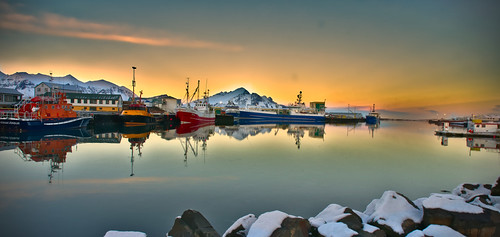
"Sunset on Höfn Harbor" by Emmanuel Milou Used by Creative Commons License. Some Rights Reserved.
“There's a sadness, written on her pretty face A sadness all her own,
from which no man can keep Candy safe” - SPRINGSTEEN
Jimmy loved junk food.
He could put away whole boxes of Hostess cakes, although you wouldn't know it to look at him. I don't remember why I know that; he must have told me at some point. I used to flirt with him at our local bar, where we were both regulars. He was a cutey, after all, but he always had a little bit of a sad edge to his smile. I wish I had a picture of him. We had no interaction outside of the bar, and I just stopped seeing him there at some point.
Jimmy died 20 years ago. He couldn't have been more than 30 or so, maybe younger. I can't find any record of his funeral, but I see his parents and his only brother all died since then and his death is noted in their obituaries. I know where they were buried so maybe I'll go sometime and see if he's there, too.
Gaston had no such sadness about him: he was full of energy. A wrestler in high school, he still lifted weights and looked it. When he was not DJing at that same bar, he also helped renovate it. My love affair with Jeep Wranglers began with him: he had a nice blue one with all kinds of mods. I got to ride in it once: he took me to a Marky Mark concert after I won the tickets on the radio. I was afraid to drive in the city then, and still don't like to.
Gaston disappeared, too, but that happens in a bar. I found out later through a friend that he was also gone. He did have a picture of him for me, though, in his graduation suit. I still have it.
The bar used to have plaques on the wall for a bartender who kept working there long after he he'd been diagnosed with cancer, and one of the drag performers who also died a few years ago. I asked if Gaston would ever get one, but it was so long ago, there are probably few people still there who would recognize him.
For years I have helped a dear friend of mine borrow and display some panels from the quilt. Not enough people were coming to see it, though, and people in the place where we hung it said it made them sad to look at it, especially at Christmastime. My friend bore the expense single-handedly, and it was a lot of work for us and another friend of his to go get the panels out of the chilly storage facility where they live most of the time, put them up and take them down, so we didn't do it this year. But we would still do it, somewhere, if people would come see.
Last year, I resolved to make, or--more accurately--commission, a quilt panel for Gaston. I know he doesn't have one, because you can check. As it happens, a year later, I haven't gotten anywhere with that. I feel bad about it, and I still want to do it.
I don't know enough about Jimmy to make one for him, really. Not yet, but I'll keep trying to find someone who does. I don't think he wants to be remembered by a box of Ho-Hos, although I could always get to see that smile by teasing him about it.
A young guy told me today that World AIDS Day doesn't really speak to him "just because I'm gay" and pointed out that men like him are no longer the largest group of new infections. I know this is thanks in part to the drugs, but I wish the pharma companies didn't make it sound in their commercials like HIV was reduced to a minor inconvenience for those lucky enough to afford their products.
I didn't argue with my young friend. He didn't know guys like Gaston and Jimmy, and he didn't live with the fear that we did. Because of them, we got tested. Because of them, we stopped taking chances. Because of them, we're here.
Twenty Fourth Sunday After Pentecost Kristallnacht (1938) This was a weekend of broken glass. On Friday, one of my friends made us a wonderful dinner. Roast chicken, haricorts verts sauteed with garlic and lime, and a whole tray of yams baked over shredded coconut. He treats us to feasts like this quite often, as do many of the gifted cooks we know, probably because they know we are not that handy in the kitchen. As he was cleaning up, the pan, slick with sweet syrup, slipped from his hands and crashed to their new tile floor, exploding into a million pieces. The floor survived, but I wasn't sure if I was sadder about: the pan or the loss of those leftover yams! We hurried to clean it up before their dog accidentally stepped on some glass or--worse--tried to lick up the mess. Yesterday, another celebration, other friends' son turned ten, and a houseful of people with more food and drink than we could safely consume. "I always have nightmares that there won't be enough," she once confided in me. Later in the evening, while a few of us were making some music, someone accidentally dropped a drink. CRASH! More shards everywhere, and a puddle to clean up. Today, however, the broken glass existed only in the abstract. My friends at St. Peter's Episcopal Church in Clifton, N.J. chose the 77th anniversary of Kristallnacht "the night of broken glass" to observe their annual remembrance of the victims of the Holocaust by inviting Helen Paktor, who survived that experience, to speak to us.
Helen Paktor (right) with her daughter
Jeanette Mahler and Dr. Jacob Lindenthal
PHOTO CREDIT: Dr. Jacob Lindenthal
The talk was introduced by Dr. Jacob Lindenthal, who servesa professor in the Department of Psychiatry at Rutgers New Jersey Medical School in Newark. Dr. Lindenthal interpreted for us a series of photographs he took at Auschwitz. Coming from a family who lost loved ones in the camps, he recalled shaking with emotion when seeing the railroad tracks leading into it, to the point where he dropped one of his cameras, a vintage Leica. He described meeting Helen Paktor, the guest of honor, during the last year and developing a strong kinship based on their mutual experience of loss. Helen Paktor was born in Tarnow, Poland, in 1925. Her parents worked in the dressmaking industry for which the area was known. She was 14 when German troops invaded her town, rounding up her family among the other local Jews and herding them into the city's ghetto, where they were subjected to forced labor and unprovoked violence, while their homes were pillaged. Her father was killed, and she and her mother were separated from her brother and sent to the first of three concentration camps. Helen told us matter-of-factly about how the prisoners were treated. Brutality was a daily occurrence, and there was the constant white smoke from the crematoriums. They were forced to work 10-12 hour days on just crumbs of bread and "soup" that was little more than hot water. Helen and her mother were lucky to be together, as they helped one another survive. She told us of sleeping top-to-toe so they could warm one another's frostbitten feet under their arms. On their third encounter with "Doctor Death" Josef Mangele, who personally inspected prisoners' left arms to see if they retained enough muscle tone to be fit for work, Helen was worried her frail-looking mother would be singled out for execution, so--by prior arrangement--she "stumbled" forward and pushed her mother, creating a distraction.
The ploy worked, and both women lived to see the day Soviet troops liberated the camp. The guards had actually abandoned it ahead of the advancing army, but electrified the gates to prevent the prisoners from escaping. Helen and her mother returned to their hometown and she tried for years to locate her brother, traveling as far as Italy, only to discover that he, too, had been killed. They emigrated to America in the 1950s, her mother first, then Helen a year later. She married and had two children, and lives in Livingston today. The range of questions people ask Helen is amazing, and unfortunately in some cases reveals the ignorance that many Americans have about this dark period in human history. She does not mince words in her replies. When asked how she responds when she learns about Holocaust deniers, Helen pointed at the numbers tattooed on her arm and asked "Why would any sane person do this to herself?" A young man once asked if that was to help her remember her address. She said no, it was to help him remember what the Nazis had done. She was also asked if she'd consider having the tattoo removed since it was a constant reminder of the horrors she had witnessed and endured. "As if I needed a visual to be reminded." Someone else asked, "Did you ever consider suicide in the camps?" She looked us for a long moment before replying firmly, "No. I wanted to live." Understandably, there is still much anger in Helen's voice when she talks about the Nazis. She testified at a trial in Munich for some camp officials, but said very little was done to punish them. According to Lawrence Rees, author of Auschwitz, A New History (2005) only 12% of the camp's 7,500 staff were ever brought to justice, and many of the sentences were trivial. Helen brightens when discussing the heritage and contributions of the Jewish people. She shared that--despite being about 1% of the world population--Jews have won 22% of all Nobel Prizes. It is important to her that this history and heritage is passed down.She spent time last
year with a young man named Andy Antiles as part of his preparation for
Bar Mitvah. Andy writes about his experience here.
Helen's daughter Jeanette was with her at today's event, and they both expressed profound gratitude for the expression of humanity offered by the people of St. Peter's. They were moved to tears by the choir chanting the ancient Hebrew prayer "Ani Ma-Amin" ("I Believe") during the morning's Eucharist, which was Helen's first time attending a worship service in other than a synagogue.
In conclusion,Helen read aloud from an essay "Concerning the Jews" written by Mark Twain and published in Harper's in 1897. Twain who--having just spent time in Austria--perhaps saw the signs of what was to come.
"The Egyptian, the Babylonian, and the Persian rose, filled the planet
with sound and splendor, then faded to dream-stuff and passed away; the
Greek and the Roman followed, and made a vast noise, and they are gone;
other peoples have sprung up and held their torch high for a time, but
it burned out, and they sit in twilight now, or have vanished. The Jew
saw them all, beat them all, and is now what he always was, exhibiting
no decadence, no infirmities of age, no weakening of his parts, no
slowing of his energies, no dulling of his alert and aggressive mind.
All things are mortal but the Jew; all other forces pass, but he
remains. What is the secret of his immortality?"
At age 90, Helen's continued strength of spirit is a clue to that secret.
Abridged versions of this post were republished in the Voice of the Episcopal Diocese of Newark, and in the December 2015 edition of The Episcopal Journal.
This morning's groggy scan of the Face-space feed revealed that the annual "Keep-My-Christ-in-Your-Christmas" sanctimony has--like the onslaught of reminders to get out there and shop--crept yet earlier. I'm convinced that in my lifetime we will start seeing ads for next Christmas before this Christmas is over. Of course the important season of Advent gets completely lost in the tide, but that's a rant for another day.
This time the outrage del'année is because That Omnipresent Coffee Company -- having dispensed its last not-actually-pumpkin spice latte for the year--has gone with a plain red motif for its disposable cups during not-really-peppermint season. That's right! No Santa Claus, no tree, and, shamefully, no Baby Jesus, surrounded by adoring animals. So you must boycott, and you must tell everyone. Because this is a Christian country, by golly, and we've got to make sure nobody forgets!
The irony that this is being held up as an example of "religious persecution" on the 77th anniversary of Kristallnachtsimply cannot be overstated. More on that later today.
The fact that this is getting any traction whatsoever suggests American Christians as a group have become so warped by privilege, that we confuse any thwarted attempt to impose our beliefs on the greater society as "persecution". And let's be clear. It's not like Allyourbucks used to have Christian images on their cups and abruptly took them away. If you want to be outraged at them, why not check out their resistance to label GMO ingredients on their products, or the fact that we're still using so many throw-away cups at all?
The Rev. Emily C. Heathsummed up my reaction so well that I was hesitant to write about this topic at all:
"Do you think Jesus would rather we remember his birthday by putting it
on a coffee cup that’s going in the trash? Or would he rather we
remember it by no longer treating one another as disposable?"
I could not say that any better, and I commend her entire post to you. I actually lament the commercial bonanza that Christmas has become, and the fact that--to get us in the mood to spend--we're surrounded by saccharine schlock so early so that we're sick of it by the time the actually holiday arrives. But any one of us could choose to walk away from all that and observe the season--or don't--however we please.
I did, however, resort to arcane sacristy-rat humor to further point out just how ridiculous this whole manufactured snub truly is:
A Proclamation to the Outraged:
The Feast of Christ the King
not being for several weeks, and thusly the season of Advent to follow,
any talk of red cups (other than for the movable feast of Beer Pong) is
verily premature.
Ye are reminded that the acceptable and
orthodox cup choice of the day remains consistent with the weeks After
Pentecost, known by our Roman friends as Ordinary Time.
This message (was not) brought to you by the Homer Laughlin China Company, manufacturers of Fiestaware. With Fiestaware, there's no excuse for sloppy orthodoxy on your table!
I was struck this week by two passages we read in my Education for Ministry seminar, both quotes of Lloyd Steffen, Chaplain at Lehigh University in Philadelphia.
The first is to do with listening. How often have we been speaking to someone and realized from their body language or their response that they were not so much listening as waiting for their turn to talk? How often have we realized someone has asked us something and we don't know what it was because our mind was somewhere else? Steffen suggests there is more to this than laziness or narcissism:
“The ability to listen depends not in the first place on any
particular skill or technique, but on a fundamental respect for one’s
partner in conversation. Listening is thus a moral act. Listening is an
act of attending to the other that discloses the strangeness of
otherness, disrupting our comfortable self-images and threatening to
undo our everyday experience of ourselves (and others) as familiar and
basically unified personalities. Not listening becomes a way of securing
ourselves from encounter with the mystery of otherness. Listening
exposes us to our own desires not to want to share of ourselves.
Listeners are required not only to welcome the strangeness of the other
but to risk self-disclosure in the act of listening, for the listener
must at some point recognize and then expose to the other his or her own
strangeness—and not only to the other but to one’s own self.”
This can be damaging enough on the interpersonal level, but what about what is going on in the universal church? The recent discourse around what constitutes "religious freedom" in a pluralistic society demonstrates what happens when Christians can no longer count on the privilege of assuming the political and social norms are in line with their own... or even that their fellow Christians will agree with them on what those norms should be. How do we find a way forward when we can't even hear one another above the noise in our own heads?
“We are in need of a theology of listening, for a willingness to listen
ultimately expresses an attitude of love. Christians believe that Jesus
listened to God and to those he encountered in his daily life. We do
neither. If we listened to one another we should be inviting one another
into new forms of relationship based on openness and respect and a
willingness to share ourselves.If we listened for God, we should
spend our time not praying for ourselves but listening to our prayers to
see what we are saying not to God but to ourselves. The heart is a
great mystery. Christians believe that God knows the human heart (and we
do not), for that heart is where God’s omniscience lies. God does not need to be informed about our wants and needs. It is we who need to know what we want, what we fear, what we love.”
The bolded bits struck me particularly. We have all been the recipient of mass prayer requests for this
or that cause, generally with a specific requested outcome. Pope
Francis recently decried the notion of God as magician... how is one
left to feel when one's request is not granted?
When you agree
to pray for a third party, what are you really doing beyond repeating
the obvious desired result (wellness, a job offer, etc.)? Is it like opening multiple trouble tickets
for the same problem, where your wish might get granted because it
seems to be popular? If non-believers see
our notion of God as a cosmic suggestion box, for which we'd have only
ourselves to blame, it is small wonder that they don't take people of
faith seriously; it would be a very simplistic, childish view of a god, and difficult to defend when things don't turn out according to the script.
So should we stop praying for those people? Certainly not. We agreed that a more beneficial form of prayer is to reflect on the situation and our own response to it... how can we "be Christ" in the situation for the people affected? Knowing that giant unseen cheering squad is out there certainly can have a positive effect on a person's state of mind, the impact of which in situations requiring confidence and healing should not be understated.
If nothing else, we can pray to become better listeners.
JOHN MAXTONE-GRAHAM LECTURES ABOARD QM2 IN HIS TRADEMARK KILT (MY PHOTO, ALL RIGHTS RESERVED)
I was saddened to learn yesterday of the passing of maritime historian and author John Maxtone-Graham, many of whose books about passenger ships are in my collection. Peter Knego, who operates the popular site Maritime Matters, said in his obituary that "Mr. Maxtone-Graham’s poetic style of writing and his charismatic onstage
manner were an inspiration to generations of fans of ships and the
sea. His breakthrough The Only Way To Cross, when published in 1972,
was one of the first non-Titanic books to capture the essence of the
ocean liner."
John possessed an encyclopedic knowledge of ocean liners and cruise ships, and delivered it--both in writing and at speaking engagements--with grace and humor.
One of my favorite of his tales describes an incident one night aboard the Bergensfjord of the Norske Amerikalinje (Norwegian America Line) in the 1960s, captured in his 1985 book Liners to the Sun:
A woman, after having caught several garments on a protruding screw in her cabin panelling and forgetting to tell the steward about it, decided to fix it herself. She couldn't get the screw in any further, so she took it out instead. Just as she removed it from the wall, the Bergensfjord was struck by a tsunami and heeled violently to port, throwing people and contents to the deck. Until she learned the cause of the accident, she was secretly terrified that her meddling with the ship's infrastructure had somehow triggered it.
John and wife Mary were frequent passengers as he was often called upon to give lectures on board, particularly for maiden voyages and others of historic significance. Whether in suit and tie or his trademark kilt, he struck a distinguished and gallant figure.
My father and I had the privilege to hear John speak several times as the RMS Queen Mary 2, flagship of the storied Cunard Line, made her inaugural crossing from Southampton, England, to New York in 2004. Despite the number of ship enthusiasts and industry names on board, I somehow ranked to have breakfast with him, and he patiently endured a tour of the amateurish design I had created for a ship like the QM2 before Cunard had the funds or the will to do so themselves. My copy of his coffee-table book about that ship bears both an inscription (in which he amusingly took the heat for smudging his own signature) and a stamp commemorating the fact that our encounter took place during that historic voyage.
MY MEMORABILIA FROM THAT VOYAGE INCLUDES JOHN'S INSCRIPTION IN THE COMMEMORATIVE BOOK, AND HIS APOLOGY FOR SMUDGING IT.
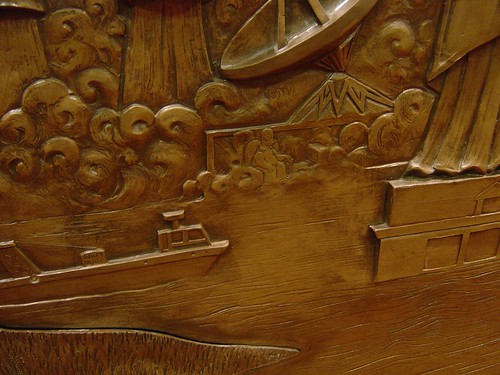
One amusing piece of trivia: John's son Ian Maxtone-Graham is one of the brains behind the TV series The Simpsons, and--hidden among the details of a faux-bronze relief along a companionway on the QM2's lounge deck--the sharp-eyed can spot Homer among the mythological figures and wonders of creation.
HOMER SIMPSON AMONG THE MARVELS OF THE EARTH ON A FAUX-BRONZE RELIEF ABOARD THE RMS QUEEN MARY 2. PHOTO CREDIT: GARY BEMBRIDGE. USED UNDER CREATIVE COMMONS LICENSE.
While the movie Titanic takes some credit for the renewed interest in the golden era of ocean liner (which spanned from roughly 1890 til 1960, when jets began carrying the majority of passengers across the Atlantic) it is writers and historians like John who make sure this unique era is thoroughly and engagingly documented for generations to come.
Thus says the Lord: "A voice is heard in Ramah, lamentation and bitter weeping. Rachel is weeping for her children; she refuses to be comforted for her children, because they are no more." Thus says the Lord: "Keep your voice from weeping, and your eyes from tears; for there is a reward for your work." Says the Lord: "they shall come back from the land of the enemy; there is hope for your future." Says the Lord: "Your children shall come back to their own country." - JER. 31:15-17
I'm hesitant to even comment on last night's news that nine members of a A.M.E. church in Charleston, S.C., were shot by a 21 year-old man who spent an hour participating in their prayer meeting before pulling out a gun and opening fire, reloading several times and continuing to shoot people despite pleas from the crowd to stop.
I have no business saying anything. I don't live there. I don't know these people. I can't pretend to know what it's like to be subjected to the kinds of subtle and overt aggression that people of color face, particularly in a state where symbols of a time when enslaving other people was acceptable are displayed on public buildings as a reminder that there are people among them, including people in positions of power, who wish it was still the case.
And yet I will.
I will because--if it was me--I would want to know that others felt devastated, too.
I will because it will never, ever be okay with me that my actions, or lack of actions, contribute to a society where one group of people is "more equal than others". The older I get, the less comfortable I am with the idea that I can manipulate how I am treated by my appearance in a way that others cannot, and that assumptions will be accordingly made, privileges granted, opportunities extended.
I will because, despite that, I know all too well how it feels to have adjectives applied to you that you didn't choose, other assumptions made, and privileges withheld, because of a biological trait over which you have no control, but for which you should have absolutely no reason to feel ashamed.
I will because we all bleed red, and whether you are Caucasoid or Afro-Caribbean or Hmong or Coeur d'Alene, you are entitled to feel safe in your house, at your place of worship if you have one, or on any street in America, because your kin fought and died for that just as mine did, and I have no more right to that feeling than you do.
I will because I, and my sisters and brothers around the planet, meet in places very much like Emanuel with people we don't know, and offer them whatever comfort we can with the thought too frequently in our minds that something like this can happen. And yet we do it anyway, because can you imagine what kind of a world it would be if we gave into our fear, and stopped?
I will because there are people whom I love who work in law enforcement, and i want desperately for the things I believed about members of law enforcement as a child to be, without exception, safe things for a child of any color or upbringing to believe. I am grateful for the men and women in blue, along with civilians, who put their lives on the line to swiftly apprehend this shooter.
As old as I am, I am still naively optimistic on most days that these things are possible and we will someday reach that promised land. There is an expression I love, whose rightful authorship I have not been able to pin down: "We ain't what we could be, we ain't what we gonna be, but at least we ain't what we was." I believe that, and I have to believe the arc of history will continue to lead us forward.