I'D LOVE TO HEAR FROM YOU

Comments, criticisms, or (one can hope) compliments are more than welcome! Please let me know what you think, tell me I'm crazy (I suspect this) or what you'd like to hear about. Comments are screened before publication, so if you want to share something with me only, just put that in the comment and I'll keep it to myself.

THANK YOU FOR VISITING!
Showing posts with label Cunard Line. Show all posts

Tuesday, July 7, 2015

Requiescat in Pace: John Maxtone-Graham

JOHN MAXTONE-GRAHAM LECTURES
ABOARD QM2 IN HIS TRADEMARK KILT
(MY PHOTO, ALL RIGHTS RESERVED)
I was saddened to learn yesterday of the passing of maritime historian and author John Maxtone-Graham, many of whose books about passenger ships are in my collection.  Peter Knego, who operates the popular site Maritime Matters, said in his obituary that "Mr. Maxtone-Graham’s poetic style of writing and his charismatic onstage manner were an inspiration to generations of fans of ships and the sea.  His breakthrough The Only Way To Cross, when published in 1972, was one of the first non-Titanic books to capture the essence of the ocean liner."

John possessed an encyclopedic knowledge of ocean liners and cruise ships, and delivered it--both in writing and at speaking engagements--with grace and humor.

One of my favorite of his tales describes an incident one night aboard the Bergensfjord of the Norske Amerikalinje (Norwegian America Line) in the 1960s, captured in his 1985 book Liners to the Sun

A woman, after having caught several garments on a protruding screw in her cabin panelling and forgetting to tell the steward about it, decided to fix it herself.  She couldn't get the screw in any further, so she took it out instead.  Just as she removed it from the wall, the Bergensfjord was struck by a tsunami and heeled violently to port, throwing people and contents to the deck.  Until she learned the cause of the accident, she was secretly terrified that her meddling with the ship's infrastructure had somehow triggered it.

John and wife Mary were frequent passengers as he was often called upon to give lectures on board, particularly for maiden voyages and others of historic significance. Whether in suit and tie or his trademark kilt, he struck a distinguished and gallant figure.

My father and I had the privilege to hear John speak several times as the RMS Queen Mary 2, flagship of the storied Cunard Line, made her inaugural crossing from Southampton, England, to New York in 2004. Despite the number of ship enthusiasts and industry names on board, I somehow ranked to have breakfast with him, and he patiently endured a tour of the amateurish design I had created for a ship like the QM2 before Cunard had the funds or the will to do so themselves.  My copy of his coffee-table book about that ship bears both an inscription (in which he amusingly took the heat for smudging his own signature) and a stamp commemorating the fact that our encounter took place during that historic voyage.

MY MEMORABILIA FROM THAT VOYAGE INCLUDES JOHN'S INSCRIPTION IN
THE COMMEMORATIVE BOOK, AND HIS APOLOGY FOR SMUDGING IT.
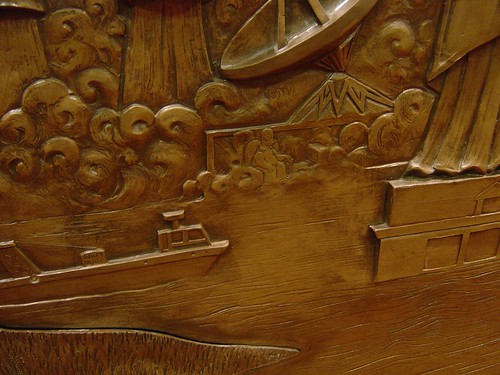
One amusing piece of trivia:  John's son Ian Maxtone-Graham is one of the brains behind the TV series The Simpsons, and--hidden among the details of a faux-bronze relief along a companionway on the QM2's lounge deck--the sharp-eyed can spot Homer among the mythological figures and wonders of creation.

Homer Simpson hidden in the Queen Mary 2 (QM2) Hallway Panels
HOMER SIMPSON AMONG THE MARVELS OF THE EARTH ON A FAUX-BRONZE RELIEF
ABOARD THE RMS QUEEN MARY 2.
PHOTO CREDIT: GARY BEMBRIDGE.  USED UNDER CREATIVE COMMONS LICENSE.

While the movie Titanic takes some credit for the renewed interest in the golden era of ocean liner (which spanned from roughly 1890 til 1960, when jets began carrying the majority of passengers across the Atlantic) it is writers and historians like John who make sure this unique era is thoroughly and engagingly documented for generations to come.

Sunday, October 26, 2014

And All This Time the River Flowed

Yesterday, I was privileged to see a performance of Sting's new musical The Last Ship, currently in previews on Broadway.  A project that had been in the works since 2010, the production follows a concept album in 2013 last year (from which only some tracks made it to the score as presented to us) and a short run in Chicago.

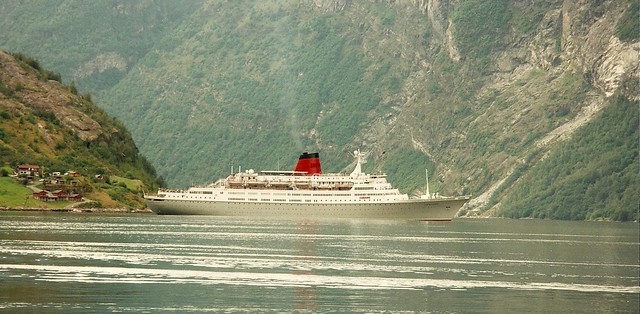
Set in the village of Wallsend-on-Tyne in northeastern England, the show is a stylized account of the conclusion in 2007 of shipbuilding activity by Swan-Hunter, whose accomplishments include the legendary Cunarders RMS Mauretania (holder of the transatlantic speed record) and Carpathia (rescuer of the RMS Titanic survivors). Wallsend produced the last passenger liner built in the United Kingdom (the MS Vistafjord for Norwegian America Line, which later also sailed for Cunard as Caronia) in 1973.

MS Vistafjord
MS Vistafjord, the last liner built in the UK, shown here in Cunard colors at anchor in
Geirangerfjord, Norway in 1993 PHOTO CREDIT: flickr.com/aah-yeah Used under Creative
Commons. 
Some rights reserved.

The show begins with a flashback of sorts, as Joe Fletcher (Jamie Jackson) is injured on the job and wants his son Gideon (Montclair's own Collin Kelly-Sordelet) to assume his place as breadwinner by becoming an apprentice at the yard.  Gideon rejects this idea and instead signs on as a merchant mariner, promising girlfriend Meg (Rachel Tucker) he will be back for her.

Returning fifteen years later upon the news of his father's death, Gideon (played as an adult by Michael Esper) learns that the yard is to be closed for lack of any further work. This is semi-factual: Following delays and cost overruns, the still-incomplete HMS Lyme Bay, the last vessel to be laid down at Wallsend, was towed in 2006 to a competing yard and Swan Hunter was barred from further naval contracts, ending 130 years of shipbuilding on the Tyne.

Gideon seeks out Meg and discovers she is less than receptive to a reconciliation, her feelings complicated by a teenage son Tom (also portrayed by Kelly-Sordelet) and another man, Arthur (Aaron Lazar), who wants to marry her.  Arthur (also a former shipbuilder) has taken a job with a company that wants to see the yard sold and used for shipbreaking and scrapping, an idea the workers find repulsive and insulting.

Encouraged by the parish priest (brilliantly wrought by Fred Applegate... if ever there was a right priest for a particular congregation, Fr. James O'Brien is it!), the workers, including Gideon and Tom, defiantly embark -- against all odds -- on one more project, which symbolizes their collective well-being and pride.


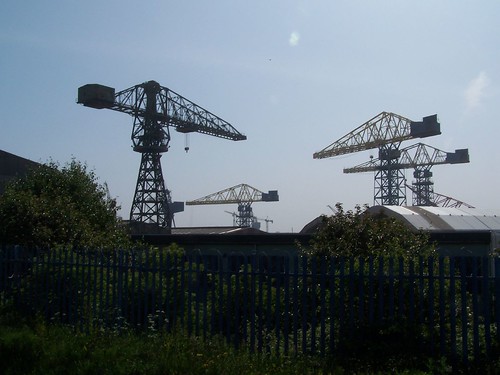
Taking down the cranes
In 2007 the Wallsend cranes, which had dominated the skyline for generations , were dismantled and
shipped to India. 
PHOTO CREDIT: Mick Gallagher. Used under Creative Commons license. Some rights reserved
I will not spoil with more details of the plot.  I have read that the show is semi-autobiographical, which leads me to wonder what Sting's upbringing was like. There is no mother in the play, and the relationship between Gideon and Joe is clearly freighted, with allusions to abuse.  The singer's parents died of cancer within months of each other in 1987 and he explained in a 1996 interview with Q that he declined to attend their funerals, and later regretted it.  A period of writer's block followed, and it was not until he released The Soul Cages in 1991 that he felt properly able to mourn.

"My father was... snatched away from me at the wrong time. For me and for him. It was just at the point when I was beginning to make my journey home and understand my parents more - the decisions they made,"  Sting observed.  "Having written the songs, what I learnt was to forgive myself for my part in it and forgive my father and my mother for what they did that hurt me."

In parallel, Gideon misses Jim's funeral by mere days and is forced to work through unrequited feelings as the story unfolds.  Two tracks from The Soul Cages, "Island of Souls" and "All this Time", accompany original songs in the show.

The play gives you a lot to chew on.  The theme is one that has repeated itself many times, some of them in places a lot closer to home, as traditional ways of earning a living handed down by generations give way to technology and globalization.

Layer that with the complex relationships between the players as they make difficult choices, and a cast that does well to get you invested as if this was really happening around you. Musically, Sting's influence is heavy, but he draws well from the history of the area, particularly for the company pieces.

The Last Ship is in previews at the Neil Simon Theater.

Saturday, May 31, 2014

For Those in Peril on the Sea

MEMORIAL DAY

The RMS Queen Mary
After a two-day meeting in Pasadena, my friend Matt and I got a lift down to Long Beach for a visit to one of my favorite places, the former Cunard ocean liner RMS Queen Mary, which has served since 1967 as a static attraction and hotel. 

The Queen Mary along with her running-mate* the RMS Queen Elizabeth were laid down in the 1930s with the goal of a two-ship service across the Atlantic.  Since they could make the crossing in 4 1/2 days, it was possible to have a departure in each direction every week.

In practice, it would take another 15 years for this to be realized.  Construction on the Mary was interrupted by the Great Depression for several years, and she finally entered service in 1936, only to be requisitioned by the military when World War II broke out.  The Elizabeth was nearing completion in 1939 when fighting broke out, and her first function was as a troopship.  Capable of moving 15,000 men at a time, the two liners were credited with shortening the war by a year or more.

The ships' role in the war effort is documented as part of the walking tour which is included in the cost of an overnight hotel stay.  They often sailed alone as few vessels could keep up with them.  In 1942, the Mary accidentally struck and sank one of her escort vessels, the HMS Curacoa, with the loss of over 200 men.  She was directed to keep moving, rather than risk far more lives.

In 1948, the ships were returned to Cunard and refitted.  The goal of a weekly express service was finally realized, and the Mary and Elizabeth allowed the line to dominate the transatlantic passenger trade until the advent of the jet airliner led to its decline.  The two ships were replaced by the smaller RMS Queen Elizabeth 2 (herself now also retired) in 1969.  That ship operated alone, spending much of the year off the transatlantic run to perform cruises, and it was assumed for decades that she would be the last liner.  However, a resurgence in interest (brought about in large part, ironically enough, by James Cameron's depiction of the sinking of the RMS Titanic) in ocean travel for its own sake led cruise giant Carnival to purchase the ailing Cunard Line and construct the RMS Queen Mary 2, the largest liner and for a time the largest passenger ship ever built.  My dad and I were aboard in 2004 for one of her first crossings.

The original Queen Elizabeth was briefly targeted to become a hotel in Florida, but was subsequently purchased by Chinese shipping magnate C. Y. Tung and renamed Seawise University (Sea-Wise, C.Y.'s, get it?)  In the process of refit in Hong Kong harbor in 1972, several fires broke out simultaneously and she was destroyed.

The Mary however, was purchased by the City of Long Beach and -- after an epic final voyage around the horn of South America -- arrived at her current home.  Her success in this role has been somewhat checkered, I believe in large part because she is berthed in a remote industrial area which is not walkable from the city itself.

On this particular weekend, however, she was bustling.  Her convention space, carved from what had been the cheaper passenger accommodations and forward engine rooms on the lower decks, was the venue for at least one high school formal, and we encountered bridal parties and business gatherings in addition to what appeared to be a healthy amount of tourists there for the ship herself.

Artwork in the former First Class Restaurant aboard the
Queen Mary.  Crystal models of the Mary and her
running-mate RMS Queen Elizabeth were moved along a
track to show their relative positions as they cris-crossed
the North Atlantic.
There is a good deal of controversy about the steps her various operators have taken to realize a profit.  Only her first class spaces were preserved, and much of her original furnishings are apparently piled up in areas that are not accessible to the public. Since she has now been at Long Beach for longer than she operated as a ship, the accumulated attempts to keep people interested and visiting have led to a number of arguably regrettable choices, such as the "ghost tour" and the fact that there is now a Starbucks on the Promenade Deck.  The thinnest of threads links some of the attractions to the ship's own story (example: the current Lady Diana exhibit).

Among the spaces that retain their grandeur are the Observation Bar, which overlooks the bow, and the First Class ballroom and dining room.  Since these bigger rooms are rented out for private events, it is only by dumb luck that regular hotel guests are able to see them.  Fortunately, on Sundays the latter is used for a ($50!) champagne brunch, and we were able to sneak in as it was winding down and grab some photos.

The Immortal Chaplains


Stained glass window depicting the Immortal
Chaplains, aboard the RMS Queen Mary
One area that is easily missed, but deserves to be seen, is the Immortal Chaplains.  This ersatz chapel was created on A Deck forward by survivors of the sinking of the USAT Dorchester.  This cruise ship-turned-troop transport was torpedoed off the coast of Greenland on February 3, 1943.  Of the 900 men on board, only 230 survived.

The chapel was created to honor the four clergymen who -- after comforting others and helping them to safety -- surrendered their own life jackets and went down with the ship, praying and singing together.

I wondered at first what this had to do with the Queen Mary, and learned that among those who contributed to the chapel's creation were two crew members from the German U-boat that sank the Dorchester.  They were transported to the United States aboard the Mary a year later, and the sub's first officer later said "We, the sailors of U-boat 223, regret the deep sorrow and pain caused by our torpedo.  Never again should be such a murderous war.  We should all live as these immortal four chaplains... to love where others hate."

NOTE: The Mary and Elizabeth are frequently referred to as "sister ships" which is technically incorrect.  This term is only used for ships built off the same plans.  The Elizabeth had two smokestacks instead of three and was slightly larger (and holds the record of the largest riveted vessel ever constructed), but the Mary was faster and always slightly more popular.

Thursday, January 13, 2011

When the Ship Comes In

Hilary of Poitiers - Bishop & Doctor

Okay well it has been an embarrassing amount of time since I have posted anything here.  My friend David described this in a similarly apologetic post as having "gone galt" so then of course I had to go see what that meant, and another ten minutes were lost.

So, what's been happening?  Well right after Thanksgiving, we went to Florida, which was fun although really cold (for Florida) which meant we had a great time in the theme parks because there weren't any lines to speak of.

We got to visit a co-worker from years back and her husband, ride round on golf carts and see alligators.

Then there was Christmas, and a ridiculous snowstorm or three.   We're in the thick of winter here, now, but as someone pointed out earlier, it was still light enough to see at 5 o'clock, so the days are starting to get noticeably longer again.

We did have a rather unfortunate experience on New Years' Eve at a restaurant in Montclair called Costanera.

Queen Elizabeth 2 in 2008
There is an interesting maritime event unfolding in New York Harbor as we speak, although I am unfortunately not participating.  All three ships of the storied Cunard Line are berthed in the city at the same time: The Queen Mary 2 at the Brooklyn Cruise Terminal, and the quasi-sisters Queen Victoria and the new Queen Elizabeth at the Passenger Ship Terminal on Manhattan's west side, the latter having just completed her maiden transatlantic crossing.  My friend Doug Newman was aboard, and you can read his account on his blog.

This is is only the second time the entire fleet has been together in the port, which speaks as much about the modern need for marketing pomp as it does the state of the company's affairs: in the 1950s they operated over fifty vessels, now they have just three.

Queen Victoria at the Passenger Ship Terminal
The first was three years ago, for the Victoria's maiden arrival.  At that point the legendary QE2 was still in service, and a friend and I took a boat trip out into the Upper  Bay to watch  as the the three ships preened in front of the Statue of Liberty under a fireworks display.

I was also on hand for the mammoth Queen Mary 2's first visit to the city; in fact my dad and I were aboard, having made the maiden crossing from Southampton in April of 2004.