Random patter from one easily amused and more easily confused.
I'D LOVE TO HEAR FROM YOU
Comments, criticisms, or (one can hope) compliments are more than welcome! Please let me know what you think, tell me I'm crazy (I suspect this) or what you'd like to hear about. Comments are screened before publication, so if you want to share something with me only, just put that in the comment and I'll keep it to myself.
On Thursday, February 4th, the SS United States
Conservancy stunned the preservationist community by announcing that the
much-ballyhooed plans for the ship were not to redevelop it as a static
public attraction in New York as rumored, but in fact that a cruise
line was interested in purchasing it for return to revenue service!
The liner, which holds the transatlantic speed record, was laid up in
1969 and has been idle ever since, her mid-century interiors long since
stripped away and sold at auction. For the past 20 years, she has been
berthed in south Philadelphia, where drivers on I-95 and the Walt
Whitman Bridge glimpse at her fading red-white-and blue smokestacks.
A a press conference held on Pier 88 in New York (long home of the storied Compagnie Générale Transatlantique
(French Line)), Crystal Cruises, a luxury brand owned by Hong
Kong-based Genting Group, announced they had agreed to front the ship’s
$60,000-per-month dockage fees until the end of the year whilst they
determine if renovating her further use is even feasible. A new
propulsion system would have to be provided ( Crystal’s president
asserted she would still be the fastest out there) and there is concern
about contaminants lurking in her Cold-War-era bowels.
The renovated ship would carry about 800 passengers, far fewer than
she was designed to accommodate. Her interiors are a veritable clean
slate: all non-structural materials were gutted in the 1980s in the
Ukraine. Her designer’s preoccupation with fire meant asbestos and
other hazardous substances were used in abundance. A promotional video
by the cruise line indicated her superstructure would be expanded to
accommodate modern passenger expectations like stateroom balconies.
Certain features like the enclosed promenade decks and the cozy Navajo
Lounge would be maintained or recreated, and one would assume that a nod
to her history would be evident throughout.
Screen
shot of artist’s rendering of the SS United States as proposed Crystal
Cruise Lines vessel from Feb. 2016 press conference
My feelings are mixed: While of course a ship is built to go to sea,
this vessel was designed and laid down for a specific route and market
that was lost to the jet airplane many years ago. To make her “work”
as a modern cruise vessel, she will have to be modified almost beyond
recognition, and will still be a compromise at best. There is
precedent, the SS France, of similar vintage, enjoyed 20 additional years of life as the cruise ship Norway, but not without two additional decks and much updating.
Which brings up my second concern: Genting also owns Norwegian Cruise Line which operated the Norway.
After a boiler explosion rendered her inoperable, her owners claimed
she was being brought to Asia for repairs, but in fact were accused of
duping the German government when their real intention was to scrap
her. Under the Basel Convention, she would not be permitted to leave
the EU without a plan in place to remove the asbestos and other hazards
present throughout her interiors. NCL actually purchased the United States once
before with very similar intentions to the ones being proposed now, but
determined it was not feasible. It remains to be explained what is
different this time.
Even if they are successful, I and the others who paid to keep her
alive these recent years are still likely to be short-changed. As a
hotel and museum, she would have been accessible to millions of people
including those who appreciate her history. Instead she will become a
playground for the super-rich, and the rest of us will be left waving
from the shore.
JOHN MAXTONE-GRAHAM LECTURES ABOARD QM2 IN HIS TRADEMARK KILT (MY PHOTO, ALL RIGHTS RESERVED)
I was saddened to learn yesterday of the passing of maritime historian and author John Maxtone-Graham, many of whose books about passenger ships are in my collection. Peter Knego, who operates the popular site Maritime Matters, said in his obituary that "Mr. Maxtone-Graham’s poetic style of writing and his charismatic onstage
manner were an inspiration to generations of fans of ships and the
sea. His breakthrough The Only Way To Cross, when published in 1972,
was one of the first non-Titanic books to capture the essence of the
ocean liner."
John possessed an encyclopedic knowledge of ocean liners and cruise ships, and delivered it--both in writing and at speaking engagements--with grace and humor.
One of my favorite of his tales describes an incident one night aboard the Bergensfjord of the Norske Amerikalinje (Norwegian America Line) in the 1960s, captured in his 1985 book Liners to the Sun:
A woman, after having caught several garments on a protruding screw in her cabin panelling and forgetting to tell the steward about it, decided to fix it herself. She couldn't get the screw in any further, so she took it out instead. Just as she removed it from the wall, the Bergensfjord was struck by a tsunami and heeled violently to port, throwing people and contents to the deck. Until she learned the cause of the accident, she was secretly terrified that her meddling with the ship's infrastructure had somehow triggered it.
John and wife Mary were frequent passengers as he was often called upon to give lectures on board, particularly for maiden voyages and others of historic significance. Whether in suit and tie or his trademark kilt, he struck a distinguished and gallant figure.
My father and I had the privilege to hear John speak several times as the RMS Queen Mary 2, flagship of the storied Cunard Line, made her inaugural crossing from Southampton, England, to New York in 2004. Despite the number of ship enthusiasts and industry names on board, I somehow ranked to have breakfast with him, and he patiently endured a tour of the amateurish design I had created for a ship like the QM2 before Cunard had the funds or the will to do so themselves. My copy of his coffee-table book about that ship bears both an inscription (in which he amusingly took the heat for smudging his own signature) and a stamp commemorating the fact that our encounter took place during that historic voyage.
MY MEMORABILIA FROM THAT VOYAGE INCLUDES JOHN'S INSCRIPTION IN THE COMMEMORATIVE BOOK, AND HIS APOLOGY FOR SMUDGING IT.
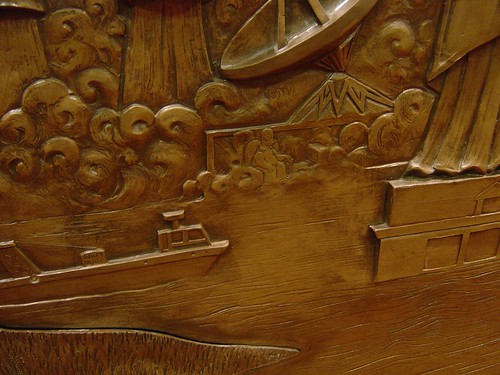
One amusing piece of trivia: John's son Ian Maxtone-Graham is one of the brains behind the TV series The Simpsons, and--hidden among the details of a faux-bronze relief along a companionway on the QM2's lounge deck--the sharp-eyed can spot Homer among the mythological figures and wonders of creation.
HOMER SIMPSON AMONG THE MARVELS OF THE EARTH ON A FAUX-BRONZE RELIEF ABOARD THE RMS QUEEN MARY 2. PHOTO CREDIT: GARY BEMBRIDGE. USED UNDER CREATIVE COMMONS LICENSE.
While the movie Titanic takes some credit for the renewed interest in the golden era of ocean liner (which spanned from roughly 1890 til 1960, when jets began carrying the majority of passengers across the Atlantic) it is writers and historians like John who make sure this unique era is thoroughly and engagingly documented for generations to come.
I'm generally not someone who would encourage trespassing or other illegal behavior, but I could not resist watching the video footage an "urban explorer" captured aboard the salvaged wreck of the cruise ship Costa Concordia, which is currently being stripped of its fittings in Genoa in preparation for scrapping.
An unknown individual, who identified himself on social media as "AdHoc" snuck aboard the ship at night sometime earlier this year and walked around filming and taking still photos of what he saw.
To someone who is somewhat familiar with passenger ships, it was eerie to see the spaces and shapes associated with a relaxed time at sea, now peeling and muddy and piled with garbage, having been "raised from the dead" last September in a pretty amazing feat of engineering that cost over $1 billion US (so far).
The Costa Concordia was cruising off the coast of Tuscany on the night of January 13th, 2012 when she struck a rock and began taking on water through a 230-foot gash in her hull. In a rather grievous violation of maritime law, no abandon ship order was given for over an hour, by which time she had begun to heel over and drifted closer to shore. She eventually came to rest off the village of Giglio, which allowed some people to actually swim ashore.
Given how badly the evacuation was managed, it is somewhat amazing that of the 3,229 passengers and 1,023 crew members on board, only 32 died. This was the largest passenger ship ever lost in peacetime, and her commander, Francesco Schettino, has been convicted of manslaughter based on his actions before and after the collision, which included having his girlfriend (neither a paying passenger nor a crew member) on board and in the wheelhouse at the time of the accident, and abandoning the ship himself before all the passengers were evacuated. Australian journalist Phillip Knightley described the incident as the "most significant event in modern maritime history"
because "every single safety procedure designed to make sea travel safe
failed miserably."
The cruise line Costa Crociere S. p. A., is one of the brands owned by Carnival Corporation and the Concordia was built from the same plans as their Carnival Splendor. Governing bodies and industry groups on both sides of the Atlantic reviewed and tightened safety procedures in the wake of the wreck, including that large vessels are expected to stay two miles from ecologically sensitive coastlines and that boat drills must be conducted before leaving port.
Those in our area could not miss the headline earlier this week of a five-alarm fire that destroyed much of an apartment complex known as Avalon at Edgewater. If you've been around a while, you may remember that the same complex burned in 2000 as construction neared completion.
I'm not really wild about the trend toward wood frame construction for high-density housing like this. With over 400 apartments in a city block, that's a lot of stoves, candles, extension cords, heaters, potentially careless smokers, etc., in a small area. The building is still relatively new, but what happens when wiring and other material is 30, 40, 50 years old? It is not as if it is cheap to live there, either; I saw mention of rents upwards of $3,000 a month. We're getting two similar complexes in our town (one by the same developers) and I expressed concern to town officials that we may be exposed to similar risks.
On Thursday the Newark Star Ledger reported that a worker's blowtorch accidentally started the blaze, and that the crew called and spoke to their supervisor for 15 minutes before dialing 9-1-1, thus critically delaying firefighters' response. This reminded me of another fire, which took place right across the river at Pier 88 in the Passenger Ship Terminal, seventy-three years ago this coming February 8th.
The SS Normandie, luxurious flagship of the Compagnie Générale Transatlantique, took shelter in New York when World War 2 began. Her crew remained on board until December 1941, when she was seized by the U.S. Navy and renamed the USS Lafayette, vessel AP-53.
Workers using blowtorches to remove iron handrails in the ship's cavernous first-class lounge accidentally ignited a stack of life preservers, which were full of a very flammable substance called Kapok. They attempted to extinguish the fire, but the ship's sophisticated sprinkler system had been abandoned by the Navy and they quickly discovered that the fittings did not match American hoses.
The fire spread rapidly; the Normandie boasted numerous large public spaces (the First Class restaurant was longer than the Hall of Mirrors at Versailles) which unfortunately acted like a giant chimney. The FDNY used every means at its disposal to pour water on the ship, and she soon began a dangerous list away from the pier. Her Russian-born designer Vladimir Yourkevitch arrived at the scene and attempted to provide expertise that would have possibly saved her, but he was ignored. In the middle of the night, like a suffering whale that beaches itself, the beautiful ship fell on her side in the muck.
Burned-out wreck of the USS Lafayette (ex-Normandie) lies on her side at New York's Pier 88
PHOTO CREDIT:
James Vaughan. Used under Creative Commons License. Some rights reserved.
She would remain there for a year, an embarrassing waste. The Navy considered re-purposing her as an aircraft carrier, but the damage was found to be too extensive and they focused on other priorities. She was scrapped at Port Newark after the war's end. Luckily, much of her interior fittings had been removed and stored before the disaster, and can be seen in places like the Metropolitan Museum of Art, Our Lady of Lebanon (the Maronite Catholic Cathedral in Brooklyn), and the Chicago Hilton.
Like the Avalon fire, her loss was ruled an accident, and--also similarly--the response immediately after it began played heavily into the outcome. The design of passenger ships has changed significantly since then; the SS United States, launched 12 years later, had almost no wood on board, and both she and the SS France employed large amounts of asbestos, which was also subsequently ruled to be hazardous. Large spaces like those aboard Normandie now have to be subdivided by fire-suppressing bulkheads and doors.
But, on land, are similar precautions being taken? Hopefully we will not have to wait 73 years for a lesson from the Avalon fire to be learned.
By now you are probably sick unto death of references to the R.M.S. Titanic as we approach the centennial of her sinking. Actress Kate Winslet reportedly cringes when she hears "My Heart Must Go On" and every time a cruise ship encounters any kind of mishap, breathless passengers insist "it was just like the Titanic!" Of course it was... except that it was 2,800 miles away, 90 years later, within sight of land and your inconvenience was limited to warm beer for an afternoon in the Anchors Aweigh Lounge til the lights came back on.
Simulated Size Comparison: Titanic vs. Oasis of the Seas(Caution: Contains Music)
For those with no other references, the Titanic remains the "go-to" vessel, to which every new passenger ship is compared. However, for ship geeks like me, the most interesting thing about her is that she almost immediately failed at her job: that is, to get her human cargo safely from one side of the Atlantic to the other. Her speed and size statistics were almost immediately eclipsed by other vessels, and few can name her two sisters, both of which also met with disaster in varying degrees. Since then, hundreds of liners -- ever larger, ever faster -- came and went, most of them long forgotten except by a nostalgic handful. Today's plodding cruise behemoths bear little resemblance to the ships of that time, yet passengers who -- when asked what ship they spent their vacation -- answer, "Um, Carnival?" know Titanic. People who have never seen the ocean know her name and remember her story.
To me the human dynamic of what happened that night, and what it says about the time in which it occurred, is far more interesting than the ship itself, or even the human errors and vices that made it happen. We recently started watching the British "costume drama" Downton Abbey, which is set in England in the same time period, and seeing the characters interact with those in their own and in different social strata is helping to understand a little more about the way events unfolded. Just as scullery maid Daisy knows that she is never to set foot in the family dining room, some in third class seemed to accept as normal that their station in life meant that it was more important that a wealthier person should live while they would die. Just as the Dowager Countess has no problem with the idea that the townspeople let her win the village rose competition every year regardless of merit, the mother of Winslet's fictitious character Rose is more concerned that nobody of lesser pedigree be seated next to her in the lifeboat than the fact that -- for the vast majority of souls on board -- there will be no seat at all. While that remark was fictitious, it was probably not especially unlikely.
Fast-forward a century, the lines of class -- while not erased -- are certainly blurrier than they once were. While it is taking an embarrassingly long time to get past the concept of race or ethnicity as a marker of your human worth, at least we've evolved to the point where making such crass remarks is considered bad manners in most circles. And if someone on the Costa Concordia tried to assert that a balcony suite meant he was entitled to evacuate the tilting cruise ship first, he would have likely been thrown overboard.
The Butt-Millet Memorial Fountain
Washington DC
My friend Julio mentioned in his new pop culture blog recently that a novelist used simple statistics and known cultural facts to surmise that "the love that dare not speak its name" was most certainly in bloom aboard the ill-fated ship, and that -- unlike the preposterous inter-class romance in The Movie -- males from from various passage grades and even the crew were free to roam past barriers and interact. While his assertions are mostly speculation, I learned recently that at least one pair of men on board were widely assumed to be a couple. Major Archibald Butt, who served as chief military aide and close friend to Presidents Roosevelt and Taft, shared a home in Washington DC with a painter named Francis Davis Millet, and the two were traveling together aboard Titanic after Millet got Taft to convince Butt he needed a recuperative vacation. Both died, and the fact that a fountain bearing both their names was constructed the following year near the White House signals that their relationship was both recognized and respected by the President is telling considering that -- 100 years later -- the Current Occupant is "still evolving" on the issue.
Okay well it has been an embarrassing amount of time since I have posted anything here. My friend David described this in a similarly apologetic post as having "gone galt" so then of course I had to go see what that meant, and another ten minutes were lost.
So, what's been happening? Well right after Thanksgiving, we went to Florida, which was fun although really cold (for Florida) which meant we had a great time in the theme parks because there weren't any lines to speak of.
We got to visit a co-worker from years back and her husband, ride round on golf carts and see alligators.
Then there was Christmas, and a ridiculous snowstorm or three. We're in the thick of winter here, now, but as someone pointed out earlier, it was still light enough to see at 5 o'clock, so the days are starting to get noticeably longer again.
There is an interesting maritime event unfolding in New York Harbor as we speak, although I am unfortunately not participating. All three ships of the storied Cunard Line are berthed in the city at the same time: The Queen Mary2 at the Brooklyn Cruise Terminal, and the quasi-sisters Queen Victoria and the new Queen Elizabeth at the Passenger Ship Terminal on Manhattan's west side, the latter having just completed her maiden transatlantic crossing. My friend Doug Newman was aboard, and you can read his account on his blog.
This is is only the second time the entire fleet has been together in the port, which speaks as much about the modern need for marketing pomp as it does the state of the company's affairs: in the 1950s they operated over fifty vessels, now they have just three.
Queen Victoria at the Passenger Ship Terminal
The first was three years ago, for the Victoria's maiden arrival. At that point the legendary QE2 was still in service, and a friend and I took a boat trip out into the Upper Bay to watch as the the three ships preened in front of the Statue of Liberty under a fireworks display.
I was also on hand for the mammoth Queen Mary 2's first visit to the city; in fact my dad and I were aboard, having made the maiden crossing from Southampton in April of 2004.
I am supposed to be going through the giant jumble of CD's, shucking them from their jewel cases and installing them in a giant album, along with the little booklet that accompanies most of them. Needless to say, tedious work. I have the attention span of a fruit fly under the best of circumstances, but this is just plain eye-crossing, and the little booklets really don't want to fit in the little pockets, so instead I keep getting up and finding other things to do. Then there is the problem of what to do with the jewel cases, which have an annoying tendency to slide off their stacks into a jumble of 'eighties synth-pop chaos that fuels my desire to eject them from my home. But do I just throw them out? Surely someone, somewhere can do something with them, since they sell new empty ones in the store. There must be a market, but who? Where? Thus, the project has been oft-delayed.
And if I didn't feel bad enough about the entropy that surrounds me, I see that in a New York Timesinterview, folk legend and community activist Pete Seeger, 91, feels guilty if he stays in bed past 8 a.m. "There's letters to answer," he explains, and in my head I hear it in the voice I know so well. "There's logs to split." My association with the Seeger and Guthrie families goes way back, so of course I let Rhythm Nation (don't judge!) slip off the pile and sat down to read.
Grabbing whatever is handy from the "icebox", Pete is out the door to tackle whatever project the day brings. He is still writing and recording music, and active at the Beacon Sloop Club, which he "tricked people" into helping him build several years ago by promising (and presumably delivering) a pot-luck dinner. "Food is one of the great organizing tools," he confides.
Seeger's association with boats goes back a long way: in the 1960's he and Toshi-Aline Ôhta (his wife of 67 years), along with Don "American Pie" McLean and others raised the money for the construction of a handcrafted sloop, the Clearwater, which they sailed from her birthplace in Maine to the South Street Seaport and then up the Hudson in 1969. The Clearwater Foundation has had notable success in driving the cleanup of industrial contaminants, and a report two years ago noted a "significant decline" in the mercury found in sampled fish. The Clearwater is now joined by the gaff sloop Woody Guthrie and at times by the schooner Mystic Sailor, in providing educational cruises to schools, environmental groups and the public. Funded in large part by the annual two-day Clearwater Festival, the organization is credited with influencing much of the progress in local and national environmental policy.
GARDEN STATUE of ST. FRANCIS
G.E. (the company who bore much of the blame, and the cleanup expense, for the Hudson River mess) notwithstanding, Seeger is not without his critics: His early concerns about the rights of workers drew him to a brief involvement with the Communist Party. That and some recordings he made prior to WW2 landed him in front of Joseph McCarthy in 1955 and eventually in contempt of Congress, although the ruling was later overturned. In 1995, Seeger told the New York Times Magazine, "I still call myself a communist, because communism is no more what Russia made of it than Christianity is what the churches make of it."
Politics aside, it's difficult (and probably unwise) to argue with a 91-year-old man who heats his house with wood he chops himself. I couldn't help but notice the coincidence of reading this on the Feast of St. Francis of Assisi, an Italian who shunned the comfortable circumstances into which he was born as Giovanni Francesco di Bernardone, choosing instead extreme poverty and charitable work. We know from his writings and the folklore that surrounds his legacy that he loved animals, referring to them as brethren.
The life of St Francis is of course enacted and vivid theology. To understand him we must be careful not to detach him from his context and refashion him as a kind of non dogmatic, leftist eco-freak. He was nourished by the praise of God as seen in his creation which is one of the great themes of the psalms and the canticles which he used in daily worship. Francis does not use the word “natura” and instead talks of the heavens and the earth, the world and all creatures under the heavens. Unsurprisingly he does not have a modern concept of nature as a complex of scientific laws governing the universe. Instead he was profoundly aware of the communication between creatures and their creator as we participate in the God-spun web of life."
- THE RT. REV. RICHARD JOHN CAREW CHARTRES, BISHOP OF LONDON (2005)
Francis exemplified putting the greater good ahead of personal desires, sacrificing much in the process. According to a 2005 sermon delivered by The Right Rev'd Richard John CarewChartres (Anglican Bishop of London), in the early 1200's, Francis traveled to Egypt in the midst of a Crusade and attempted to win the conversion of the present Sultan. While unsuccessful, he did earn the leader's respect and a trusted role for the monastic order which he established that remains in the region to this day.
Seeger and his family are not churchgoers, but "we use the word God quite often. One of my most recent songs has God in every verse. Every time I’m in the woods, I feel like I’m in church." Wherever he is, I like to think St. Francis would look with approval at all he has managed to (and continues to) accomplish.
Now, can either of them clue me in on what to do with these CD cases?
Our house is a mess. I don't mean it's dirty; people who know us don't have to wonder who is Oscar and who is Felix, but neither of us has the time or patience to go around doing the white glove test. We manage to keep it sanitary and -- especially after an alarming episode of Hoarders -- we guiltily nudge ourselves into action to disperse recyclables, junk mail and obsolescent electronics to prevent it from devolving into a complete Collyer Brothers situation.
I'm referring more to all the little things about it that I want to fix. The kitchen floor is worn to the point where it never looks clean, the dining room did not come out the color I wanted and the curtains remain on a Certain Party's ironing pile despite a number of hints, subtle and otherwise. The shutters out front were not the right wood for outside and are now coming apart at the seams, literally. Nobody's sure exactly how it is that the furnace continues to function when I think it enjoyed a former life as a boiler on the Mauretania before coming into our employ.
Everywhere I look, I see mismatched, unraveling or scuffed beyond repair. There's never enough time, and there's never enough money, to make it look the way it does in my head. I looked back at old blog posts to see when we got the giant captain's bed (I immediately nicknamed it "the tree fort") thinking we'd get the mattress to fit it the next month. It was Lent, and we're still on the old, too-small mattress.
As I am sure is the case with just about anybody, no matter how much money comes in, there always seems to be someone, or something, that is clamoring for a piece of the pie. We are both lucky to have full-time jobs, me for long enough to have some of the benefits that new entrants to the job market may never see. But that does not make me any less worried about there being enough to get by on during those golden years, which suddenly don't seem so far away.
But by nature of the fact that I'm sitting in a room that doesn't leak, using a computer, had a healthy dinner, and don't have to share either of those items with anybody, I've already got more than 99% of the world's population beat. And if you're reading this, in all likelihood, so do you.
In the midst of my frustration that my little patch of the American dream is not blooming as rapidly as I might like, I was humbled by a beautifully written reminder by my friend, the Rev. Elizabeth Kaeton, that my priorities are just a shade off when I fuss about such things. Not that I should need to be told: the headlines and statistics are a daily grim reminder of the suffering that people endure every day. What touched me was the way she articulated her appreciation for something as simple as twilight, which is free for the taking, but yet goes unnoticed by me and every fool who is too busy finding fault with our charmed lives to appreciate all the gifts that surround us.
Today's port-of-call was St. Lucia. A little more than a hundred miles from Barbados, it allowed the Serenade of the Seas to chug along at a leisurely pace while we slept.
Herod explains how bananas grow
St. Lucia is mountainous and a large swath of its interior is relatively unspoiled. Today I took a tour with several parties in our cruisecritic.com "family", again researched by one of them in advance. Our guide, Herod, restricts the tour to ten people, which meant minimal waiting and plenty of flexibility to stop when something looked interesting and ask questions.
We had more exposure to the local people today than in Barbados, where we spent most of the day on a boat. As we twisted through the forests and towns, men and women would wait patiently at the roadside offering handicrafts, fresh fruit and (in several cases) the opportunity to get cozy with large snakes. The sales pitches were not aggressive or frequent enough to be really annoying, and I expect our guide -- who does this every day -- knew who could be trusted.
Among the things we saw were coconut and banana groves (with the opportunity to sample fresh fruit right off the tree), an ancient volcano which still emits sulphur-ripe steam, and a small waterfall surrounded by lush vegetation teeming with birds and butterflies.
But the highlight for me was when Herod announced that he was taking us to his house, where his mom had prepared lunch.
Anybody who knows me will roll their eyes at this; all you do is mention food and you immediately have my attention. However, I loved this idea. I know folks who will seek out familiar brands wherever they go instead of chancing some culinary misadventure, and the McDonald's and T.G.I. Fridays' folks have capitalized on this from Reykjavík to Dubai. But I don't know of a better way to experience a place than to go to someone's home and share food with them that they prepared.
Lunch with Herod's Mom
Herod's mom was warm and gracious, and their house has a big terrace with a splendid view of one of the Pitons, the twin conical lava domes for which St. Lucia is famous. We were treated to a buffet of curried chicken, fried codfish, rice and beans, plantains, and various other goodies.
After lunch, we took a water taxi to a remote resort, situated between the two Pitons, to spend an hour or so on the beach. We shared this space with just a handful of other tourists, and so were able to take in the rugged beauty of the place in peace. Having gotten more than my share of sun the night before, I commandeered a chaise lounge under a canopy of overhanging sea grape and just took it all in.
Our return trip was accomplished by speedboat, much to the delight of the youngest members of our party. Somehow these two pre-teen girls ended up right up in the bows, and every time the boat crested a wave, they would be literally tossed airborne, only to thump back down onto the (thankfully cushioned) seat. They screamed and laughed all the way back to Castries, where the boat deposited us veritably at the ship's doorstep.
Tonight was formal-dress on board. This is the subject of consternation for some, while others -- like me -- enjoy it on the rare occasions that I am required to dress up. On some lines (Cunard transatlantic in particular) you will still be politely turned away from the dining room without a jacket, but In the Caribbean on most of today's mass-market ships, the dress code is more of a suggestion than a rule, and we saw people wearing everything from black tie to tank tops as we headed to dinner.
Everyone in our party made an effort to comply without going crazy buying new gear which we would not have much future use.I own a tux, for the simple reason that it was de rigueur aboard the Queen Mary 2 and I scored a sweet deal on one when we were preparing for that ship's maiden transatlantic crossing to New York in 2004. It dawned on my last week that I should probably try the darn thing on and make sure I could still get in it, since it hasn't seen the light of day since Emily's wedding a few years ago. Thankfully, I have neither packed on enough muscle or fat to require any alterations.
At Barbara's request, we posed in various groups on the swank glass staircase in the ship's lobby, sporting our finery while the Company photographers snapped away. These souvenir photos are mind-bendingly expensive, but it's part of the experience, so -- as many times as we say we're not going to do it -- we always end up buying at least a few. Barbara had special reasons for wanting to document this trip, so for that purpose it was worth having the professional shots done.
The dinner was wonderful, and the Serenade's classic double-height dining room complete with a ceremonial staircase provided an elegant backdrop for our fellow passengers in their fancy duds. But -- if I had to choose -- I'd still take that lunch under the Pitons, served up with a smile by Herod's mom.
This morning, we arrived at our first port of call, Barbados, having been at sea all day yesterday. Invigorated by being aboard ship again, or perhaps just not used to a new bed, I woke up before dawn, grabbed my camera and meandered through the empty corridors looking for coffee and a spot to watch the sunrise. I love the chance to explore the ship when very few of my fellow passengers are afoot, as it also give me the chance to photograph the public spaces without intruding on other peoples' vacations.
This ship is fairly typical of those being built in the early 2000's. She carries about 2,400 passengers, and most of her public spaces are located either fairly low in the ship or on the very top two decks, with four levels in between devoted almost exclusively to cabins so that the vast majority of them can sport private balconies. We have one of these for the first time: earlier voyages were either on a tighter budget or (in the case of our transatlantic voyage in April of 2004) in a season and place when the weather conditions would not warrant the expense. I chose our room specifically: located on the edge of a semicircular "bump" that extrudes from the side of the superstructure, it afforded us a slightly larger balcony than normal, just enough to let both of us stretch our legs out a bit. Unfortunately the extra space did not come with extra furniture: we have two upright chairs and a miniscule table, so it is not quite as conducive to lounging as I had hoped.
As luck would have it, we will be the only ship at each of our five ports of call. This makes me happy in the sense that we will not be competing heavily for taxis, tours and shops, but I also do like seeing other ships and photographing them.
I have been asked repeatedly why we did not choose one of the newest or largest vessels coming down the ways: this line's newest ship, the Oasis of the Seas is so big that it boasts various different "neighborhoods" (I can't help but wondering if any of them are "rough") as well as a zipline and a full-sized carousel. Frankly, the idea of 5,400 people invading a small Caribbean island all at once is not particularly appealing, especially as the ship is too large to dock everywhere and requires the use of tenders to shuttle passengers ashore. In addition, the ship is on the most mundane itinerary the Caribbean has to offer, and -- since the majority of us have been here before -- we wanted something a little more exotic.
Catamaran Crew
I had done some homework in the months leading up to our voyage. I am a big fan of cruisecritic.com, because it enables you to connect in advance with other people who will be on your particular sailing and ask questions about the ship and itinerary from more seasoned cruisers. In our case, there are over 50 people, either users of the website or their traveling companions, so we did quite a bit of bonding before even setting sail.
Yesterday, I met a number of them at a planned event in one of the lounges. Today, three parties from that group as well as two other members of my entourage went on a catamaran tour that one of the "critics" had researched in advance. We had a fantastic time, skimming along the smooth waters off the coast to an inlet where giant turtles lurk. We got to snorkel with them, and they are apparently pretty used to people because they did not seem bothered in the least. Two young brothers in our group had a waterproof camera and were deep-diving to get better shots, which they shared with me later
Giant turtle off Barbados. Courtesy of Grandmaison family
Unfortunately the day was not without a casualty: one of the husbands in our group lost his wedding ring while in the water, and -- despite the efforts of the boat's captain and the brothers -- it was not found.
Later this evening, we had some more serious business to deal with; in fact, the impetus for our trip. After we set sail again from Barbados, we met with two officers of the ship at an appointed time and were escorted below to the aft mooring deck, a spot normally not accessible to passengers. There, after a Certain Party led us in a brief prayer service while a handful of the ship's crew looked on, we were permitted to scatter a portion of Henry's ashes overboard into the ship's wake, followed by handfuls of rose petals thoughtfully provided by the Company. It was one year to the day since his death.
For as much as it hath pleased Almighty God to take unto himself the soul of our dear brother here departed, we therefore commit his ashes to the deep in sure and certain hopes of the Resurrection to eternal life, through our Lord Jesus Christ.
This simple and yet powerful ritual marked the end of a year of "firsts": holidays, birthdays and other events where we were keenly reminded of his own contributions or strong opinions about such things were supposed to be done, and the hole left by his absence. As we moved through the seasons, each of us mentally "bookmarked" these occasions, particularly when we got into the summer, when each milestone was already clouded by his illness.
But the ship keeps moving. We had originally been told that they might either slow down or stop, but as it turned out, that was not the case, and -- in a way -- I'm glad. It symbolizes the fact that time stops for no one, and -- while we will obviously never stop missing him -- this was the "last first" when it comes to Henry. He was not one to wallow in the past, and wouldn't condone us doing so either. His life -- and his death -- changed us, and we carry those marks with us, but we also have to be ready to keep living fully into whatever is meant to happen next. The ship keeps moving, and we move with it.
My love of ships dates back to 1974. That summer, my grandfather's sister and her husband departed New York on the S/S France, flagship of the storied Compagnie Générale Transatlantique, known simply on these shores as the French Line, on their way to spend the summer in Europe. Retirees who never had children, they lived simply most of the year, but my uncle Ziggy was never one to scrimp when it came to food or travel, and they took some spectacular vacations for working-class people of the time.
By the time I arrived on the scene, the jet age was in full swing and airlines had already won over most of the passenger traffic between the United States and Europe. Ironically since the majority of leisure travelers were American, the United States Lines was one of the first to go. The S/S United States, not yet 20 years in service, was laid up in 1969 and -- though still around -- has yet to carry another passenger. One by one, the state-run steamship companies of Germany, Holland, Italy, Greece and France would give up the fight, and - in fact - the mighty France was abruptly withdrawn from service during my aunt and uncle's vacation. But they were old-school, and -- rather than spend seven hours in an airplane seat -- they returned to the States aboard the last holdout, Cunard's Queen Elizabeth 2. That ship continued to offer regular transatlantic crossings (interspersed with cruises to other places) until 2004, when she was replaced on the route by the much larger Queen Mary 2. My dad and I were aboard when that fantastic vessel finished a stormy crossing and arrived in New York for the first time, to a hero's welcome. But that's another blog entry.
CGT poster advertising the France
Getting back to 1974, if the days of the transatlantic liner were waning, there is no evidence of it in my memory of that afternoon. In those carefree days, steamship lines welcomed the family and friends of departing travelers aboard the ships on sailing day. As had always been the tradition, all that was required was a token donation to a seafarers' charity. It was good P.R., because -- at least in my case -- that short visit left me with a desire to pack up and go on my own ocean voyage, one that would not be fulfilled for another 25 years but which is only stoked, rather than quenched, by every day spent aboard ship.
I actually remember very few details of the ship itself. Oddly enough, one thing that stuck in my head was the placement of the bathtub faucets, on the middle of the long wall vs. at one end. One story which I can't recall personally but is is stuck in the family lore relates to this or another such bon voyage party. My uncle had several brothers, and -- like him -- each of them was "a real character" as my paternal grandmother would say. Apparently one of these uncles had earned quite a reputation aboard ship. A cabin steward saw him with our entourage and brusquely inquired, "Are you on this trip?" Upon learning he was headed back down the gangway shortly, the steward rolled his eyes and sighed, "Thank god! I still remember you from the last time!"
Carnival Victory berthed in San Juan
Hopefully my own reputation is better. As I write this, a Certain Party and I, along with his entire immediate family and a friend of his mom, are somewherein the Windward Islands aboard the M/S Serenade of the Seas, part of the Royal Caribbean Cruise Line. This is my eighth ocean voyage (tenth if you count overnight ferry crossings), a fact that is hardly remarkable given the prolific cruisers and crossers of my acquaintance. But no sooner did we arrive at the terminal in San Juan when I felt the same rush that came over me on Pier 88 in New York all those summers ago, a feeling that built as we explored our compact cabin, met the steward, verified our dinner table assignment, and underwent all the little rituals that mark the beginning of seagoing travel, culminating with our after-dark departure past the brilliantly lit Victory (even Carnival ships look pretty at night). I could get used to this.