I'D LOVE TO HEAR FROM YOU

Comments, criticisms, or (one can hope) compliments are more than welcome! Please let me know what you think, tell me I'm crazy (I suspect this) or what you'd like to hear about. Comments are screened before publication, so if you want to share something with me only, just put that in the comment and I'll keep it to myself.

THANK YOU FOR VISITING!
Showing posts with label Joe Kay. Show all posts

Tuesday, June 16, 2015

Too Many Flags to Fit

 “A boy like that will kill your brother
Forget that boy, and find another
One of your own kind, stick with your own kind”
- WEST SIDE STORY

This Sunday was Flag Day in the U.S. We have an enclosed porch with the ability to fly eight flags, which I do only on special occasions. Besides the American and Episcopal Church flags, which I fly on most nice days, I have a bunch of others, representing my partner’s and my varied ethnicity, places we’ve been, and some (like Wales) that I just have because visually it’s a cool flag. I have a vague sense of the major holidays in these various countries, as well as seasonal fillers to trot out when appropriate. We may the only people in New Jersey with Mardi Gras flags, for example, but I have attended the real thing in Louisiana many times and think observing it with gusto is a great way to usher in Lent.


Since my youngest sister married, it occurred to me that — just among my siblings and our partners — we now don’t have enough spaces to represent everybody’s background completely. Besides our own Italian, Lebanese, and Polish roots, some of which our spouses share, we have connections to Germany, Peru, and various British isles. I guess we can’t have everybody over at once, or someone’s going to feel slighted when they pull up to the house.

With that in mind, I saw with pleasure that a blogger whom I discovered recently, Joe Kay, had a piece from last year republished today by Sojourners. From This Day Forward… or Backward” starts out by describing the pressure Kay experienced from his family to marry someone just like them: Eastern European and Catholic. There was a tremendous fear that “the old ways” would be lost if this purity was not preserved. As he put it:
“To so many people, my relationship wasn’t about finding someone who fit me — it was more about me finding someone who fit them.”
My family has one pretty homogeneous narrative: my mother’s mother’s mother came from Poland as a teenager, quickly married a Polish man, and lived for most of her life in Greenpoint, Brooklyn, where it was (and may well still be) possible to get by while speaking and reading only Polish. When my grandmother was of age, she also married a Pole, and her two siblings who married did likewise (in fact their spouses were also siblings, children of another family from the neighborhood).

My dad’s background is somewhat different. When my Italian-American grandfather brought his Lebanese-American wife to live with his Italian-immigrant parents above their grocery store, the two women both continued to do what they did best: cook amazing meals, each in her own kitchen. In fact, my grandmother was among the few people whose cooking my great-grandmother would eat besides her own.

There was some initial resistance, however, on her folks’ part: Italians, in that age of Mussolini, were viewed with an extra layer of the suspicion that most immigrant groups faced, and the Lebanese compensated for their share of discrimination by playing up their political and cultural association with the French. Once they proved themselves, however, both my grandfather and my cousin’s husband (also Italian) were adopted as part of the tribe.

My parents’ disparate backgrounds did not, as far as I know, cause any strife for their respective families , and neither did they impose any such restrictions on us (our mindset is pretty much Hey, another food to try!). As fate would have it, my sisters still all married Catholic men, two of whom are at least part Polish.

I guess by choosing another dude (and a WASP, to boot!) I wandered furthest from the field of what anybody might have expected from me, but I am grateful to say none of this has been an issue for anybody in my extended clan, including that same Polish grandmother, who is now 94. Thus I had tremendous sympathy for what Kay experienced.

This kind of concern still exists, even in the ethnic soup that is New Jersey. Some cultures prefer to associate only with their own, and to not do so can trigger suspicion and displeasure. An Indian friend’s family took a long time to get used to the idea that his lovely wife, also Indian, was not of their religious tradition; and a young Italian guy I dated briefly told me that if were to ever meet his family, I should not disclose my mixed heritage, the fact that I grew up in another town, or that I was no longer Catholic. And that was just to describe me as “a friend”! I never did end up meeting his family, as there was no way I was going to keep up that charade.

On June 12, we recalled a milestone in our collective recovery from such fear: 48 years ago, the Supreme Court ruled in Loving v. Virginia that the state had no interest in preventing people of different races from marrying. Since 2003, the precedent this ruling set has been employed in the case for marriage equality for same-gender couples. As we approach the expected ruling that may finally put that struggle to rest (at least on paper) I’m grateful to my kin for embracing the relatively newfangled idea that a relationship is primarily for the people who are in it. As Kay said it:
“If someone really cares about you, they’re going to want to know whether this other person makes you laugh, helps you feel loved, brings out the best in you, and challenges you to grow. Does being with them bring you joy? Does your relationship bring you a deep experience of love? It does? Great! Congratulations! I am so happy for you! You are truly blessed.”
Would that it doesn’t take another 48 years before same-gender couples achieve the same degree of normalcy those of mixed race, ethnicity or religion are at least starting to achieve. In the meantime, as I look forward to empanadas joining the pierogi, insalata caprese, and tabbouleh on the table at family gatherings, I am glad that there is always room on my family’s mental porch for another flag, even if the real one can’t hold it.

Saturday, December 20, 2014

Sleep in Heavenly Peace?

Lillian Thrasher - Missionary to Egypt (1961) 

 I HEARD TELL, PERHAPS APOCRYPHAL, SOME YEARS AGO OF A SERMON given--if memory serves me--by our former bishop, the Rt. Rev. John Shelby Spong. His Grace began by drawing a Johari window-style diagram, with four unlabeled panes, on an easel pad and asked the congregants to rattle off things they knew about the Christmas story ("laid in a manger" "three wise men" "answering the census", etc.) which he proceeded to put in one of the boxes without comment.
 When he was satisfied, he labeled the boxes "Matthew" "Luke" "John" and "Hallmark". Guess which one had the most in it?

The sermon was intended to educate us about what we know, vs. what we think we know about the birth of Christ. As I have embarked as an adult on a more informed understanding of my faith, I have discovered that much of the "givens" with which I had grown up are not scriptural in origin, and even the ones that are still find themselves subject to nuances of interpretation. For example, nowhere in Scripture does it say there were three wise men, but yet we "know" this and we even "know" their names.


Shine on, Surfer Jesus
A lot of my early faith experiences were surrounded by imagery that --although we kidded around about it during my formative years in Roman Catholic youth groups and campus ministries--undoubtedly had an effect on how I "saw" the people and places in these stories.  For the most part they were depicted as photogenic Caucasians, generally Nordic-looking (Jesus) or Slavic (Mary), spotlessly clean and groomed, and always with a white dinner plate inexplicably fixed to the back of their heads.  As a child I wondered is it strapped on, or is it just hovering behind them, like the Good Witch Glinda's transporter bubble?

Even today when I search Youtube to hear some of the music that evokes that time for me, the videos (often lovingly if amateurishly produced by the faithful) show Jesus tall and chiseled, his grin perfect and his blond highlights catching the sun off the Galilee, looking for all the world like he might have just left his surfboard on the beach.

This does of course not fit with even the assumptions we can safely make in absence of facts.  Icelandair did not serve Tel Aviv in the time these stories described, and nothing we've been able to find suggests Jesus worked as an Abercrombie & Fitch greeter prior to his public ministry. The Holy Family and Jesus' subsequent followers were in--all likelihood--short (by today's standards), olive-skinned, hairy, and frequently wont of a bath.

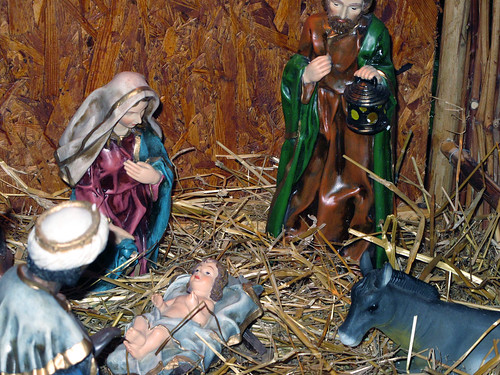
This was all brought to mind recently by a wonderful article by Joe Kay about holiday manger scenes, where he asks why these characters are all portrayed as serene and picture-perfect (and, inexplicably, Norwegian) despite what little we know about the journey they took, the conditions in which they lived, the money they didn't have?  I won't try to paraphrase what Mr. Kay says, because frankly I can't improve upon it:
"If our manger scenes were realistic, Mary would be recovering from a painful labor full of sweat and blood, with a look on her face that’s anything but serene. And Joseph — wouldn’t he be a nervous wreck, too? His hand too shaky to hold a lantern?

And about that newborn. Shouldn’t he be red-faced and screaming? Eyes clenched closed and wisps of hair stuck to the top of a head that‘s still odd-shaped from all the squeezing?

Instead, we’ve sanitized and romanticized it. We’ve removed all the blood and sweat and tears and pain and goo. It’s no longer something real. We’ve left out all the messy parts. The oh-my-God-what-now parts. The I’m-screaming-as-loud-as-I-can-because-it-really-hurts parts. The oh-crap-I’ve-stepped-in-the-animal-droppings parts. The real parts."
Nativity scene 017
Nativity scene at St. George's Church, Kobanya, Budapest, Hungary
PHOTO CREDIT: András Fülöp Used under Creative Commons license. Some rights reserved

Since we have artistic control of how we "see" them, why do choose to make them look perfect and unflustered when we know this was not the case? Why--as we struggle to make this more than a season of spending money we don’t have to buy people, some of whom we don’t even like, gifts they don’t need; eating and drinking too much and then feeling guilty--do we give the heroes of this story supernatural powers they didn’t have (endless energy, patience, WetNaps...) and make them less like us? 

I think it is a shame that the canonical Gospels don't include the argument after Joseph refused to ask for directions and the donkey ended up circling Bethlehem for 45 minutes with his left signal on, or the talking-to Jesus got when the bus had to go all the way back to Jerusalem because he was still at the temple, wowing 'em with his mad parable skillz.  We set ourselves up for disappointment when we fall for the notion that everybody else's Christmas looks like the families in TV ads, with nobody arguing or making hard choices about how to afford it all.

As for me and my house, we’d prefer a savior who chuckles and nods knowingly when we vacuum around the piles of clutter, or "phone in" the office potluck by putting something from the deli in our own Corningware. That is the God who may wince a little when we are short-tempered or selfish, but has been there and gets it. This is a time of year when many of us are faced, more than any other time, with the urge to curl up in a ball, mid-gift wrap or bike-assembly, and cry a little. That is a God I could call on in my darkest hour and expect to be understood, and Kay seems to agree:
"We acknowledge our brokenness, and God responds with a kiss on our sweaty faces and goo-covered foreheads. Reminds us that even though we make mistakes and bad choices, we ourselves are never a mistake or a bad choice. Instead, we are always a chosen miracle. And when we feel totally broken, that’s when we’re the most beloved."
If your sugarplums are all color-coordinated and your family beach photo with the Santa hats came out perfectly on the first try, more power to you. Go ahead and carve your nativity figures out of cream cheese just like Martha taught you.  We, the Chaos Muppets, may need to tape a sheep's leg back on or bring in the Power Ranger understudy for one of the shepherds, but each will nonetheless be a familiar home to the Savior when he comes.

May God bless us, every one.