I'D LOVE TO HEAR FROM YOU

Comments, criticisms, or (one can hope) compliments are more than welcome! Please let me know what you think, tell me I'm crazy (I suspect this) or what you'd like to hear about. Comments are screened before publication, so if you want to share something with me only, just put that in the comment and I'll keep it to myself.

THANK YOU FOR VISITING!
Showing posts with label Lent. Show all posts

Sunday, March 3, 2019

Who Was That Masked Man, Anyway?

The Last Sunday After the Epiphany

Exodus 34:29-35
2 Corinthians 3:12-4:2
Luke 9:28-43


I spent most of the past week in that slightly foggy state brought about by a cold. I’m not telling you this in a plea for sympathy, but it may give some context to the rest of what you’re going to hear. It definitely helped me identify with the followers in today’s readings, who were left trying to process events seemingly out of a fever dream. This is your brain. This is your brain on NyQuil.

I tend to fixate on strange details even while operating at 100%, and my preparation for this morning was no exception. With all the glowing faces and booming voices in today’s readings, the thing that caught my attention was that little veil that Moses kept playing with. Go in to talk to God… take off the veil. Come out to talk to the people… put on the veil.. What was that all about? The people of Israel are about to embark on a new covenant with God, with new rules for life, and here their leader is, having his own personal masquerade party.
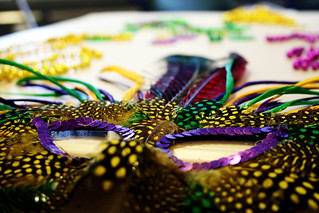
Mardi Gras mask
"Mardi Gras Mask" by Caitlin Reagan
Used under Creative Commons License. Some Rights Reserved
Speaking of masquerade parties, Tuesday is Mardi Gras. Mardi Gras, French for “Fat Tuesday” has its roots in the church. It represented the last chance to use up ingredients like butter and eggs, back in the time when Christians abstained from not just meat but all rich foods throughout Lent, not just on Fridays. This rigorous dietary observance had a practical aspect as well: meat that they had stored away for winter was nearing the end of its usefulness, and there would be lean days ahead until spring produce was ready.

Mardi Gras marks the end of a season known as “Carnival” (literally “farewell to meat”) which may have been adapted from the Roman pagan festival of Saturnalia. In the Middle Ages, when Lent was a period of intense spiritual practice and self-discipline, people needed a good party first to get themselves in the right frame of mind.

As Europeans colonized various parts of the world, they brought these traditions with them, where they would get combined with and flavored by indigenous practices. Different cultures at various times in history have marked the period with more of a wild party atmosphere that would overtake a whole city, still true today particularly in New Orleans, Rio, and Sydney, to name but a few.

Even today there is a scattered practice across the various mainline churches to informally designate the last Sunday before Lent as Mardi Gras Sunday. Some churches will have special brass music at worship, cajun food or even a dance. In the Anglican church, pancakes became the symbolic food of choice, and I hope you will all join us for some on Tuesday night.

Masks, costumes, and other disguises have always figured strongly in the observance of Carnival. From the earliest days, it was an opportunity for commonfolk to put on rich regalia, sometimes poking fun at their wealthy neighbors or otherwise putting the social order on its head.

Venice specifically has a tradition of elaborate masks, which were allowed to be worn from the Feast of St. Stephen (December 26th) until Lent began as a temporary escape from the city’s rigid social hierarchy. This practice lasted from the 12th century until 1797, and was revived in 1979. Carnival of Venice, as the song goes, is again a major celebration and tourist attraction.

On my last trip to New Orleans, I visited a little museum in the Treme neighborhood that showcases the tradition of “Mardi Gras Indians”. These groups of African-Americans pay homage to the native american tribes around the city who once sheltered people escaping slavery, by creating elaborate beaded and feathered costumes. Each outfit takes six to nine months to make, weighs up to 100 pounds, and is generally worn once or only a few times.

In modern-day Belize, prominent community leaders cross-dress or wear decadent costumes while dancing for money and prizes in a traveling band known as a comparsa. Carnival in all its forms presents an opportunity to level the social playing field and escape the norms of behavior that are otherwise expected, and in some times and places brutally enforced.

.But let’s get back to Moses and that veil, shall we? Moses, unable to contain the glow his face took on after speaking to God, covers himself with a veil to soothe his frightened followers. Likewise in the Gospel, Jesus appears transformed into dazzling white before three of his disciples, accompanied by Moses and Elijah, which renders the sleep-deprived Peter incoherent.

Why do you suppose the followers in both these stories were so disturbed by the change they observed in their leader? Moses, surely somewhat enraptured from his one-on-one encounter with the Almighty, didn’t even notice his face had changed until it was pointed out to him. I couldn’t help but feel a little bit bad for him, like “Hey, P.S. I just spoke to God! But sorry if my suntan is freaking you out.” Likewise, I wonder if Jesus, bemused by Peter’s reaction, was tempted to tell his dumbfounded disciples “Fasten your seatbelts, kids. You ain’t seen nothin’ yet!”

But yet we can identify with the followers in both these stories as well, can’t we? They were tired, maybe impatient. They’d already been asked to take extraordinary leaps of faith, giving up their familiar lives and wandering into a physical and spiritual unknown. We tend to like for the people we know to behave predictably, and I suspect they did too. But now, in both stories their leader was suddenly looking radically different and they were being told God was speaking through him with new, life-changing commandments for them to follow.. How much more could be expected of them?

I thought we would spend a few minutes on the kinds of masks we wear in our own lives.  Not actual masks, mind you, although that would make the office or the grocery store more entertaining. To mask or veil something, or ourselves, suggests deception. This isn’t always a literal or visual tactic. Sometimes it can be as simple as the details we include or leave out when telling a story. I think we all do this to ourselves and others by varying degrees, sometimes unconsciously, sometimes in self-defense, or to seem nice or smart or successful or normal. How often do we say or hear “how are you?” and the acceptable one-word response is “fine”?

But it can also be as profound as hiding a major aspect of our identity, like the people who live silently for decades with anxiety, illiteracy, addiction, or abuse; or who suppress feelings about their gender or sexual orientation out of fear they will be rejected by the people in their lives.

Then there are the physical masks we wear. We can say things about how we want to be perceived by others by the things we buy, where we go, and what we do, and we have a multibillion dollar marketing industry ready to help.

The online world introduced a whole new set of masks for us to play with. While we may think of social media as a way to present a more glamorous or exciting version of our lives to an online audience, it also allows people to tap into communities and exchange ideas that either cultural taboos, physical isolation or even political oppression would have made impossible ten years ago.

Anonymous screen names have allowed people to organize resistance movements or escape dangerous situations. However, like real masks which can allow anonymous injury to others, these online personas can have a dark side, too, like when they also allow us to spew vitriol at strangers that we’d likely never have the nerve to say to their faces.

It is not always with deceptive or malicious intent, however, that we embrace these masks.. Sometimes it’s because we don’t think the other person can handle the unshaded truth, and it’s easier or kinder to let them be with an alteration. Maybe Moses donned that veil to keep the people from being distracted while he tried to get them on board with what the covenant with God was going to mean for them, which was far more important, but Paul suggests he wasn’t doing them any favors, because instead of remembering the covenant, their minds went back to the veil.

But sometimes it’s because we’re afraid of how the “real” us would be received. Moses, you may recall, was a stutterer who was dragged reluctantly into a leadership role. When he obtained “that glow” after speaking to God, maybe he was just as uncomfortable with the attention to his appearance as his followers were seeing him in this different light. How often do we stifle our own needs or ideas for fear of sounding silly or presumptuous or “high-maintenance”? There’s an element of our culture that discourages thinking of yourself as too special, and thus we might take steps to “fit in” by dumbing down our dreams or putting them aside to be what is “appropriate” or convenient for those around us.

Yet when Moses went back in to consult with God, the mask comes off. And so it should be with us, as if God couldn’t see past it anyway! Paul tells us, “when one turns to the Lord, the veil is removed. Now the Lord is the Spirit, and where the Spirit of the Lord is, there is freedom.” How freeing indeed that we have a God who knows our frailties and selfish idiosyncrasies and loves us anyway?

My hope for this Lent is that we can all examine the masks we wear, the limits we put on ourselves and others, that are born of fear and doubt; That we challenge ourselves and those we encounter to be transfigured by God’s presence, and not hide but embrace the irrepressible glow that comes from God’s love for us. We have only to listen to to the words and model the actions of his son, whose covenant with us requires only love, pure and unmasked, for God, one another, and ourselves, just as we are. And what a celebration that would be. Amen.

Tuesday, March 24, 2015

Running On Empty

This post was actually begun on the Feast of Christ the King, but needed to wait til now to be shared.
 

MY FRIEND MICHAEL SAYS THAT THE CHURCH WILL SUCK YOU DRY IF YOU LET IT. By that he means, if you don’t allow yourself say “no” sometimes, you will find yourself on every committee and guild, and have guilt pangs if you ever have to leave before the last dish is washed and the last chair is stacked, despite the insistence of the EMTs carrying your stretcher towards the ambulance. There is a truthism that if you want to get something done, ask a busy person. The church seems to have taken this very seriously, maybe because it works. For them. For a while. But then what?

I read an article recently called “The Rise of the Dones”. Basically, the Dones are the people above. They have volunteered at the soup kitchen and taught Sunday School and stuffed envelopes and sat through all three liturgical cycles five or twenty times and heard seemingly every possible take on the readings from the pulpit. They grow tired of feeling that no how matter how much they do, it is never enough. Up your pledge, stay on vestry one more year, miss your TV show or your kid's game for that meeting. So, they bolt.

A dear clergy friend from whom I sought counsel told me it was totally okay that my partner and I left our church because it wasn't working out with the new rector. As she put it, we were not being fed. Her assumption, and ours, was that we would look around, find someplace else, and feel fed again. And we tried. We went to about twelve places with no expectations, and landed on one where the rector was everything his counterpart was not. We did our best to adapt to the way things were done differently, and struggled to fit in, until he abruptly left six months later. We stuck it out for another six months or so, and finally drifted away. Well, my partner drifted; I walked out in the middle of a service and never went back. That was over  a year ago, and I have not gone to church regularly in all that time. It is no-one's fault; it's just how things are right now.

Separately from, but related to that, I have concluded all but one of the ministries in which I am involved.  If you read my previous post "Hurt People Hurt People" you know as much about that as I do.

Am I a "done"? I don't know, but -- as my friend Matthew says -- I can sure see it from where I live.

I don’t want be a Done. It’s not that I don’t miss it. Sometimes I do, but it’s hard for me to articulate whether I miss something I actually had, or am pining for a kind of community that I have yet to find, or create.

I am being fed, through recitation of the Daily Office (boy howdy, those lenten psalms are rough, but apropos) and the Church of the Internet.  You can attend morning prayer online with a group and find wisdom and beauty from all quarters in music and writing.  The prophetic Jennifer Thorson wrote an absolutely brilliant sermon for Christ the King:
“The Rich and Powerful of today are not listening to Scripture any more than the Kings and Queens of the past who claimed that their leadership was a Divine Right. Earthly rulers may push and shove to get their way, they may see themselves as God-like, but the God of our scripture is a Shepherd King with dirt under his nails instead of blood on his hands, and the earthly powers are mere sheep, just as the exiled Israelites of Ezekiel’s time were sheep, just as you and I and the poorest of our brothers and sisters are sheep.”
I do go to actual church sometimes. During a trip to North Carolina, I visited a parish I helped my friends find and join a few years ago. They had a guest preacher (Jeffrey Pugh, Ph.D.) , and his take on the Gospel parable of the unprepared bridesmaids was to use the lack of oil as a metaphor for contemporary fatigue, confusion and despair:
“Immersed in a world that seems bereft of hope or promise, we still wait for the Not Yet. We wait for deliverance from empire that grinds us all down by its incessant demand for more power. We exist in the middle of a world where any lie is told to gain control over others, and wealth is used by an oligarchy to oppress those who do not have the ability to fight back. We await in the darkness of billions of dollars spent on weapons of destruction, and of political propaganda to maintain control, and it keeps us all -- especially the rich and the powerful and those who benefit from this -- in a great darkness that leaves us feeling our way along a long dark tunnel of any light. We are exhausted, and our light has gone out.”
A few weeks later, two friends and I “did church” of a different sort, driving 2 1/2 hours to Lancaster, Pa., to hear author Anne Lamott speak. Her voice resonates with me the strongest, here in the tunnel, because she makes no pretense of being any better at it than I am. Completely forthright about her own fractured upbringing, struggles with addiction, and “teeny control issues” she told us that God fully expects us to be messy, and grouchy, and selfish sometimes. That was a relief to hear, because I don't even have her dissonance-inducing compulsion to be perfect. But listening to her tell of her friends and family members, followed by the stories some of the other audience members shared, I couldn’t help but feel like a little bit of a jackass. Yes, our church experience got screwed up, but nobody died, or even stole my sticker collection. And I am surrounded by loving and talented people who give tremendously of themselves.

So maybe I need to shut the hell up. I can be fed, if I take the time to look and listen. And more importantly, I can make sure that others are. Pugh and Lamott had similar answers, on the theme of Don’t Become Part of the Problem. She suggested treating yourself to TV and m&m's for a few days, but ultimately, find someone to talk to. Or sit with a kid and make angels out of coffee filters. Her congregation of 32 people operates on the thinnest and most frayed of shoestrings, but she describes it as a place of unspeakable joy, and I believe her. I pray that I will have that feeling about church again someday.

Pugh says, “Christ returns to every heart that makes room for forgiveness and grace. The second coming happens every single day we choose to make peace instead of war; every moment when we extend mercy to those in need. It is not the constant watching that is the heart of faith; it is the preparation for the long haul. I can manage being kind for fifteen minutes in a day... but a lifetime?”

I guess we can find out.

Monday, March 11, 2013

Right-Sizing

Gregory the Great - Bishop & Doctor (604) 

“Baby I've been thinkin’ ’bout a trailer by the sea
We could go to Mexico, just you, the cat, and me”

- JESSIEby JOSHUA KADISON

Much is made of how complex our lives have become. In addition to the people with whom we interact with in real life, most of us are entrenched in social networks of virtual friends, interest and action groups. Besides choosing from 300 channels of TV programming available 24/7 and automatically getting recorded for you to watch some other day, there are myriad streaming and on-demand selections to choose from right now. I read the other day that one TV service lets you record up to five programs simultaneously. I’m lucky if I can find one thing I want to sit through.

A whole store devotes itself to giving you new ways to put stuff away. You can subscribe to a magazine whose touted purpose is to unravel the mysteries of decorating, child care, and emotional health. Squads of “geeks” stand ready to spring into action and make all the bells and whistles jingle and toot in harmony. An invisible cast of thousands labors unseen to ensure that your ability to watch “Cat Friend vs. Dog Friend” on your phone at a traffic light is unimpeded, and if you feel tempted to get a new phone before your two-year commitment is over, there are companies ready to take the old one off your hands... for a fee of course.

Living With Less.  A Lot Less.” - Graham Hill, Sunday New York Times

When I first saw today’s “most emailed” article, I assumed it was going to be about an individual or a family whose consuming habits were suddenly cut to the quick by the ongoing economic situation which seems to be if not directly affecting everyone, at least keeping us all under the same anxious pall.

In fact, it was the experience of a successful entrepreneur named Graham Hill (founder of treehugger.com) who has the means to live however he wants to, but discovered -- completely by accident -- that his consumer habits seemed to be driven more by inertia than actual need or even desire.  Having made a bundle on the sale of a successful start-up, he purchased a large house, and hired someone to fill it with things: in many cases, his role was limited to a hasty choice from a series of Polaroids. He then ended up seeking roommates because the house was too big for him, especially because he was rarely there. By this point, his vocation had taken him to the opposite coast, where he did the same thing with a big loft before he realized how much time, cost and energy was being expended for so little personal payout.

The next chapter of Hill’s life brought him to Europe, where he discovered that -- in the right company -- he could be happy and productive with just what he could transport in a backpack. Today he lives in a tiny but extremely functional studio, which can be adapted to host dinner parties for 12 or a pajama party for four.

What few of us stop to think about is what compels us to purchase, engage, and accumulate so many objects and obligations , let alone to what degree they actually make us happier people. The Gospel reading on Ash Wednesday, which kicks off the Lenten season, invites to rethink our priorities a bit:
“Do not store up for yourselves treasures on earth, where moth and rust consume and where thieves break in and steal; but store up for yourselves treasures in heaven, where neither moth nor rust consumes and where thieves do not break in and steal. For where your treasure is, there your heart will be also.”
MATTHEW 6:19-21

While not everybody subscribes to the notion of an afterlife, for me this passage definitely invites some reflection about how I spend not only my money, but my time.  I'm not 22 any more, and -- just because I can -- I don’t necessarily have to get a new outfit or drop a chunk of change on drinks in the city, just because “everybody else is.” As we face more economic and vocational uncertainty, I take more pleasure in a zero-balance credit card.

Airstream Sunset on South Beach
“Airstream Sunset on South Beach” by Monica Bennett
Copyright, all rights reserved.
We live in a house which is -- like Hill’s -- far more than we really require. When we first met, the same two people and two cats survived in what was essentially two rooms for many months. It did not take us long to “grow into” and find uses for all the space we have now, but it isn’t necessary, and the amount of money and work it takes to maintain it often makes me think the protagonist in Joshua Kadison’s ballad was on the right track. I spend an annoying amount of time staving off unwanted catalogs and recyclables, purging clothing out which I've grown (or aged), and -- after ten guilt-inducing minutes of Hoarders: Buried Alive on a recent Saturday -- cleaning out an entire closet, most of whose contents hadn't seen the light of day in years.  While I'm not quite ready to live out of a backpack, we could certainly pare things down quite a bit and get along just fine.  When it comes down to it, if you can’t find happiness by surrounding yourself with the kind of people who bring you joy, no amount of bling is going to fix it.

The same can be said for the “networks” into which we become immersed. A foray into the game Second Life was cut short when I realized how much it was eating into the first one.  We have a family joke about people bringing their little electronic friends to the table: we are all trivia buffs, so inevitably an argument will require someone to look up a batting average or film credit. Even the biggest protester is occasionally guilty of whipping out the digital version of Grandma’s Brag Book, but we do strive to be “in the moment” on the rare occasions that we are able to get everybody together. 

Now, if you’ll excuse me, I’m off to IKEA... I just need something real simple to hold all these magazines!