Random patter from one easily amused and more easily confused.
I'D LOVE TO HEAR FROM YOU
Comments, criticisms, or (one can hope) compliments are more than welcome! Please let me know what you think, tell me I'm crazy (I suspect this) or what you'd like to hear about. Comments are screened before publication, so if you want to share something with me only, just put that in the comment and I'll keep it to myself.
The Right Rev. Mariann Edgar Budde, Bishop The Very Rev. Randolph Marshall Hollerith, Dean The Cathedral Church of St. Peter & St. Paul 3101 Wisconsin Avenue NW Washington, DC 20016
Your Grace and Your Reverence:
With all due respect to your offices and the admiration I felt for your comportment over the past year, I felt compelled to join the chorus of bewilderment and dismay surrounding the decision to offer the pulpit at the Cathedral to Max Lucado.
I freely admit, that—like Bishop Robinson—I had never heard of this person before this controversy ensued. Almost twenty years after fleeing an intolerant denomination for one which purported to celebrate or at least respect people like me, I felt I could use my church leadership as an imprimatur to discern “whatever is true, whatever is noble, whatever is right” … whatever will keep me from feeling like God considered me a mistake. I thought I could assume, for example, that a man who likened my relationship to bestiality or incest would not be invited to preach at a Sunday Eucharist at what had felt, heretofore, like a safe place.
While I understand the somewhat unique role the Cathedral plays in the national conversation by nature of its location and appreciate the privilege this has given the wider church at various moments in history, I assert that it is still the Episcopal cathedral in that city, with a responsibility to the LGBTQ people, some of them horribly church-burned, who seek safety within its walls specifically because of that affiliation, and the spotlight it enjoys means decisions like this are seen far and wide and impact how the entire denomination is perceived, especially now.
I spent twelve years working to cajole, nudge, and in some cases beg this church towards actual LGBT (we never got to the Q) inclusion. After hearing countless painful stories, enduring some withering diatribes, and witnessing some quite un-Christian behavior, I eventually had to step away for my own well-being. While we have as an organization been congratulating ourselves for a long time on how inclusive we are, it appears today in a lot of eyes that we are not yet there.
As a denizen and frequent unofficial ambassador of the church on the social Internet, I am today watching LGBTQ people who were looking to us as a sanctuary now reconsider that choice. Arguments about diversity of opinion are ringing hollow with them: people who have been wounded by words like Lucado’s do not want to hear that we need to give him a turn. And—as Jim Naughton pointed out—he is not some unknown prophet who needs the Episcopal Church’s help to be heard. My pointed question to you is: do we need his?
I am reading again the Isaiah passage from this morning and trying to decide what outcome to pray for here. I know from your public response that you are not unaware of how this decision has been received. I pray you find the wisdom and fortitude to repair this breach and make Wisconsin Avenue again feel like a safe street in which LGBTQ people can live.
In faith,
Christian Paolino Former Stakeholders Council Chair, IntegrityUSA
----
EDIT: The following statements were issued since this was published:
It is easy to think of LGBT culture in New York as beginning with the Stonewall Riots of 1969. It is particularly easy for me, since I was also born that summer. Less, however, is known about what life was like for folks prior to that, which may well be because much of it took place in secret for the participants’ own safety: in unmarked clubs, with coded language that allowed communication under the noses of a population which would betray them to family, employers or the police. Being gay, or even something as innocent as a woman wearing pants in public, could cost you your job, home, and friendships, or get you arrested, raped, or beat up.
Juliana cover.
Used with author's permission.
The first novel by playwright Vanda, Juliana gives us a look at this particular time and place by introducing her own characters to famous names of the day, many of whom risked their own careers, reputations, and marriages to indulge in “the love that dare not say its name” as the nation finds itself reluctantly drawn once again into war.
We see New York through the lens of a wide-eyed suburban Long Island girl “Al”, who moves to the city with her three childhood friends (Aggie, Danny, and Dickie). Each has dreams of making it big in the arts world, which they quickly discover is populated by folks quite unlike the ones they knew in Huntington. When big-talking producer Max Harlington III comes to their table, Aggie & Danny are entranced, while Al and Dickie remain skeptical. He takes them to clubs where cross-dressers, “bull daggers” and interracial couples all find sanctuary.
Taken in by the big promises of Max, the friends each set about fulfilling their dreams only to discover that, to quote Debbie Allen: ”Fame costs… and right here’s where you start payin’... in sweat.” Running between auditions, lessons, soul-killing day jobs, and infested apartments, they struggle to keep their friendships alive. It has always been assumed that the couples (Al and Danny, Aggie and Dickie) would marry someday, but as the book progresses, that dream becomes as elusive as the thought of your name up in lights.
For Al, the biggest distraction is Juliana, a talented vocal performer who seems perpetually on the brink of success. Juliana awakens feelings in Al she was unaware she possessed, then shocks her further by making it clear the interest is mutual. Although Al continues to harbor some disdain for Max, he proves useful in making this connection. When things with Juliana go awry, however, Al flees back to Max’s place only to make a further unwelcome discovery that throws all her plans for the future into disarray.
Vanda
Used with author's permission.
One of the prevailing themes for me is the degree to which LGBT people of this time period bought into the societal narrative that there was something wrong with them. Beyond entering into sham marriages and other means of protecting themselves, the characters continue to use words like “perversion” to talk about their own feelings. It is not hard to accept this as realistic given what they were hearing from the culture at large. Sadly this still occurs today despite all the “it gets better” cheerleading, positive role models and at least the patina of tolerance from official channels.
The declaration of war in 1941 sends the characters’ lives in different directions. Max, Dickie, and Danny all end up overseas and Al contributes much of her time and energy to the Stage Door Canteen, a real-life place on 44th Street where military men were fed and entertained by Broadway personalities. Here she mingles with greats like Katharine Hepburn, Ethel Merman, Alfred Lunt and Lynn Fontanne, who performed or helped staff the club. Many of these stars had cameos in a film named for the club, which stood on the site of the former New York Times printing press.
Dickie, Max and Danny all make it home alive, but not unscarred. They describe the conditions gay men and women encountered during deployment… perhaps the roots of “don’t ask, don’t tell” where camp behavior was tolerated and even encouraged in some quarters, but one misplaced word of affection could erase years of dedicated service with the stroke of a pen. Small wonder that a study 60 years later found almost 15% of closeted LGBT veterans attempt suicide: imagine the nightmarish memories of combat layered with the constant fear of being found out.
Meanwhile, Al--at a breaking point--confides in best friend Aggie, whom she has helped through some serious setbacks, only to discover that their bond is not stronger than the prejudices with which they were all raised. Betrayed, Al turns again to the unconventional people from whom she continues to try to distinguish herself. I found it interesting and even a little vexing that these individuals, apparently further along the road of self-acceptance, continue to tolerate this behavior almost without reproach. It is not always clear what she brings to the table of these friendships besides judginess and a need for a whole lot of hand-holding. But I suspect then, as now, there are those who see their younger selves in the newcomer and thus deal with such foibles gracefully.
Nevertheless they take her under their wing and we see such real-life scenes of early gay New York as Spivey’s Roof, a nightclub on the Upper East Side where gay men and women were allowed to congregate as long as they (mostly) behaved. A young Walter Liberace played here briefly before unwittingly crossing Madame Spivy, the club’s imperious owner, namesake, and star performer, a scene described in the book.
The first volume leaves off with relationships on hold and a lot of unanswered questions. Luckily, a sequel which picks up at around D-Day is due out this summer. Meantime, an ensemble cast periodically performs scenes from the book at the legendary Duplex nightclub on Christopher Street, just steps from the Stonewall Tavern. You can learn about upcoming events on the Juliana Project Facebook page or by visiting vandawriter.com and subscribing to her free newsletter.
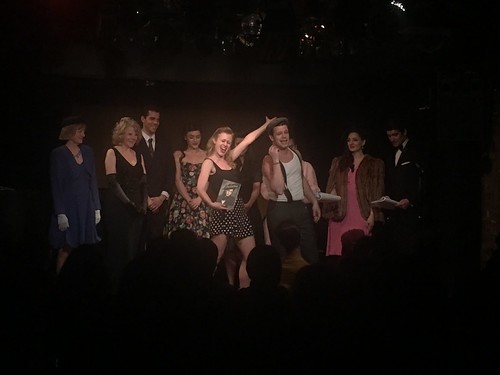
The cast of a staged reading from Juliana at the Duplex. My photo.
As we remember the sacrifices of those lost in our country’s wars, my mind goes particularly today to those who served and died for their country, likely leaving behind secret friends and partners who were not honored or comforted, and perhaps never even learned their fate.
Greetings from the Future! I realize that I (45-Year-Old You) am still not on speaking terms with 16-Year-Old-Me for not lifting weights instead of taking gym class whenever you had the chance. For the record, we’re still thudding three miles around the track everyday trying to get rid of that Burger King sandwich you just ate.
However, since New Jersey is in the midst of celebrating Pride, I’m feeling benevolent. I realize you don’t yet know what that is, sheltered little Catholic School graduate that you are. But someday you will not only come to terms with the way you feel about some of the guys you know, but there will be guys who feel the same way back, and you will no longer think you are some kind of alien species with crossed wires.
Speaking of which, not three months ago, two of those boys in your high school class, who weren’t always the nicest to you, manned up and apologized for the way that they acted, completely unbidden. I know it’s hard to believe now, but 45-Year-Old-You wasn’t even overwhelmed with surprise at this development. People change and grow, and — if you have any kind of conscience at all — it seems to be human nature to carry around those little hurts that you cause, like pebbles in your shoes. Redemption — when you find it — can feel be a relief, and 45-Year-Old-You was actually glad to be a part of that exchange.
We’re not supposed to give spoilers, but you’ve seemed kind of in the dumps lately, so I’ll throw you one. Breathe a word of it and I’ll deny everything, mind you, but listen: Right now, in a house not that far from your freshman dorm room with the roommates you’re afraid of, a ten-year-old boy is growing up fast. Years from now, when you’re both what you currently consider ancient (don’t think I didn’t hear that!), he will cross your path and catch your eye. In a church, no less. Yes, I know a church just told you to take a hike, but God won’t give up on you just because that nun did, and when it’s time, you’ll grudgingly come around.
A few years after that (I should warn you, they keep going by faster, like some crazy carnival ride) you and he will be the proud uncles of nine (count them, nine) beautiful and intelligent nieces and nephews, and each of your families will treat you like there’s nothing wrong with you being together. Because there isn’t.
So hang in there, 18-Year-Old Me. The best is yet to be.
Knowing what you do now, what would you tell your eighteen-year-old-self?Keep the party going by replying to Brita's original letter, and/or using the hashtag #Dear18YOMe.
It's been over a decade since I found a home in the Episcopal Church and -- almost immediately thereafter -- got involved in ministry with LGBT people. As society's attitudes about sexuality have evolved and congregations have become more willing to acknowledge the diversity in their midst, this has shifted from providing "safe spaces" off to the side for our folks to pray and socialize as their whole, authentic selves, to actually getting whole faith communities to weave universal welcome into their mission and identity.
What I haven't yet offered up here is how I came to be an Episcopalian in the first place. At the tender age of 18, I was a member of the Antioch young adult group at a Roman Catholic parish. Caught up in the emotion of a retreat, I shared with a trusted friend, and a priest, the secret that I was experiencing same-gender attraction. Despite being assured that this would be kept confidential, I got a phone call (from a nun, no less!) several weeks later saying it would be "better for the others" if I wasn't around. "Some of the parents have concerns," she explained, without elaborating.
I did not actively attend church again for over ten years. I was in church, because I worked as a paid musician here and there, but it felt like a job and I was an outsider there to perform a service, not a member of the community.
At some point, I went to hear my friend Jennifer sing at St. George’s Episcopal Church in Maplewood, N.J. The denomination meant nothing to me at the time. We were both raised in the days of the Baltimore Catechism, and my CCD classes left me with the kind of "us-and-them" mentality that meant there were only two kinds of churches you needed to worry about: the Roman Catholic Church and Everybody Else. But that visit -- where the Right Rev. John Shelby Spong preached about the nuances of sin in a way I had never heard -- set me on a new course. When 9/11 devastated our area, I found myself delivering donations to another Episcopal parish, with a partnered gay priest. Okay, I get it. I said grudgingly. I went back a few times, ended up on a committee or two, and was received (a service for converts, very similar to confirmation, where you formally commit yourself as an adult member of the church) a few years later.
It should not be a surprise that my area of ministry quickly ended up being to other LGBT people. I have now worked in diocesan ministry for nigh unto ten years, and on the national level for about four. The most profound thing I have learned is -- as traumatic as my own experience was -- it was peanuts compared to what some of my brothers and sisters have experienced at the hands of the church. And, in the ecclesiastical equivalent of PTSD, the collateral damage of all those individual little wars reveals itself on a regular basis, even (aye, maybe especially) among leaders of the movement.
I have witnessed spectacular displays of distrust and hostility (some of it richly deserved) leveled at institutional religion, and sometimes laser-aimed at the unfortunate soul who naively identified as a member. In my official capacity, I attended a memorial for a man I had never met, and my expression of gratitude for his decades of service was lost when a complete stranger, learning what group I was there to represent, proceeded to publicly lambaste me for ten minutes about events that took place in that organization while I was many miles away attending grammar school.
I have also seen it -- heartbreakingly often -- among our own: we shoot accusations like arrows from the safety of our Facebook chairs, far enough away to avoid getting splattered with the mess. Too often, people all theoretically working for the same cause fall into predictable opposing teams, mess with one of us, you've messed with all of us, or something like that. Simply disagreeing with a person’s ideas or interpretation of an event is immediately labeled as bullying, slander or worse, and decades of toxic history are dragged out yet again like some kind of dystopian yearbook to prove... what exactly?
It is contagious, this; I have been guilty of it myself, which I deeply regret. I can get caught up in the need to avenge wrongs that had nothing to do with me. I have walked away from conversations and shut myself off from further contact with people who seem to be repeated triggers. And I have, truth be told, contemplated frequently whether the rate of progress, which feels downright glacial at times, is worth the emotional toll. Maybe I should just fold my tent quietly, dust myself off, and walk away. What’s another ten years in the desert?
In trying to atone for and heal from my own contribution to this malaise, I keep coming back to a conversation I had with a friend about her troubled son, whose treatment of her ricochets between intense devotion and blinding rage. The words that entered my head, which I wrote on a napkin while she was describing one such encounter, was:
HURT PEOPLE
HURT PEOPLE
Now if you are not "hearing" that in your head, maybe you recall seventh-grade English and how much fun it was to diagram sentences:
Or, to put it another way: "Hurt (adj.) people HURT (verb) people."
The one thing LGBT people almost universally have in common is that we have all been -- at one time or another -- treated badly. As children, we got mocked for being different or strange; for not liking dolls when we should, or walking funny. Later, we may have been rejected by family members, passed over for jobs, kicked out of churches, or accused of being immoral and a danger to children simply because the gender that turns our head, or that we claim as our own, is not what others expected it be. I have yet to meet the person who avoided it totally, although it is getting better, thanks be to God!
The Velveteen Rabbit
illustration by William Nicholson
Public Domain (1922)
Those of us who are doing inclusion work are -- by definition -- revisiting those old personal hurts, over and over again; either by talking other people through them, or trying to explain to potential allies how it feels to be a person like us. We don't have the luxury of shutting those bad memories in a box and celebrating the happy, well-adjusted person we became, safe to pursue career and relationship goals by nature of the progress the church and the state have made. Like the Velveteen Rabbit, it is our scars that will make us “real” to those wounded hearts whose trust we must carefully earn.
Perhaps this is the gift that we carry to the altar. Maybe we sacrifice "moving on" in order to build the church and the world where others may someday do so undamaged. If that is so, then we must acknowledge what that costs, and the attendant dangers.
This means we can, if we're not careful, see our present circumstances only through the scratched lenses and battered, taped, frames of the past. We are liable to interpret the words and actions of others as if we were back in that awful place we fought so hard to overcome, particularly when we find ourselves under stress. In that dark world, allies can easily be mistaken for tormentors, and that puts us at a higher risk of inflicting further wounds on them, if we can’t see their vulnerable spots past the scales on our own eyes. Trust me, I know there are some people who just manage to push your buttons, but in the heat of the moment it is easy to confuse the person and the issue; what is really their damage and what is just our own stuff, coming back to haunt us.
It also means we can become so used to victimhood that it has become too comfortable, or too scary, to give up. We have fought hard to achieve wider acceptance, but with equal rights comes equal responsibility. It is good that we are different, and it is important and wonderful that we are survivors, but it doesn’t make us "special" in the sense that we should continually expect to get a pass for bad behavior because of it. We find it exhausting when others do it; we should learn to recognize it in ourselves.
With the bread we need for today, feed us. In the hurts we absorb from one another, forgive us. In times of temptation and testing, strengthen us. From trials too great to endure, spare us. From the grip of all that is evil, free us.
For you reign in the glory of the power that is love, now and forever. Amen.
So what next?
As a souvenir of that fateful weekend, I have -- shoved into the top of a closet -- a grocery bag full of palancas, letters of affirmation from other Antioch members, parishioners and others that I received on the retreat. The word palanca is Spanish for "lever" and the purpose is to give someone a spiritual "boost" through prayer or encouragement. So this is my palanca for you, 21st-century style:
If any of this struck a chord with you, I invite you to play the video below, eyes closed if you want, and think about your own experience while you listen. Hold up the hurts you’ve endured, and the hurts you’ve caused, and allow yourself to feel forgiveness, given and received. Think about what you might say or do differently next time. What if you shared one of these vulnerabilities with the person who causes you the most angst, and asked them to share one of theirs with you? What would your relationship be like after that?
That song was composed by Gregory Norbet, a former member of the Benedictine monastery at Weston, Vermont. It is a working farm in a rustically beautiful setting, particularly in autumn, and has been a "go-to" place of refuge for my entire life.
The pond at Weston Priory
We can… you and I can… build that place of sanctuary for each other. We can learn to help each other heal from what has happened to us, and be the palanca, the lever, that helps them accomplish what they otherwise could not. We can have the grace to ask for forgiveness when we screw up (and we will screw up… I know I will) and know that it is offered with sincerity. We can know that it is okay not to always be perfect, and not always be right, and not always have the last word.
We can do this, aye, we have to do this. We are called to be a force of good in the world, are we not? How can we take that on with so much distrust and resentment underfoot? We need each other on this road, flaws and all, and we can get there much quicker if we learn how to bring out the best in one another, instead of the worst.
“Jesus Consoles the Women”
from Clarence Enzler’s Everyone’s Way of the Cross
Christ Speaks:
How often had I longed to take the children of Jerusalem and gather them to me. But they refused. But now these women weep for me, and my heart mourns for them-- mourns for their sorrows that will come.
I comfort those who seek to solace me.
How gentle can you be, my other self? How kind?
I Reply: My Jesus, your compassion in your passion is beyond compare. Lord, teach me,help me learn. When I would snap at those who hurt me with their ridicule, those who misunderstand, or hinder me with some misguided helpfulness,those who intrude upon my privacy – then help me curb my tongue.
Recently I returned to San Francisco after a long absence. It was my third time in the city, the first being an idyllic sojourn at the Fairmont on Nob Hill at age 14, when my mom and I accompanied my dad on a business trip. I remember being told with great politeness that the man who played the piano in the cocktail bar was very particular about who else touched it, and then being presented with another instrument (Steinway grand, natch!) in a disused conference room with the invitation to enjoy it for the rest of my stay.
My second visit was in 1991 with my then-roommate Glenn. In our early 20s, we were traveling on a budget and relied on the Hotel/Motel Red Book for our choice of accommodations sight-unseen in those pre-Trip Advisor days.
Our first hotel looked as if it survived the Great Fire of 1906, but just barely. If there was an actual fire, other guests on the floor were instructed by a large sticker to break the painted-over glass in the door to our room to access the fire escape. We decided to leave before one of them decided to try.
Our next place of residence, the Leland, was -- unknown to us until we had arrived -- not exactly a tourist hotspot either. Most of its guests were either more permanent, or just there for an hour or so. We stuck it out for our few remaining days in town, but the Fairmont it was not, and I was not surprised to learn that it suffered a major fire a few years later, displacing 60 people who called it home.
Polk Street was at that time in its last throes as a former gay mecca that pre-dated the Castro. By the 1990s, in a city decimated by AIDS, the once-vibrant scene was pretty downbeat. We were largely surrounded by sex workers and those whom they attracted, as well as many young people who were -- as the Brits say -- "living rough" on the streets of the Tenderloin. Both were surprisingly engaging and we had a number of exchanges, some humorous, some heartbreaking. At a luncheonette, for example, I learned that you could eat three-quarters of a meal before pretending to find glass in it and walking out in a manufactured huff.
Everybody had a story: Going to be an actor, going back to school, just here 'til I turn 18. They accepted our presence without question; thrown -- if anything -- by the fact that we were neither buying nor selling, and really only interested in conversation. By and large, they took it in stride. I -- on the other hand -- had my world rocked. I grew up in the woods in what I now understand to be a life of great privilege compared to how most of the world lives. We understood such things as poverty mainly in the abstract: we knew that it was important to care for those who had less than you, but we rarely encountered the kind of gritty reality in which my friend and I found ourselves.
The following year saw the release of Where the Day Takes You, a film portraying the lives of a group of young people on the streets of Los Angeles. It marked the feature debut of Will Smith (as a double amputee, no less), but also featured such names as Dermot Mulroney, Ricki Lake, Kyle McLaughlan and David Arquette which would later become household words. Their daily routines of trying to score food, money, drugs, a place to sleep, were starkly similar to what we witnessed first hand in the Tenderloin, and both have haunted me ever since. Below is a montage of scenes from the film, set to "Precious Pain" one of several songs by Melissa Etheridge that appear in the soundtrack.
"Empty and cold, but it keeps me alive
I gave it my soul, so that I could survive
Keeping me safe in these chains, precious pain" - MELISSA ETHERIDGE
There are approximately half a million homeless young people in the United States, with just 4,000 shelter beds designated for this age group. Depending on whom you ask, between 20-40% of them identify as LGBT (compared to 10% of the general population). These young people are twice as likely as their straight/cisgender peers to have experienced sexual victimization (60% vs 30%) and seven times more likely to experience sexual violence, and most have either been thrown out of their homes or fled for their own safety. A crushing 62% of them commit suicide.* In the movie, Lil-J, portrayed by Balthazar Getty, resists and then ultimately resorts to sex work, only to be traumatized by a flashback of being molested by an uncle. Young people who experience gender variance are at particular risk, frequently being denied access to shelters or encountering violence.
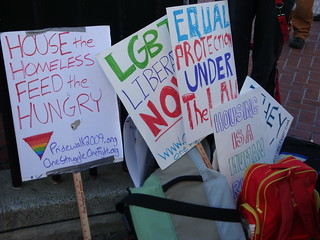
Signs at San Francisco Shine 2009
PHOTO CREDIT: LarryBobSF flickr.com/larrybob
Some Rights Reserved
Used under Creative Commons License.
In a country that views the homeless as "a problem" and will spend money to install spikes in the sidewalk so they can't find a place to rest instead of offering them food, shelter or counseling, runaway/throwaway LGBT youth and young adults are near the bottom of an already-low pile. Struggling young mothers and their children garner much of the limited sympathy the public can muster.
Fortunately, at least in some places, this unique need is being met in specific and appropriate ways:
The Church of St. Luke in the Fields is located just off Christopher Street in New York's West Village, where many young people (a large number of them either homeless or housing-insecure) gather every weekend. The congregation responded by creating an event each Saturday night known simply as "the church" which provides a meal, programming, and access to counselors and doctors. The church would like to expand the mission to a 24/7 drop-in center but is meeting stiff resistance from some of its neighbors.
Another youth center which intentionally engages LGBT youth (although not exclusively) is The Door, which provides a host of counseling, education, and social opportunities in a positive, affirming environment.
The Hetrick-Martin Institute, which helped open the Harvey Milk High School in 1985 as a place of refuge for LGBT students to learn in safety, recently added an after-school drop-in center in Newark.
In addition, the Ali Forney Center operates a network of shelters and temporary residences, while providing access to health care and counseling. Residents are encouraged to continue their education and secure employment, with the goal of preparing them for an independent and stable future. Their "get help" page lists resources in many other states. Several of their facilities were badly damaged during Hurricane Sandy.
Contributions and other support for all of these projects are always welcomed, and -- in some cases -- sorely needed.
I am mystified and saddened that parents could reject their own offspring on the basis of something as innate as attractional orientation or gender identity, but -- given what our society prioritizes and glorifies -- I suppose I shouldn't be. In a place where a person can say gays deserve death by stoning and still get elected to statewide office, there are clearly people who agree. It is equally sad, but unsurprising, that there appears to be a strong correlation between identification as "strongly religious" and rejecting your kids.
In the years since I last visited, the Tenderloin has -- like Times Square -- been sanitized and gentrified. The coffee shop where we conversed with those young survivors is now part of a trendy chain, and there was scarce evidence of the area's former population. However, they're still around. A recent article estimated there are 1,000 teens and young adults squatting in abandoned buildings, couch-surfing, or camping in the city's parks. The Homeless Youth Alliance focuses its efforts on the Haight-Ashbury neighborhood, and acknowledges that the city has long been a mecca for young people seeking an escape.
I will go to bed tonight in a house my great-grandfather built, doubly grateful for a family who has accepted me as I am. I pray for those who are not so fortunate.
NOTE: Statistics from a 2009 survey by the National Coalition for the Homeless
Those of us who are deep enough in the world of religious geekdom to be aware of the Ship of Fools live in mild trepidation of the possibility our place of worship will be a port of call for that phantom menace, the Mystery Worshiper. You never know that a visitation has taken place until (s)he leaves the trademark calling card: literally, a card in the collection plate. Of course, everybody from the altar guild to the homilist fears such a guest will come on the day we are least prepared to impress, and the reviews, while taking into account a congregation's resources or lack thereof, make no bones about elements of the service they find less-than-heavenly.
My own congregation has yet to be paid such a visit, but my previous one has been. And -- while a few of the comments were beyond argument -- it's one of those things where it's okay for us to say it, but when you hear it from an outsider, well, ouch.
Animal
Thus, it was with some interest that I learned about a blog project underway called "Who are the Churches in Your Neighborhood?" If that sounds like the name of a song from Sesame Street, that's not an accident. In fact, the writer adopted as a pseudonym "Bob McGrath" after the actor who gave voice to the puppet character with the same first name. His reasons for anonymity are similar to those of the Mystery Worshiper: he wants to experience congregations as they really are, not when they're putting on a show.
However, while I've deduced that the purpose of the Mystery Worshiper is to gently and humorously show us how we are perceived by others , Mr. McGrath's intentions seem purely introspective. He decided to -- over the course of a year -- visit the 50 houses of worship closest to his home, simply "because they're there." He knows that his understanding of the various faith communities around him are shaped by everything except what they should be: direct contact with the people inside. Thus the one person he expects to be changed by this experience is the one person who should be: himself.
This is not to say that he is not observant of what he's taking in, and sometimes it is delivered with the same biting humor favored by the crew of the Ship of Fools:
"I was intrigued to see that they had built an enclosed cage for the drummer. I thought it was probably needed to mute the clanging cymbals in the acoustically challenged room, but when I saw that the drummer actually looked like Animal from the Muppet Show, I wondered if the box was for safety reasons."
Of course the article through which I stumbled into this project is the one where he visits "the gay church" aka the local Metropolitan Community Church. Founded in the late 1960s by a defrocked Pentecostal minister, The Rev. Elder Troy Perry, the MCC has emerged into a worldwide Christian denomination whose 250 congregations are majority-LGBT.
Mr. McGrath's account of his visit to the MCC church near him is three-quarters about what was going through his mind as he approached, entered and participated in the service, and very little about the service itself, much less detail than he gave to the megachurch the week before. I think that's because what struck him about it was not how "different" it was, but how different it wasn't. I'm not going to deconstruct every line, instead I invite you to read it for yourself. However, I was struck by his honesty about what was in his head going towards that visit, and what he took from it.