I'D LOVE TO HEAR FROM YOU

Comments, criticisms, or (one can hope) compliments are more than welcome! Please let me know what you think, tell me I'm crazy (I suspect this) or what you'd like to hear about. Comments are screened before publication, so if you want to share something with me only, just put that in the comment and I'll keep it to myself.

THANK YOU FOR VISITING!
Showing posts with label John Shelby Spong. Show all posts

Sunday, June 25, 2017

A Seat on the Bus: Sermon for Pride Sunday

3rd Sunday After Pentecost
Through the written word and the spoken word, may we come to know your living word. Amen.

I begin by offering my profound thanks to Mother Diana for the opportunity to reflect upon the word of God and the history of a movement with you today. She frequently refers to me as an “activist” which awakens some vague sense of guilt as I am not as active as I once was. From 2002 until 2014 I served with both The OASIS, our diocesan ministry to and with lesbian, gay, bisexual and transgender people, and Integrity, the churchwide LGBT advocacy group.

On the cover of your leaflet is a photo of the 2013 LGBT Pride March in New York. The march, which will take place later today, has been held on the last Sunday in June since 1969, commemorating the civil uprising that took place at the Stonewall Tavern that summer in response to years of systematic persecution of LGBT people by the police and mocking indifference from almost everybody else.


If you study the photo you’ll see familiar symbols: just about everybody you see is an Episcopalian or connected to the church in some way, and in fact the Episcopal Church is one of the largest single groups of participants in the March. On the banner in front and on the top of our float, barely visible a full city block away, are our church shield and the words “The Episcopal Church Welcomes You”.

That welcome was not and is not always something that could be counted on. In the summer of Stonewall, LGBT people in the church were pariahs like Hagar and her son in today’s first reading: they were perceived as a threat or dismissed as a joke, and not allowed to inherit the gift of community the church offered, unless they were willing to keep their relationships and very identity a secret. In 1974 a young English professor named Louie Crew… remember that name, if you don’t know it already… telephoned Grace Cathedral in San Francisco asking how he and his husband might meet other gay Episcopalians. The staff there laughingly passed his call around the office, making him repeat his question for their amusement. That encounter led him to start a network called Integrity which grew to be the de facto voice of LGBT people within the Episcopal Church.

There are many within the church, including within leadership, who believe with conviction that the six specific verses in scripture condemning same-gender behavior--what we in the movement call “The clobber passages”--take precedence over the broader themes of tolerance and justice found in the Gospels. As a result the process of claiming our place at the table is taking a long time and hard work by many people.

From 1976, issues of gender and sexuality have been the topic of conversation at all of the church’s triennial General Conventions, where clergy and laity from every diocese gather to steer the church forward. At that meeting, the church decided to begin ordaining women. The following year, an out lesbian, Ellen Barrett, was among the first women to be ordained as a priest. At the next convention, in 1979, the previous progress was overshadowed by a strong statement against such ordinations by the House of Bishops, drafted by Bishop Bennett Sims of Atlanta. Remember that name too.

Progress at the churchwide level continued in fits and starts. At his installation as Presiding Bishop in 1986, Edmund Browning proclaimed, perhaps prematurely, that “This church of ours is open to all. There will be no outcasts."

For many years, members of our own diocese, including members of this congregation if memory serves me, were among those marchers in New York. We drew international attention when we ordained the first partnered gay man, Barry Stopfel, in 1989. That move got Walter Righter, the retired bishop who ordained him, brought up on heresy charges by some of his peers which were not dropped until years later. Far from backing down, Righter proudly had HERETIC made up as his custom license plate.

Along with the Diocese of California--we in Newark were the first to have a specific ministry for lesbian and gay people, the OASIS, beginning in 1989. Special worship services were planned since people did not feel safe being out at church. Notice I did not say “LGBT” because inclusion of those groups has not evolved on the same timetable, and there are still many within the movement who do not feel we all belong under the same rainbow umbrella.

The tide of opinion really began to turn between the 1991 and 1994 conventions. During that time, some 30,000 Episcopalians in 1,100 congregations across the church participated in a parish dialogue about human sexuality which many said helped them to see gay and lesbian people--we’re still only at gay and lesbian, notice--as people rather than “an issue” As a result of this churchwide conversation, a “Statement of Koinonia” (fellowship) with gay and lesbian people drafted by our bishop at the time, John Shelby Spong, was signed by over 70 of his peers, including Bishop Sims, the same man who led the charge against ordination of openly gay and lesbian clergy! Sims said, “When I wrote that Pastoral Statement in 1977, I knew only one homosexual person up close. He scared me to death with his penetrating challenge that he was as complete a human being as I was.” He was talking about Louie Crew, the English professor who founded Integrity and later went on to serve on the Executive Council of the Episcopal Church. Today he lives not ten miles from this room and goes by Louie Clay, having taken the name of his husband Ernest of 40 years when they were legally married in 2013.

In 2003 the church made the news again when Gene Robinson, an out gay priest, was ordained the bishop of New Hampshire. He was not the first gay bishop: Otis Charles of Utah came out in 1993 while already seated, and Paul Moore of New York was posthumously outed by his daughter. But by choosing to consecrate him while already knowing that he is gay , the church again drew both criticism and praise from around the world.

As you probably know the Episcopal Church is part of a larger church, the Anglican Communion, which is somewhat symbolically overseen by the Archbishop of Canterbury in England. Some of the provinces of the church, notably Uganda and Nigeria, threatened to leave the communion as a result of Robinson’s consecration.

In response to this outcry, we in the Episcopal Church agreed somewhat reluctantly at the 2006 General Convention to "exercise restraint by not consenting to the consecration of any candidate to the episcopate whose manner of life presents a challenge to the wider church." Those of us who knew we presented the church with a challenge just by being in the room were strongly encouraged by Presiding Bishop Katharine Jefferts-Schori, and--in an unprecedented move--Archbishop of Canterbury Rowan Williams to temporarily sacrifice ourselves in the name of unity. The Archbishop has no legislative authority outside the Church of England, but his presence and influence at that Convention was a sign of how close to coming apart he feared the Anglican Communion was.

However, we did not behave ourselves for long. In 2009, Mary Douglas Glasspool, an out lesbian, was ordained assistant bishop of Los Angeles. A significant number of congregations in the US and Canada then left their respective churches and created the Anglican Church in North America, an expression of conservative anglicanism which has not been formally recognized by the Communion. The foundations of the Episcopal church trembled again, but held.

Parishes and dioceses for many years performed home-grown rites for recognizing and blessing committed same-gender relationships, increasingly as civil marriage equality became the law of the land in more and more states beginning with Massachusetts in 2003. Finally, after numerous dioceses used a trial rite for blessing of a civil marriage for a number of years, General Convention in 2015 voted to make marriage equality available throughout the church, just days after the Supreme Court ruling, two years ago tomorrow, that brought marriage equality to every US state. There are still some dioceses and parishes which will not perform them but the practice has the official sanction of the church and in many congregations a wedding is a wedding, regardless of the genders of the couple..

That was a lot of information about the G and the L, now let’s talk briefly, I promise! about the B and the T, for bisexual and transgender. In 2012, the church finally began to recognize gender identity as another social justice issue that required prayerful work. The General Convention in that year resolved that being transgender was not in itself a barrier to ordination, and that the church must advocate for non-discrimination laws in the civil sector. In practice, transgender clergy have had a difficult time finding employment just as their sisters and brothers in the secular world struggle with job security. The poverty rate among the trans population is approximately four times that of the general populace.

Finally the B, where we have perhaps the most work to do. People who identify as bisexual make up the largest wedge of the LGBT pie, and yet are probably the least visible or understood. In 2014, a nonprofit organization called the Religious Institute published a workbook for people and congregations to begin increasing their literacy and creating welcome.

In the past ten years or so, a “Q” was sometimes added to LGBT, standing for queer. Once used mainly as an insult, the community has claimed and disarmed this word as an umbrella term for anyone whose combination of identity and attraction is not easily labeled. An increasing number of people, particularly young people, are resisting traditional norms and embracing a more fluid way of expressing themselves. If it wishes to remain relevant to them, the church needs to meet them where they are or at least hear their perspective.

In the meantime, all these lofty resolutions and decisions needed to be made real at home, in the parishes. In 2010, the Episcopal Church, by way of Integrity, joined 13 other denominations in the Believe Out Loud program which is intended to help congregations become more informed about issues of sexuality and gender and advocate more effectively for justice and equality.

Because LGBT inclusion came early to the Diocese of Newark, it has now somewhat faded from the forefront, and is perhaps even taken for granted by those who enjoy the benefits.,There were a few years when only a handful of us crossed the river to join the march, and response to the programs the OASIS offered has largely waned. This is not meant as an indictment of anyone. To some degree it means those early pioneers for justice succeeded in their work, and worthwhile issues like gun violence, the plight of the undocumented, refugees, hunger and housing insecurity all demand our attention as we seek to be Christ’s hands in a hurting world.

However, there is also overlap as race, culture and economic status bring a disparity in the degree to which our LGBT sisters and brothers enjoy welcome, safety and opportunity both in the church and the world. Paradoxically for those Christians who believe our faith calls us to seek justice for all God’s children, cultures which are heavily religious are often slower to offer acceptance.

Like the dire family apocalypse Jesus predicted in today’s gospel, some LGBT people find themselves abandoned or even betrayed by family and community when they need them most. Recently in Chechnya, over 100 gay men were recently rounded up by police, many turned in by relatives, and subjected to verbal and physical abuse. Around the world the disproportionate number of transgender women of color who die violently every year, their attackers rarely caught.

And right here at home, five of the 49 people who died in the Pulse nightclub massacre in Orlando last year were buried at the city’s expense, because their families, some of whom did not know the victims’ orientation or gender identity prior the attack, could not or would not plan their funerals. One father would not even claim his son’s body.

State legislatures, perhaps in a backlash to the Supreme Court ruling on marriage equality in 2015, have tried to enact new laws limiting protections and freedoms based on orientation or gender identity and expression. In over 50% of the states, being LGBT can still get you fired from your job. Sadly for people of faith, In many of these cases lawmakers cite “religious freedom” as grounds to perpetuate this discrimination. We as a population are more likely to fall victim to substance abuse and suicide, and our seniors, often without their own offspring to advocate for them, sometimes end up going back in the closet just to feel safe in retirement or nursing homes.

I realize that is a gloomy summation of where things are, but it serves to remind us that not everyone has found the love and safety we believe all God’s children deserve. There is plenty for which we can find joy as well. As I described, our own church has made tremendous strides to embrace LGBT people, as have a number of other mainline denominations. And earlier this month, the new Archbishop of Newark met a delegation of LGBT Catholics at Sacred Heart Basilica. There is much work to be done, but at least there has been dialogue.

In the wider world, out LGBT people are found in places of leadership in politics, the arts, business, and even professional sports. Schools, including the Bloomfield and Glen Ridge public districts, have gay-straight alliances and have adopted policies to ensure the fair treatment of transgender students. Our governor signed the first law in the country preventing parents from forcing conversion therapy on their kids. We find ourselves and our lives depicted increasingly in the media, sometimes even by actual LGBT people!

Here at Christ Church, a home was created for P-FLAG, an organization for the parents of LGBT children. Familiar symbols including the Believe Out Loud branding signal to passersby that this is a place where they are safe, welcomed, and celebrated. I am pleased that Christ Church has chosen to identify as a Believe Out Loud Episcopal Congregation and hope we can continue to explore together what that means in this time and place.

As Paul tells us today, in baptism, we all die to sin, just as Christ--who had no sin--died to sin, once for all. In our own tradition, we pledge at baptism to seek and serve Christ in all persons, loving them as ourselves, and respecting the dignity of every human being. Each of us has our own struggles with that, I suspect, as we encounter people who challenge the way we’ve come to understand our world. Those of us who are LGBT know we can cause those feelings simply by being who we are, but that doesn’t stop us from having them about other people either. If we agree that sin is anything that separates us from God, I ask we all be aware of those times when we allow the prejudices we all carry to win out over that calling to love each other without condition.

Thankfully, in perhaps the greatest news in today’s lessons, we have the best possible teacher. No matter how we might excel at loving one another, current science cannot calculate how small a fraction that is of the reckless, shameless love our God has for each of us. Every hair on our heads is counted, the secrets our hearts are open and all our dreams known.

My prayer today, for all of us, is that we never stop learning about one another, hearing one another’s stories, wiping one another’s tears, sharing one another’s joy, and seeking to recognize each person we meet as the precious creation of God that they are. That we turn to one another and say, “I see you, heterosexual newlyweds, homeless gay man, bisexual woman, transgender artist, queer youth. I see you, widowed priest, Choctaw bishop, black attorney, wheelchair warrior. I see you, undocumented worker, frightened asylum seeker, grieving mother, struggling breadwinner. I see you, proud soldier, neglected veteran, dedicated policewoman, devoted teacher, autistic child. And when I see you, I see Jesus.”

Then, and only then, will the church become what Bishop Browning proclaimed we were and thus challenged us to become: a church where all are truly welcome as their authentic selves, and there are truly no outcasts.

Then and only then will our baptismal covenant be truly realized.

Then and only then will the cries of those on the margins due to their attractions or their appearance or their circumstances be heard like God heard Hagar and her son and find comfort and peace within our walls.

Then and only then will “pride” not be code for “solidarity” in a struggle that never seems to end.

Then and only then will we not have to remind people that our lives matter because it will be safe to assume that they know and agree.

Then and only then will our laws truly bring liberty and justice to all.

Then and only then will we reveal the face of Christ, no longer bloody but GLORIOUS, upon the earth.

This year the Pride March will be televised for the first time, but I will not be marching today. After over twelve years of work among leaders of the movement, many of whom were coping by varying degrees, with the battle scars of their own history, I experienced burnout and had to step aside and into the wilderness. But I have not given up. I frequently pass this forlorn-looking old double-decker bus on a used car lot in Belleville, and--perhaps as a sign I’m becoming one of those Crazy Christians that Presiding Bishop Michael Curry says we should be-- I never fail to spend the next few miles daydreaming how cool it would be to ride down Fifth Avenue on that bus, decked out with a huge banner saying the Episcopal Diocese of Newark welcomes you… just as you are”. In my dream we use it not just for Pride but for Memorial Day, Thanksgiving, Martin Luther King Day, or any time where the church needs to make a visible witness to the world.

I ask God’s blessing upon you, and upon your own dreams. And If I figure out a way to get that bus, I’m saving you a seat.  Amen.


SOURCES:


Saturday, December 20, 2014

Sleep in Heavenly Peace?

Lillian Thrasher - Missionary to Egypt (1961) 

 I HEARD TELL, PERHAPS APOCRYPHAL, SOME YEARS AGO OF A SERMON given--if memory serves me--by our former bishop, the Rt. Rev. John Shelby Spong. His Grace began by drawing a Johari window-style diagram, with four unlabeled panes, on an easel pad and asked the congregants to rattle off things they knew about the Christmas story ("laid in a manger" "three wise men" "answering the census", etc.) which he proceeded to put in one of the boxes without comment.
 When he was satisfied, he labeled the boxes "Matthew" "Luke" "John" and "Hallmark". Guess which one had the most in it?

The sermon was intended to educate us about what we know, vs. what we think we know about the birth of Christ. As I have embarked as an adult on a more informed understanding of my faith, I have discovered that much of the "givens" with which I had grown up are not scriptural in origin, and even the ones that are still find themselves subject to nuances of interpretation. For example, nowhere in Scripture does it say there were three wise men, but yet we "know" this and we even "know" their names.


Shine on, Surfer Jesus
A lot of my early faith experiences were surrounded by imagery that --although we kidded around about it during my formative years in Roman Catholic youth groups and campus ministries--undoubtedly had an effect on how I "saw" the people and places in these stories.  For the most part they were depicted as photogenic Caucasians, generally Nordic-looking (Jesus) or Slavic (Mary), spotlessly clean and groomed, and always with a white dinner plate inexplicably fixed to the back of their heads.  As a child I wondered is it strapped on, or is it just hovering behind them, like the Good Witch Glinda's transporter bubble?

Even today when I search Youtube to hear some of the music that evokes that time for me, the videos (often lovingly if amateurishly produced by the faithful) show Jesus tall and chiseled, his grin perfect and his blond highlights catching the sun off the Galilee, looking for all the world like he might have just left his surfboard on the beach.

This does of course not fit with even the assumptions we can safely make in absence of facts.  Icelandair did not serve Tel Aviv in the time these stories described, and nothing we've been able to find suggests Jesus worked as an Abercrombie & Fitch greeter prior to his public ministry. The Holy Family and Jesus' subsequent followers were in--all likelihood--short (by today's standards), olive-skinned, hairy, and frequently wont of a bath.

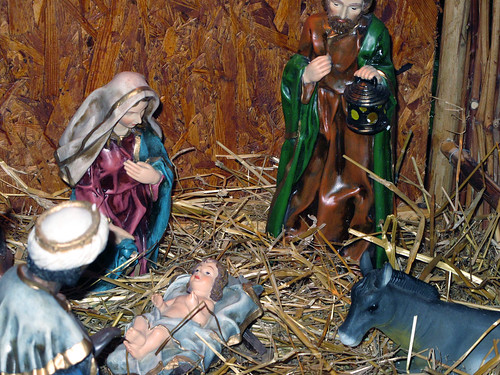
This was all brought to mind recently by a wonderful article by Joe Kay about holiday manger scenes, where he asks why these characters are all portrayed as serene and picture-perfect (and, inexplicably, Norwegian) despite what little we know about the journey they took, the conditions in which they lived, the money they didn't have?  I won't try to paraphrase what Mr. Kay says, because frankly I can't improve upon it:
"If our manger scenes were realistic, Mary would be recovering from a painful labor full of sweat and blood, with a look on her face that’s anything but serene. And Joseph — wouldn’t he be a nervous wreck, too? His hand too shaky to hold a lantern?

And about that newborn. Shouldn’t he be red-faced and screaming? Eyes clenched closed and wisps of hair stuck to the top of a head that‘s still odd-shaped from all the squeezing?

Instead, we’ve sanitized and romanticized it. We’ve removed all the blood and sweat and tears and pain and goo. It’s no longer something real. We’ve left out all the messy parts. The oh-my-God-what-now parts. The I’m-screaming-as-loud-as-I-can-because-it-really-hurts parts. The oh-crap-I’ve-stepped-in-the-animal-droppings parts. The real parts."
Nativity scene 017
Nativity scene at St. George's Church, Kobanya, Budapest, Hungary
PHOTO CREDIT: András Fülöp Used under Creative Commons license. Some rights reserved

Since we have artistic control of how we "see" them, why do choose to make them look perfect and unflustered when we know this was not the case? Why--as we struggle to make this more than a season of spending money we don’t have to buy people, some of whom we don’t even like, gifts they don’t need; eating and drinking too much and then feeling guilty--do we give the heroes of this story supernatural powers they didn’t have (endless energy, patience, WetNaps...) and make them less like us? 

I think it is a shame that the canonical Gospels don't include the argument after Joseph refused to ask for directions and the donkey ended up circling Bethlehem for 45 minutes with his left signal on, or the talking-to Jesus got when the bus had to go all the way back to Jerusalem because he was still at the temple, wowing 'em with his mad parable skillz.  We set ourselves up for disappointment when we fall for the notion that everybody else's Christmas looks like the families in TV ads, with nobody arguing or making hard choices about how to afford it all.

As for me and my house, we’d prefer a savior who chuckles and nods knowingly when we vacuum around the piles of clutter, or "phone in" the office potluck by putting something from the deli in our own Corningware. That is the God who may wince a little when we are short-tempered or selfish, but has been there and gets it. This is a time of year when many of us are faced, more than any other time, with the urge to curl up in a ball, mid-gift wrap or bike-assembly, and cry a little. That is a God I could call on in my darkest hour and expect to be understood, and Kay seems to agree:
"We acknowledge our brokenness, and God responds with a kiss on our sweaty faces and goo-covered foreheads. Reminds us that even though we make mistakes and bad choices, we ourselves are never a mistake or a bad choice. Instead, we are always a chosen miracle. And when we feel totally broken, that’s when we’re the most beloved."
If your sugarplums are all color-coordinated and your family beach photo with the Santa hats came out perfectly on the first try, more power to you. Go ahead and carve your nativity figures out of cream cheese just like Martha taught you.  We, the Chaos Muppets, may need to tape a sheep's leg back on or bring in the Power Ranger understudy for one of the shepherds, but each will nonetheless be a familiar home to the Savior when he comes.

May God bless us, every one.

Wednesday, July 30, 2014

Hurt People Hurt People

Mary, Martha, and Lazarus of Bethany - Companions of Our Lord     

It's been over a decade since I found a home in the Episcopal Church and -- almost immediately thereafter -- got involved in ministry with LGBT people. As society's attitudes about sexuality have evolved and congregations have become more willing to acknowledge the diversity in their midst, this has shifted from providing "safe spaces" off to the side for our folks to pray and socialize as their whole, authentic selves, to actually getting whole faith communities to weave universal welcome into their mission and identity.

What I haven't yet offered up here is how I came to be an Episcopalian in the first place. At the tender age of 18, I was a member of the Antioch young adult group at a Roman Catholic parish. Caught up in the emotion of a retreat, I shared with a trusted friend, and a priest, the secret that I was experiencing same-gender attraction. Despite being assured that this would be kept confidential, I got a phone call (from a nun, no less!) several weeks later saying it would be "better for the others" if I wasn't around. "Some of the parents have concerns," she explained, without elaborating.

I did not actively attend church again for over ten years. I was in church, because I worked as a paid musician here and there, but it felt like a job and I was an outsider there to perform a service, not a member of the community.

At some point, I went to hear my friend Jennifer sing at St. George’s Episcopal Church in Maplewood, N.J. The denomination meant nothing to me at the time. We were both raised in the days of the Baltimore Catechism, and my CCD classes left me with the kind of "us-and-them" mentality that meant there were only two kinds of churches you needed to worry about: the Roman Catholic Church and Everybody Else. But that visit -- where the Right Rev. John Shelby Spong preached about the nuances of sin in a way I had never heard -- set me on a new course. When 9/11 devastated our area, I found myself delivering donations to another Episcopal parish, with a partnered gay priest. Okay, I get it. I said grudgingly. I went back a few times, ended up on a committee or two, and was received (a service for converts, very similar to confirmation, where you formally commit yourself as an adult member of the church) a few years later.


It should not be a surprise that my area of ministry quickly ended up being to other LGBT people. I have now worked in diocesan ministry for nigh unto ten years, and on the national level for about four. The most profound thing I have learned is -- as traumatic as my own experience was -- it was peanuts compared to what some of my brothers and sisters have experienced at the hands of the church. And, in the ecclesiastical equivalent of PTSD, the collateral damage of all those individual little wars reveals itself on a regular basis, even (aye, maybe especially) among leaders of the movement.

I have witnessed spectacular displays of distrust and hostility (some of it richly deserved) leveled at institutional religion, and sometimes laser-aimed at the unfortunate soul who naively identified as a member. In my official capacity, I attended a memorial for a man I had never met, and my expression of gratitude for his decades of service was lost when a complete stranger, learning what group I was there to represent, proceeded to publicly lambaste me for ten minutes about events that took place in that organization while I was many miles away attending grammar school.

I have also seen it -- heartbreakingly often -- among our own: we shoot accusations like arrows from the safety of our Facebook chairs, far enough away to avoid getting splattered with the mess. Too often, people all theoretically working for the same cause fall into predictable opposing teams, mess with one of us, you've messed with all of us, or something like that. Simply disagreeing with a person’s ideas or interpretation of an event is immediately labeled as bullying, slander or worse, and decades of toxic history are dragged out yet again like some kind of dystopian yearbook to prove... what exactly?

It is contagious, this; I have been guilty of it myself, which I deeply regret. I can get caught up in the need to avenge wrongs that had nothing to do with me. I have walked away from conversations and shut myself off from further contact with people who seem to be repeated triggers. And I have, truth be told, contemplated frequently whether the rate of progress, which feels downright glacial at times, is worth the emotional toll. Maybe I should just fold my tent quietly, dust myself off, and walk away. What’s another ten years in the desert?

In trying to atone for and heal from my own contribution to this malaise, I keep coming back to a conversation I had with a friend about her troubled son, whose treatment of her ricochets between intense devotion and blinding rage. The words that entered my head, which I wrote on a napkin while she was describing one such encounter, was:

HURT PEOPLE
HURT PEOPLE

Now if you are not "hearing" that in your head, maybe you recall seventh-grade English and how much fun it was to diagram sentences:

Or, to put it another way: "Hurt (adj.) people HURT (verb) people."

The one thing LGBT people almost universally have in common is that we have all been -- at one time or another -- treated badly. As children, we got mocked for being different or strange; for not liking dolls when we should, or walking funny. Later, we may have been rejected by family members, passed over for jobs, kicked out of churches, or accused of being immoral and a danger to children simply because the gender that turns our head, or that we claim as our own, is not what others expected it be. I have yet to meet the person who avoided it totally, although it is getting better, thanks be to God!

The Velveteen Rabbit
illustration by William Nicholson
Public Domain (1922)
Those of us who are doing inclusion work are -- by definition -- revisiting those old personal hurts, over and over again; either by talking other people through them, or trying to explain to potential allies how it feels to be a person like us. We don't have the luxury of shutting those bad memories in a box and celebrating the happy, well-adjusted person we became, safe to pursue career and relationship goals by nature of the progress the church and the state have made. Like the Velveteen Rabbit, it is our scars that will make us “real” to those wounded hearts whose trust we must carefully earn.

Perhaps this is the gift that we carry to the altar. Maybe we sacrifice "moving on" in order to build the church and the world where others may someday do so undamaged. If that is so, then we must acknowledge what that costs, and the attendant dangers.

This means we can, if we're not careful, see our present circumstances only through the scratched lenses and battered, taped, frames of the past. We are liable to interpret the words and actions of others as if we were back in that awful place we fought so hard to overcome, particularly when we find ourselves under stress. In that dark world, allies can easily be mistaken for tormentors, and that puts us at a higher risk of inflicting further wounds on them, if we can’t see their vulnerable spots past the scales on our own eyes. Trust me, I know there are some people who just manage to push your buttons, but in the heat of the moment it is easy to confuse the person and the issue; what is really their damage and what is just our own stuff, coming back to haunt us.

It also means we can become so used to victimhood that it has become too comfortable, or too scary, to give up. We have fought hard to achieve wider acceptance, but with equal rights comes equal responsibility. It is good that we are different, and it is important and wonderful that we are survivors, but it doesn’t make us "special" in the sense that we should continually expect to get a pass for bad behavior because of it. We find it exhausting when others do it; we should learn to recognize it in ourselves.

With the bread we need for today, feed us.
In the hurts we absorb from one another, forgive us.
In times of temptation and testing, strengthen us.
From trials too great to endure, spare us.
From the grip of all that is evil, free us.

For you reign in the glory of the power that is love, now and forever. Amen.


So what next?

As a souvenir of that fateful weekend, I have -- shoved into the top of a closet -- a grocery bag full of palancas, letters of affirmation from other Antioch members, parishioners and others that I received on the retreat. The word palanca is Spanish for "lever" and the purpose is to give someone a spiritual "boost" through prayer or encouragement. So this is my palanca for you, 21st-century style:

If any of this struck a chord with you, I invite you to play the video below, eyes closed if you want, and think about your own experience while you listen. Hold up the hurts you’ve endured, and the hurts you’ve caused, and allow yourself to feel forgiveness, given and received. Think about what you might say or do differently next time. What if you shared one of these vulnerabilities with the person who causes you the most angst, and asked them to share one of theirs with you? What would your relationship be like after that?


That song was composed by Gregory Norbet, a former member of the Benedictine monastery at Weston, Vermont. It is a working farm in a rustically beautiful setting, particularly in autumn, and has been a "go-to" place of refuge for my entire life.

The pond at Weston Priory
We can… you and I can… build that place of sanctuary for each other. We can learn to help each other heal from what has happened to us, and be the palanca, the lever, that helps them accomplish what they otherwise could not. We can have the grace to ask for forgiveness when we screw up (and we will screw up… I know I will) and know that it is offered with sincerity. We can know that it is okay not to always be perfect, and not always be right, and not always have the last word.

We can do this, aye, we have to do this. We are called to be a force of good in the world, are we not? How can we take that on with so much distrust and resentment underfoot? We need each other on this road, flaws and all, and we can get there much quicker if we learn how to bring out the best in one another, instead of the worst.

“Jesus Consoles the Women”
 from Clarence Enzler’s Everyone’s Way of the Cross

Christ Speaks:

How often had I longed to take the children of Jerusalem and gather them to me. But they refused. But now these women weep for me, and my heart mourns for them-- mourns for their sorrows that will come.

I comfort those who seek to solace me.

How gentle can you be, my other self? How kind?

I Reply:

My Jesus, your compassion in your passion is beyond compare. Lord, teach me,help me learn. When I would snap at those who hurt me with their ridicule, those who misunderstand, or hinder me with some misguided helpfulness,those who intrude upon my privacy – then help me curb my tongue.


May gentleness become my cloak.

Lord, make me kind like you.

--

Adaptions of this post:

Thursday, June 5, 2014

Sorry Seems to Be the Easiest Word

I live under a pop-culture rock, and it is only because of his inner-orbit position on the Six Degrees of Channing Tatum that I even know Jonah Hill’s name. But his recent run-in with a paparazzo, culminating in his angrily calling the man a derogatory term for a gay man and commanding him to perform a particular sex act, to me is less about who he is than what he said, the public’s response, and his later reaction to his own behavior.

Hill appeared both on The Howard Stern Show and The Tonight Show with Jimmy Fallon to apologize for his outburst. Calling himself a lifelong supporter of LGBT people, he first claimed that he “didn’t mean it in a homophobic way” but then refused to give himself that pass, saying “I think that doesn’t matter how you mean things... Words have weight and meaning, and the word I chose was grotesque and no one deserves to say or hear words like that.”


The first part is old hat. We have all heard “that’s so gay” as a synonym for “stupid” or “lame” … it gets thrown around quite casually, and -- when challenged -- the default response is “that isn’t how I meant it,” in a tone that suggests that this should just be okay with you.

More extreme epithets like the one Hill used are tossed around by alpha-males like a football in their understanding of good humor, but emerge for others only at moments of anger or stress. He attempted to explain to Fallon’s audience that his behavior was triggered by a prolonged bout of harassment by the cameraman, who was hurling insults at him and his family. He seemed almost shocked, however, by his own choice of words, as if he didn’t know he was capable of saying such things. Either he’s a better actor than 22 Jump Street gives him room to demonstrate, or he genuinely regrets that we all know this about him and was somewhat stunned to learn it about himself.

What I think bears reflection, however, is why is this where (generally male, but not always) people’s brains go in that moment. Hill told Fallon “I wanted to hurt (him) back, I wanted… the most hurtful word I could think of at that moment.” Hill assumed his antagonist was heterosexual, and thus the go-to insult would be to not only imply otherwise, but to immediately then direct him to a passive role, asserting Hill’s superiority over him.

The day after this all happened, The OASIS, the LGBT ministry of the Episcopal Diocese of Newark, marked 25 years since it became the first such outreach authorized by a Christian bishop. The project, established at All Saints Church in Hoboken, N.J. in 1989 by the Right Rev. John Shelby Spong, provided a “safe space” for gay men and lesbians (bisexual and transgender folks were added to the equation later) to worship with their whole selves at a time when this was largely impossible even in a comparatively progressive church.

In his sermon at the event , the Rev. Harry Knox invited the participants to unpack a very similar theme, which is that endemic misogyny is at the root of homophobia and transphobia. If one starts out with the premise that it’s just a little bit better to be male than female, then logically one will look with disdain on a man who seems to reject this privilege by assuming a role and mannerisms you associate with women. And a woman who dares to assert herself and claim authority reserved in one’s psyche for men will be perceived as a threat. Even the gay male community has bought into it, with personal ads peppered with “masc. only” or even “straight-acting” as a selling point.

We can claim to have evolved as a society, and in fact on paper we have. New laws giving LGBT people various rights and protections are passing at a rate which has triggered resignation and even backlash from those who feel threatened by the loss of privilege the status quo might have given them. In many social settings, it is no longer okay to make racist, sexist, or homo- or trans-phobic comments and one can be expect to be challenged for it. There is noise from some quarters that this has gone so far that our collective sense of humor has been lost as a result. I think it is healthy to be able to laugh at ourselves and a little irreverence does help keep things in perspective.

That is different, however, from using words as weapons. Hill claims he regrets his actions, and many of the on-line commenters seem willing to forgive him. I have no reason to doubt his sincerity, but this accomplishes little unless he does the extra homework to examine why, as a self-proclaimed friend of our community, he immediately defaulted back to asserting his hetero-male privilege when the chips were down. If I call someone the name that he did and acknowledge I did so as an act of aggression, that means I have -- somewhere in my psyche -- bought into the idea that this is a bad thing to be, and less than me. And -- unlike what I might say during a carefully-scripted talk show interview -- what I say in the heat of a stressful encounter is raw and pure, closer to the heart.  If I were Mr. Hill, I’d be spending some time with that.

As Luke’s Gospel tells us, “Therefore whatever you have said in the dark will be heard in the light, and what you have whispered behind closed doors will be proclaimed from the housetops.” What we say impulsively lends more insight to what’s really going on inside us than the lines we get time to rehearse.

----
Adaptions of this post were published by: