Random patter from one easily amused and more easily confused.
I'D LOVE TO HEAR FROM YOU
Comments, criticisms, or (one can hope) compliments are more than welcome! Please let me know what you think, tell me I'm crazy (I suspect this) or what you'd like to hear about. Comments are screened before publication, so if you want to share something with me only, just put that in the comment and I'll keep it to myself.
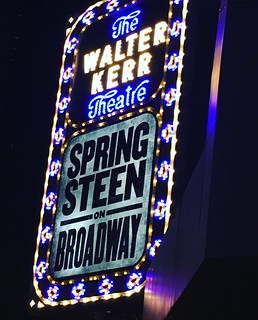
This week I read an interview in Esquire with Bruce Springsteen, in which the iconic rocker describes his mental health journey as well as his lifelong struggle to process his complex relationship with his father. A remote, hard-edged drinker, the elder Springsteen was enraged by what he saw as the weaker facets of his son's character. It wasn't until he was near death that he tacitly, sparingly acknowledged Bruce's better points, saying only "You've been good to us."
“All I do know is as we age, the weight of our unsorted baggage
becomes heavier . . . much heavier. With each passing year, the price
of our refusal to do that sorting rises higher and higher. . . . Long
ago, the defenses I built to withstand the stress of my childhood, to
save what I had of myself, outlived their usefulness, and I’ve become an
abuser of their once lifesaving powers. I relied on them wrongly to
isolate myself, seal my alienation, cut me off from life, control
others, and contain my emotions to a damaging degree. Now the bill
collector is knocking, and his payment’ll be in tears.”
That constant, unfulfilled quest for validation took its toll, and the rocker described two breakdowns, the more recent just ten years ago, and credited decades of therapy and the unwavering support of wife Patty Scafila with his survival. I could say more about that, but the interview tells it far better than I could, and you could find more detail in his autobiography. Later this month, his Broadway stage show, an abridged version of the book interspersed with a dozen or so of his songs, will air on Netflix.
Having learned these things about him, a man whose music has contributed so much of the soundtrack of my own life, brought back many of the same feelings I wrote about earlier this year.
As an ardent music fan, I've realized I have a tendency to fill in the blanks in what I know about artists' lives; their characters get shaped in my mind by their lyrics, their stage banter, and whatever they choose to share with the media. When they do or say something that departs from who I've decided they are, it's jarring. The rash of premature deaths in the past year notwithstanding, this happens in smaller ways more often by the occasional revelation, misplaced statement, or decision. Something like this happened this week. I learned something about another artist whose music I love, which suggests that we'd be in a pretty fundamental conflict on certain social issues if we actually knew each other, which we clearly don't. And I don't know what to do about it. Unlike some artists, this person's convictions are not widely known, and thus I have little to go on other than scant facts and assumptions you can draw by association. I don't know enough about the situation to decide if it changes how I feel about this individual as a person. If it did, it would change my relationship to the music, which felt yesterday like a house that had been robbed. That would have a follow-on effect on how and with whom I spend my time, especially over the past year. Part of me wants to go hardcore, only because of the time I spent fighting on this particular issue and in this particular space. On the flip, I'm reminding myself that no promises were made or broken here. We are not friends; I do not have the right to expect my values to be shared or my allegiance to be reciprocated. The music is out there, take it or leave it; anthems by flawed heroes for flawed fans, maybe that much sweeter because of the wrinkles and scars we can compare to our own.
I started to write this when Chris Cornell died. I tried again when Chester Bennington died. Ultimately I realized that I didn't have anything relevant or specific to say about those two gifted but deeply troubled artists that hadn't been more adroitly expressed by others who knew them better. Now again I'm hearing friends express loss about an artist (Scott Hutchison of the Scottish indie band Frightened Rabbit) whom I didn't get the chance to appreciate while they were alive. And I'm realizing these stories are coming out at alarming intervals.
The thing that each of these deaths brought out for me is a sense of threat for a community that I've been blessed to stumble into, probably later in life than most people would think is normal, beginning with a concert in Philadelphia in the summer of 2010. I attended to see a band called Chamberlain which had reunited briefly after a long hiatus to tour with The Gaslight Anthem. I only knew the latter's radio hits going in, but I came away a fan of both them and pre-opener Tim Barry, and have since been drawn into a community of their fans, a core group of which I have come to know as friends.
I have found myself spending more and more time at shows by a handful of bands whose fans seem to overlap quite a bit. Gaslight and their lead singer Brian Fallon are at the nexus, but I've checked out new bands just based on the t-shirts of the people around me and rarely been disappointed. Thus I've come to be familiar with the music of The Bouncing Souls, The Menzingers, Hot Water Music, The Loved Ones, Lucero, and others.
This is a little bit of a different experience than following an act like Bruce Springsteen who can sell out Giants Stadium for multiple nights (or a Broadway theater five nights a week for six months). That is a great atmosphere, but a fairly anonymous one; you only interact for the most part with the people who came with you and maybe the tall guy who keeps blocking your view. The likelihood of seeing them again is pretty much nil.
Rather than stadiums, these gigs tend to be in smaller theaters and even
bars. You start to see familiar faces, and become one yourself. I made friends with the tall guy at a subsequent show and he made sure I could see. And in between shows, you can go online and quote lyrics, brag over autographs, answer endless polls, and generally bond with your fellow fans. To my surprise, my age and general awkwardness didn't set me apart
The artists in venues like Crossroads in Garwood, The Saint in Asbury Park, and any of a dozen clubs in downtown NYC are often a few yards away, and some, like Chuck Ragan and Dave Hause, come out and talk to fans before and after. The up-and-coming acts that open for them frequently staff their own merch tables and carry their own gear in and out, and sometimes look to you for help. Sometimes they stay for a drink or four, and you have the opportunity to actually interact as, if not "friends" exactly, still more than just performer and fan. You might catch a glimmer of recognition in their eyes (it helps if you have something unique like my friend Beth's cool boombox purse) and you exist, if even for just a few seconds, as something beyond the aggregate of ticket sales and chart positions.
Someone asked me, after I mentioned seeing Jared Hart of The Scandals perform live for probably the tenth time, how I can see the same act over and over (particularly if they are fairly new and have a limited catalog from which to build a setlist). I had to think about that, and the truth is that the repetition doesn't bother me. Every show is different, with a different energy and banter, and there is even something comforting in the ritual of hearing your favorites again.
On that note, I had an epiphany during a recent set by Tim Barry, who opened that show in Philly: these shows are, in a sense, a similar experience to church when it's at its best. Whether it's shout-singing the lyrics of your favorites or the chaotic society of the mosh pit, I wondered if the a generation growing up in an increasingly irreligious time finds at these shows some of the community and energy a faith community might have otherwise provided. At a time when the pews have become somewhat of a no-man's land for me, I know I certainly do. While there is little in the way of "preaching" I've been relieved to discover by following them on Twitter and Instagram that I can feel good about being associated with them based on the worldview they put out there.
Thus when these guys share, either through lyrics or between-songs banter, anything that suggests they are struggling, it is unsettling. As much as you think they "get" you, you don't really know what's going on in there, and feel like you can't really help. Fallon in particular keeps a pretty solid barrier between his work and his personal life, probably wisely. But when you've trusted someone to contribute to the soundtrack of your life, it's hard not to feel at least a little protective in those moments. I won't pretend to understand what drives so many creative people to these dark nights of the soul: maybe it is a heightened perception of this troubled world that seems like too much to bear. And, perhaps selfishly, I worry for the fragile sense of togetherness these fandoms provide.
So even though I've never been in the crowd at an Avicii or Frightened Rabbit show, I mourn with their fans tonight. I can keenly imagine what they're feeling. I never want to hear the news they got this week.
The title of this post is from "I Just Died (Like an Aviator)" by Matthew Ryan, another of my musical finds. That is my message to the artists, both the ones whose work I love and referenced here, and the ones who are just as important to someone else. We need you here.
In the wake of Bennington's death, Music Minds Matterwas launched in the UK. The group offers 24/7 mental health services to not only artists, but anyone involved in the music industry, with a 24-hour helpline. By using this link to listen to Tyni's song "Fighter", fans can contribute to the organization. I pray that any artist who is struggling finds the help they need.
Last spring, I wrote about a young woman named Dannika Nash who quoted the Macklemore song "Same Love"
in some frank advice to the institutional church on behalf of
milliennials. In a nutshell, she warned that if the church forced her
generation to choose between it and their support of LGBT rights, it was
going to be disappointed in the outcome. Her basic message was one that
research
clearly shows is shared by many in her generation, 30% of whom do not
claim any faith affiliation at all. She implied that - for them - music
and other aspects of their culture fulfill a social-consciousness need
that religion does not.
Macklemore, classified as a
rapper, was not afraid to call out the genre's reputation for homophobia
and misogyny. In January of this year, he performed "Same Love" at the
Grammy Awards while Queen Latifah witnessed the marriages of thirty couples, including some of the same gender.
I
heard a song recently in my truck which caught my attention because the
chorus starts out with the phrase "take me to church..." Not only is
this unfamiliar subject matter for popular music (for reasons explained
above, I expect), but a Facebook buddy and his friends use the
expression "go to church" as a euphemism for their favorite pastime
(kayaking over waterfalls in the Pacific Northwest), and I thought he
might get a chuckle out of a song that features that phrase.
Video for Hozier's "Take Me to Church"
(CAUTION: Violent Imagery)
Hozier at SXSW 2014
PHOTO CREDIT: WFUV Radio
Used under Creative Commons License Some rights reserved
It
wasn't til I got home and read more about it that I understood the
song's topic is no laughing matter. Having only half-heard the words
while driving, I discovered upon closer examination that Andrew Hozier Byrne
(who goes by his middle name), a 24-year-old Irish man, is not asking
to be brought to a religious institution, at least not the ones he knows.
Describing his experience as "Every Sunday's getting more bleak / A fresh poison each week" Hozier
(or at least the protagonist in the song) is -- like Ms. Nash --
eschewing life in the pews for a "religious experience" of another kind,
in his case a lover.
What caught my attention,
however, was the subject matter of the song's video. It depicts -- in
brutal honesty -- the abduction of a gay couple in Russia by a vigilante
gang. The connection to the lyrics was not immediately clear, but --
if you know a little background on what's going on there -- it starts
to make sense.
For at least the last 12 years, anti-gay
sentiment in Russia has been ramping up. Attempts to hold pride marches
in Russian cities have been generally meant with political opposition
and/or violent protests. The country's Christian, Muslim and Jewish
leaders have all spoken out against the observances, with the Grand
Mufti Talgat Tadzhuddin encouraging flogging for the participants in the Moscow Pride of 2006.
"I always stand by the song and the point that the video made, so it’s never a chore," Hozier, who is not gay, told the London Evening Standard. "The song is about loving somebody, and the video is about people who
would undermine what it is to love somebody."
Journalist Jeff Sharlet, whose books C Street and The Family
document the degree of control a cadre of evangelical Christians have
over Washington, traveled to Russia this fall in the run-up to the Sochi
Olympics and painted a stark picture of gay life in the country which appeared in February's GQ.
Sharlet describes the growing hostility towards gay people as part of a
larger social unraveling: Russian civilians, encouraged by their
government and religious institutions, have taken matters into their own
hands.
"There's a national network called Occupy Pedophilia, whose members
torture gay men and post hugely popular videos of their 'interrogations'
online. There are countless smaller, bristling movements, with names
presumptuous (God's Will ) or absurd (Homophobic Wolf). There are
babushkas who throw stones, and priests who bless the stones, and police
who arrest their victims."
In the article, Sharlet
describes shoot-ups in bars, rapes, beatings, and computer surveillance, (even on the part of private citizens). Readers learn the measures to which people will go to survive, and the lengths others will go to tear apart the lives of complete strangers in pursuit of some dystopic fever-dream. We meet two
families that live together symbiotically, presenting as heterosexual to
the world as a cover for their actual same-gender partnerships.
Sharlet talks to both targets and perpetrators, attempting to help
readers decipher what is behind the fear and violence.
The
Duma in 2013 passed an "anti-propaganda law" which makes it illegal to
communicate about "non-traditional sexual relationships" to minors. Of
course what constitutes "propaganda" can be broadly interpreted to suit
the occasion, and one could be punished for doing anything something as
simple as holding hands anywhere "where children might see." Victims of vigilante violence are laughed at or punished if they seek help from law enforcement.
Western Connection (AKA, Why We Should Care)
If the rationale of "protecting the children" sounds familiar, it is
because it is the same mantra used to justify anti-gay laws in Africa,
and -- lo and behold -- some of the same American evangelical voices,
including Scott Lively, are taking at least partial credit.
Lively is currently the target of a federal lawsuit under the Alien
Tort Act for crimes against humanity, due to his involvement in getting
Uganda's "Jail the Gays Bill" passed. He toured that country in 2009 with several other Americans, stirring up anti-gay fear at a series of rallies. He employed the same tactics in Russia and called the passage of the law there "one of the proudest achievements of my career". His enthusiasm was shared by the American Family Association's Bryan Fischer.
Most American clergy, not unaware of shifting public opinion, are more nuanced in their positions on LGBT issues, sometimes head-scratchingly so. Televangelist Joel Osteen told Larry King "I believe homosexuality is a sin, but I don't want to preach about it." Jim Wallis of Sojourners (who is frequently described as a progressive) drafted and circulated a letter to Barack Obama in favor of a "religious exemption" to the President's executive order on discrimination by companies holding federal contracts. A number of the large, venue-based churches like Hillsong NYC, attempt to avoid the topic altogether.
But we can't not talk about it, so long as crises as large and terrifying as the one unfolding in Russia continue to happen, and as long as there are places in our own "civilized" country where people think belonging to a church makes it okay for you to be a bully and want that enshrined in the law. For those of us who believe there is a place for everyone at God's table, the recent string of domestic victories should not be mistaken as a sign that we're anywhere near done doing justice work. The "religious freedom" laws being introduced in various quarters are a clear sign of that.
Nor can we rest on our laurels while we know that hurtful things are being done in God's name anywhere in the world. The one thing our Savior didn't abide well is hypocrisy, and the YouTube generation is reminding us of that by voting with its feet. Perhaps if they saw our churches witnessing to the pain being inflicted in the name of religion and how this conflicts with the Gospel we know, they'd be more inclined to stick around.