I'D LOVE TO HEAR FROM YOU

Comments, criticisms, or (one can hope) compliments are more than welcome! Please let me know what you think, tell me I'm crazy (I suspect this) or what you'd like to hear about. Comments are screened before publication, so if you want to share something with me only, just put that in the comment and I'll keep it to myself.

THANK YOU FOR VISITING!

Sunday, July 16, 2023

"That Red Stuff" - Sermon for the Seventh Sunday after Pentecost


Preached at St. Mark's Church, Teaneck, NJ, on July 16th, 2023.


Genesis 24:34-38, 42-49, 58-67, Psalm 45:11-18, Matthew 11:16-19, 25-30  


Through the written word and the spoken word, may we come to know Your living Word. Amen.

Thus Esau despised his birthright.

Not a sentence you hear everyday, and the small group of folks that I was sitting with remarked on this and other aspects of the story. Typical commentary on this passage paints Esau as a physical, even crude man, one writer going as far as to compare him to a dog who has little appreciation for the better things in life, like his little brother’s cooking which he describes so eloquently as “that red stuff.” One must wonder if despised was the best possible translation… perhaps disregarded would be more accurate. In the moment, he was hungry, and his brother Jacob had food, and Esau told him what he wanted to hear in order to get some of it. Although life then for most people was considerably harder than what we’re used to, as Isaac’s favorite son, perhaps he was, like many of us who grew up in relative privilege, used to shooting off his mouth knowing Daddy would fix it later.

But this careless exchange was enough to seal his fate in history. Esau’s act is referred to disparagingly by Paul several times. His seemingly rash decision to trade his inheritance for one meal gets him branded as “one whose god is his stomach” … relatable … and his apparent lack of focus on societal expectations and future material security somehow makes him an “enemy of the cross of Christ” … a cross he would have no means of knowing was coming some 1,500 years later, more or less. 

Jacob, by contrast, is described as “a quiet man, living in tents,” which I heard as “an avid reader who avoids getting sweaty or dirty,” but that may be projecting a little. He was also a lot more calculating than Esau. One must wonder what their relationship was like that he would place such a high price on sharing some food with his own twin, who at least appears to be pulling his own weight in the family. Esau apparently forgot about it pretty quickly, but Jacob, whose name literally can mean “he deceives”, stored this away for later when it would prove useful. In a subsequent chapter, he engages in an act of trickery at his mother’s behest to ensure it is Jacob rather than Esau that receives their father Isaac’s blessing from his deathbed, so perhaps it was in character. 

As a result, Jacob is set up as not only the heir to Isaac’s dynasty but ensuring his place in the lineage, outlined in Matthew’s Gospel, that continues from Abraham through some forty generations, to Jesus. As you’ve heard before, inheritance was an-all consuming concern in the culture to the point where people resorted to all kinds of things including incest and murder to ensure the lineage is known and pure, or at least appears to be. So the patriarchs and matriarchs of our faith were--like us--not without their flaws.

In our small group conversation, I wondered aloud whether Esau was prone to hyperbole or was literally starving, given the writer made a point of saying he was “a man of the land” and an accomplished hunter. The person across from me piped up, saying that in fact he could have meant it literally, given that someone in our society could have four degrees and still be making $18 an hour. That may sound like a lot until you know that White Castle starts its employees at $15 and probably also provides some free food. I also realized the one telling me this speaks from experience, and then felt like the largely random circumstances of my own relative financial comfort might have made me read this story through the lens of my own privilege.

 As you may have guessed, all of this took place at the church-wide revival meeting called It’s All About Love, which JoAnn, Joan, Marsha, and I attended in Baltimore earlier this week. With a threefold focus on racial reconciliation, creation care, and evangelism, the event was intended to help reawaken our sense of mission and explore what we might do with the gifts we have, both as a parish and within the wider church.

I know it’s a cliche, but I wished I could bottle up the energy in that room and save it for the times when we could use a boost. The preaching, the music, and the wisdom that was shared with us was intended for us to bring back to you, and over the coming months we will look for opportunities to do that. Besides our very charismatic presiding bishop the Most Rev. Michael B. Curry, we heard from the Rt. Rev. Gene Robinson, the first out gay person elected a bishop in our church; Julia Ayala-Harris, the first Latina president of the House of Deputies; The Rev. Canon Stephanie Spellers, whose brainchild the event was; and others, some of whom I will mention shortly

But for today, I want to ask you, what aspects of our own birthright are we willing to “despise” for the sake of the Gospel?

In the beginning of the Sacred Ground curriculum, which Canon Spellers also spearheaded, she talks about the Episcopal Church’s legacy as the church of America’s aristocracy and what that has meant in its relationships with black and brown people. As we admire the grand structures of our cathedrals and universities, many of them funded by the philanthropy of the titans of commerce and industry that once graced our pews, can we do so mindful of the cost in terms of labor, much of it unpaid, that made those generous gifts possible? Sarah Augustine, whose roots are in the Pueblo (Tewa) nation, has spent her life working to undo the impacts of the Doctrine of Discovery, a papal decree which emboldened Europeans to colonize and subjugate much of the indigenous population of the world. She challenged us to learn about how our investments are still being used in ways that harm vulnerable populations and find ways to reduce that impact.

Brian McLaran’s book Do I Stay Christian? explores the many very valid reasons so many people, including many of our own kids, are doing just the opposite. These include the very public downfall of religious leaders and the bald institutional hypocrisy that is so easy to point out. As we recall our baptismal covenant and strive to live into its mandate of welcome and inclusion, can we do so without smugness when it seems that so many of our fellow Christians seem to have lost the plot?

Theologian Dr. Kwok Pui-Lan shared some sobering reminders from recent news about the urgent warning signs our Earth has sent us about the state of her climate. Even this morning a tornado alert was issued in Morris County. Are we willing to inconvenience ourselves or change the way we do things if it means even an incremental reduction in the harm our activities do to the planet?

And overarching all of this, Bishop Curry exhorted us to remember that--as the title of the conference suggests--love for God and our neighbor should be at the core of everything we do. He quoted Jimi Hendrix as saying, 

“When the power of love overcomes the love of power, then the world will know peace.”

I marked 20 years since my first visit to St. Mark’s last month. I am happy to the point of tears more Sundays than not for the love and community that we share in this place. There is a new sense of energy and purpose and we have some new faces, for which we are so, so very grateful. But we still have a lot of room. I am not suggesting we should be as careless with the nearly one hundred years’ investment of time, talent and treasure that is St. Mark’s as Esau was with his inheritance, but are we as a faith community willing to--in the words of William Sloane Coffin quoted by Bishop Beckwith in his dismissal blessing--“willing to risk something big for something good,” if it means that those who do not yet feel welcome or invited or even SAFE inside these walls come to know that love as a result? 

I challenge you to ponder these questions in your heart, as those of us who attended have been doing. Think about them and share your ideas with your vestry, the guilds and committees, and ask questions about the groups you don’t know much about, and maybe take a leap of faith and sign up for something new. Or just start a conversation at coffee hour with a person you haven’t met yet. 

As I said, there will be opportunities to learn more about this program and discuss its implications in the days ahead. I hope you will join us and feel some of the joy and new purpose we experienced. We have so many gifts here at St. Mark’s and the latitude to reach out in many ways to the community around us, through our music, our outreach and--most importantly--the opportunities to worship God in ways that help heal the friction between races and cultures and respect our fragile earth. 

As JoAnn pointed out on our trip home, these efforts may be like the seeds the sower was scattering in various places in today’s Gospel, in that some of them may yield fruit and some may not. May we together develop a spiritual green thumb and thus yield an abundant harvest of Christ’s love for one-another and all those we encounter.

Will you pray with me?

O God of wondrous power and still more wondrous love, you who have borne us from chaos to creation, from dry bones to dancing flesh, from death to life: Renew and revive your Episcopal Church, especially as we gather this summer for worship, fellowship, learning, and action. Send your Spirit to set us, our ministries, and our communities ablaze, so that the world might come to see and know us as the Episcopal branch of the Jesus Movement – bold, open-hearted bearers of Good News, repairers of the breach, and stewards of creation who truly look, live, and love like Jesus. We make our prayer to him, to you, and to the Holy Spirit, our loving, liberating, and life-giving God. Amen.

Monday, January 30, 2023

"Don't Tell Me, Show Me" - Sermon for the Fourth Sunday after the Epiphany


The Fourth Sunday after the Epiphany - January 29th, 2023

Micah 6:1-8; | Psalm 15 | Matthew 5: 1-12

Rise, plead your case before the mountains, and let the hills hear your voice!

In this morning’s reading from Micah, God is again scrapping with the Israelites… will they ever behave? The text we hear today follows five chapters of condemnation and doomsday prophesy against both the northern and southern kingdoms of Israel. Like a lecture from a frustrated parent, we hear the laundry list of leaders and guides that tried and failed to get them to straighten up and fly right.

Starting at verse six, we shift points of view to whatever unlucky Israelite has been summoned to the negotiating table. A list of increasingly over-the-top sacrifices are proposed, one suspects, with a degree of sarcasm that suggests this is not the first time this conversation has taken place. Both sides seem to be saying, “would you be satisfied then?”

On a mountain not far from here lives a man who could probably relate. He’s a member of the Turtle Clan of the Ramapough Mountain Indians (or Ramapough Luunape Nation), a multi-racial indigenous group that claims the legacy of the Lenape people who once occupied our whole region. If you’ve never heard of the Ramapoough, or at least by that name, you’re not alone. They tend to keep to themselves, and as a result, a mythology largely imagined by others has emerged to fill in the blanks. They are probably better known in northern New Jersey by a pejorative term that starts with the same letters as Jehovah’s Witness.

I met him on Saturday when Ellen, Mari, Bill and I attended an event at the Church of the Good Shepherd in Ringwood, an Episcopal congregation whose membership largely overlaps with the Turtle Clan. Although the church leaders were there, the event was actually sponsored by Rutgers, as part of a grant program* to explore and document the lives of disadvantaged people living in so-called “sacrifice zones” along the Passaic River, where environmental degradation was allowed to occur despite the proximity to places where people live, work and play.

In the 1960s and 1970s, the Ford Motor Company used abandoned mines in the immediate vicinity of the Ramapough people’s homes to dump millions of gallons of paint sludge, enough to fill two of the three tubes of the Lincoln Tunnel. This being New Jersey,, organized crime even got involved to ensure dumping continued despite the passage of environmental laws.

Knowing this was happening, the company still donated land for homes for the tribe to be built on the property in a model much like Habitat for Humanity. Due to lack of education or warnings, children played with the brightly-colored residue and their fathers scavenged through the debris looking for valuable metals to sell.

Shall I give my firstborn for my transgression,
the fruit of my body for the sin of my soul?’

Although the site was removed from the EPA’s Superfund list in 1994 after 53,000 tons of sludge were removed, groundwater and soil samples around homes and the church continue to reveal high levels of contaminants including lead, antimony, 1-4 dioxane and benzene, leading the area to be added to the list again in 2006 after an explosive series called “Toxic Legacy” was published by the Bergen Record. Hundreds of members of the tribe have exhibited symptoms associated with exposure to contaminants, including cancer, asthma, and diabetes.

In 2008, out of fear that Ford, then in financial peril, would go bankrupt, the tribe accepted a settlement that amounted to about $8,000 per member after attorney’s fees. Cleanup continues in fits and starts, meaning trucks of contaminated dirt rumbling through the area, but in 2011 the EPA decided to cap the remaining debris in three specific areas instead of removing it. Environmentalists remain concerned that contaminants will continue to spread, possibly reaching the Wanaque and Monksville reservoirs which supply millions of New Jerseyans with their water.

More recently, a pipeline company announced plans for an oil & gas line between Albany and Linden that would pass through the area. Fearing further environmental damage and inspired by the people of Standing Rock, the tribe staged a protest encampment in Mahwah to draw attention to the matter.

Will the Lord be pleased with thousands of rams,
with tens of thousands of rivers of oil?

My new friend has lived in this area his whole life. For decades, he worked as a town employee, and thus bit his tongue a lot about the things he witnessed out of fear he’d lose his livelihood. Now retired, he feels more emboldened to speak up, and told the event organizers, who outlined plans to draw attention and resources to the tribe’s plight, “Don’t tell me. Show me.” He and others recalled a long history of outsiders coming to the area, making and breaking promises or flinging trivial amounts of money at the problem and disappearing into a mountain of toxic red tape.

I admit that when I heard these things and saw the conditions there, this was my instinct as well. What could we well-meaning strangers do? Noticing and hearing someone complain about the church’s dilapidated sign, several of us independently, instinctively thought, “well, we could fix that!” only to hear a non-native participant—apparently reading our minds—tell us later, “As soon as I got here, I offered to fix that sign.”

But the sign is not the problem; it is just a symptom. There are people here who could fix that sign for them in two hours and we could go home feeling better about ourselves, but it would not change the fact that the children of that congregation innocently play in the grass outside at their peril. Or that young descendants of the tribe don’t want to be identified by its common surnames to avoid the suspicion and mistreatment that go with them.

Blessed are you when people revile you and persecute you and utter all kinds of evil against you falsely on my account. Rejoice and be glad, for your reward is great in heaven, for in the same way they persecuted the prophets who were before you.

You could hear a weariness in the Ramapough people’s voices as they told their stories. Many times the system has promised to make things better, and didn’t. But I also heard a rich and deeply-deserved pride in recalling passed-down wisdom and resilience. There is way more going on there than we could have absorbed in a single afternoon, or even the six months of enlightening and frequently disturbing history we’ve been learning in the Sacred Ground curriculum. I suspect that I’m not alone in that I mostly learned and thought about the Lenape in the past tense, as people who existed long ago without any explanation about where they went, leaving little behind but the names of places and school teams. Nothing was said about the residential schools—sponsored by the U.S. Government and run by religious denominations including ours—where indigenous children were “deprogrammed” of their culture in an effort to “save” them.

I left there in a pensive and unsettled state, and stopped to stare at the water of Monksville Reservoir which I kayak every summer. I had had a feeling of déjà vu in that room, and recalled that I’d actually been there once before, likely in the 1970s when all this was beginning to unfold. I’d spent another forty years mostly not thinking about them until now. But as Bill and I agreed afterwards, you can’t un-know this, and—though it probably shouldn’t—realizing that many of them are also Episcopalians makes it feel that much more imperative to not become yet another rich white person who nods sadly at their story, writes a check or two, and goes back to his privileged life.

One of the things that struck this frustrated journalism major about the Gospel is the passive voice in which the Beatitudes are written:

Blessed ARE those who mourn, for they WILL BE comforted. ‘Blessed ARE those who hunger and thirst for righteousness, for they WILL BE filled.


I noticed that Jesus didn’t say “I will bless them. I will give them comfort.” and thought, “it’s not that He won’t, but it can’t be just Him. Looking at that beat-up sign, I thought about the story, possibly apocryphal, about a statue of Christ damaged by vandals. Instead of repairing it, the church added a plaque paraphrasing St. Teresa of Avila, “I have no hands but yours.” I believe these people and situations are placed in our paths as opportunities to mirror the compassion and generosity that Christ modeled for us in the Gospel.

Oberlin College Professor and environmentalist David W. Orr said, 


“The plain fact is that the planet does not need more successful people. But it does desperately need more peacemakers, healers, restorers, storytellers, and lovers of every kind. It needs people who live well in their places. It needs people of moral courage willing to join the fight to make the world habitable and humane. And these qualities have little to do with success as we have defined it.”


The second film they showed us at the event was about a farm that members of the Ramapough created to provide the tribe with fresh organic food. Because it is unsafe to eat anything that is grown or hunted or fished in the vicinity of the dump site, the farm is located miles away in Sussex County. I learned afterwards that Amanda Kearney has actually volunteered there and wondered what other opportunities there might be to educate ourselves further and provide solidarity and support.

“Don’t tell me; show me.” With my Ramapough friend’s words still ringing in my ears, I have no idea yet what my response should look like, other than it should involve a lot more listening than talking.

He has told you, O mortal, what is good;
and what does the Lord require of you
but to do justice, and to love kindness,
and to walk humbly with your God?


Amen.


Our Land, Our Stories, a collaborative project with Rutgers University, Department of Landscape Architecture and the Ramapough Lunaape Nation, is a multimedia project for environmental justice advocacy and curriculum development for Native American history and contemporary Indigenous land relations.  The project elucidates how relationships to land are disrupted by environmental pollution. It explains how negative portrayals of Native American communities have contributed to the targeting of their lands as dumpsites, while leaving them marginalized in the remediation process. It illustrates how Indigenous communities are responding with programs for cultural restoration and food sovereignty.  Project materials were created in collaboration with the Turtle Clan, many of whom live on a Superfund site.  Materials include the Our Land, Our Stories book, The Meaning of the Seed documentary film, traveling exhibits , short video projects on our YouTube channel , social media platforms , and this digital exhibit for Rutgers University Libraries. Utilizing a variety of formats, the project incorporates multiple voices and creates a multi-media forum for sharing important stories of land and loss, and of survival and recovery.

Monday, February 28, 2022

"What Happened Next Will Amaze You" Sermon for Transfiguration Sunday

The Last Sunday after the Epiphany - February 27th, 2022

Psalm 99; Exodus 34:29-35; 2 Corinthians 3:12 - 4:2; Luke 9:28-36
 

Yasuo Nakajima considered himself an interesting person. A former competitive bodybuilder with an extensive knowledge of insects and plants, his main passion these days is his three Yamaha motorcycles, which he repairs in his living room and rides around the Japanese countryside for weeks at a time.

Thus, when the divorced father of three had been posting about his adventures on Twitter for months and had only netted six followers, he was disappointed. “No-one wants to read what a middle-aged man posts,” he later told interviewers on a TV variety show.

It was thus that Soya was born. Having seen his kids playing with the appearance-altering FaceApp on their phones, Nakajima—with a few taps—transformed himself into an attractive young woman. He created a new Twitter handle—a mash-up of his kids’ names—and began posting as his new persona. Soya did all the things Yasuo did… repaired the bikes, posed at scenic overlooks, talked about life. When he was frustrated, it showed in her normally-beaming face.

Unsurprisingly, Soya’s posts were far more popular than Yasuo’s had been. Before long, she had thousands of followers, and Yasuo began adjusting his real-life appearance to make the ruse more effective, growing out his hair and experimenting with skin care treatments to help the app do its job. Soya’s manner of speech—though sprinkled with emojis —was largely a product of Yasuo’s own personality, and over time his two identities grew closer together. “When I compare how I feel when I started to tweet as a woman and now, I do feel that I’m gradually gravitating toward this persona … this fantasy world that I created,” Nakajima told the Washington Post. “When I see photos of what I tweeted, I feel like, ‘Oh. That’s me.’ ”

What began more or less as a gag was hard to turn off when each post was rewarded with so much positive attention. Over time he allowed more of himself to imbue Soya’s persona, and hers into his. He is far from the first person to experience what Stanford University researchers call the Proteus Effect, where the drivers of virtual-reality characters, or avatars, start to adopt qualities of their creation as if they were their own.  

In the Internet’s early, text-only days, it was possible to reinvent oneself completely and thus escape the expectations that match your real-life age, gender, and appearance. Few people used their real names on message boards. Victims of bullying and abuse found a safe forum to escape their isolation. Virtual-reality platforms like SecondLife allowed users living with disabilities or insecurities to create characters who look however they wish, free from stigma or baggage. And many of them started to “own” those idealized characteristics to some degree.

It wasn’t until the advent of smart phones and social media platforms like Facebook that real-life identity checks became the norm, in large part so they can assert control over your wallet. And in the age of the “selfie”, it would be difficult to keep up a fake persona for long.

Until now. Advances in image-altering filters like the one Yasuo used, which can respond in real time to  every nuance of your expression, are making it possible for any smart phone user to create still images or even video with an idealized or distorted version of ones’ self (or someone else) that many others will unquestioningly accept as real. Researchers are eyeing this with fear that blurring the lines between fantasy and reality will have damaging effects on our culture’s standards of beauty, and with it our collective sense of self-worth. Child psychologists are already worried about the effect this is having, particularly on young women and girls. Some "deepfake" influencers, as they are known, have been exposed with side-by-side photos of their true, less-perfect selves. It could also have profound political or legal implications if we can no longer assume that a video of a politician speaking about foreign policy is really and truly that person saying those words.  

Once Soya’s popularity had taken off, Yasuo’s debated what backlash there might be if he was “outed” especially how his kids might react. Our choices—even when they’re good ones for us—can have a real impact on the people who know us, or think they do. As we heard in the reading from Exodus as well as Luke’s Gospel, humans generally crave predictability. We expect those in our lives to be the people they have always been. When someone close to us reveals that they have been carrying a secret or that they are changing the trajectory of their life in a way that does not match our image of them, we can find it disconcerting and don’t know how to react. We may find ourselves like Peter, babbling about construction projects in a misguided show of support, but more often find ourselves wanting to bury our heads in the sand like the Israelites around Moses, rather than cope with the cousin who wants to be called by a new name or referred to with pronouns we don’t know how to pronounce.

The transgender people I worked with at Integrity and the OASIS all asserted they did not “become” the other gender when they transitioned. They were always that person; they were just finally allowed to fully be that person in the world. In other words, they were not putting on a mask; they were finally taking it off. That insight helped me relate a little better to what the apostles, including His own siblings, must have felt when Jesus told them, “I am still the man you have known all this time. But I am also, and always have been, God.” and also His heartache when time and time again they—and we—don’t get it.

For his part, Yasuo does not identify as transgender, nor did he try to gain any reward through his deception, a practice called catfishing. But he realized last spring that fans were starting to realize there was more to Soya than met the eye. Perhaps unconsciously, he had allowed glimpses of his unaltered body and mannerisms to slip into her world. After struggling with the possible consequences for a while, finally one night he posted an image on her account of a motorcycle with his unaltered face visible in the mirrors.

To his amazement, his fans by and large took the revelation in stride. Beyond the flurry of media attention to the technical novelty of his “creation”, people, including his own kids, seemed to understand that Soya—though not a real person—is authentically part of who Yasuo is. While he may have masked himself in a way that was more likely to get us to notice, the stories he shared were his own, and the number of people following Soya’s adventures continues to grow.

I am not suggesting there was anything particularly admirable about the path Yasuo took, but as someone of similar vintage who spends probably too much time online, I do understand his motivation. The social internet is clearly ruled by the young and the genetically gifted. I may think my long-winded stories are interesting, my dad jokes are funny and my pictures are pretty, but the algorithm apparently disagrees and saves opportunities to be seen—called impressions—for the more-sought-after demographic, leaving me with the digital crickets, scrolling through the carefully curated versions of their lives that the beautiful people deign to share. So I can look at another guy’s long-haired midlife crisis with some empathy.

I think the take-away here is not so much what Yasuo did or why, but how the public responded when he came clean. Each of us faces the choice of how to react when those we love reveal layers of themselves—be they dreams or shortcomings or simple, hard truths. Maybe we would inwardly prefer that they continue to masking these aspects of themselves, at least when there’s company, while Grandma’s alive, in front of the neighbors. However—as Paul said—isn’t it us, then, who stubbornly keep putting on a veil, over our minds?

God—who sees past any filters we can dream up—thinks we can do better.  As Paul told the Corinthians, “All of us, with unveiled faces, are seeing the glory of the Lord as though reflected in a mirror, and are being transformed into the same image from one degree of glory to another.”

Let us pray and strive to bring about the realm of heaven right here… that we might all have the grace to welcome and listen to even those whose choices or ideas challenge us… maybe even especially them. That this can and will be a place where no masks—physical or metaphorical—are needed, so that all who enter can feel seen and heard and safe and loved… just as they are.

Monday, February 8, 2021

An Open Letter to the Bishop and Dean of Washington, re. Max Lucado Sermon

Bakhita - Monastic (1947)


February 8th, 2021


The Right Rev. Mariann Edgar Budde, Bishop
The Very Rev. Randolph Marshall Hollerith, Dean
The Cathedral Church of St. Peter & St. Paul
3101 Wisconsin Avenue NW
Washington, DC 20016

Your Grace and Your Reverence:

With all due respect to your offices and the admiration I felt for your comportment over the past year, I felt compelled to join the chorus of bewilderment and dismay surrounding the decision to offer the pulpit at the Cathedral to Max Lucado.

I freely admit, that—like Bishop Robinson—I had never heard of this person before this controversy ensued. Almost twenty years after fleeing an intolerant denomination for one which purported to celebrate or at least respect people like me, I felt I could use my church leadership as an imprimatur to discern “whatever is true, whatever is noble, whatever is right” … whatever will keep me from feeling like God considered me a mistake. I thought I could assume, for example, that a man who likened my relationship to bestiality or incest would not be invited to preach at a Sunday Eucharist at what had felt, heretofore, like a safe place.

While I understand the somewhat unique role the Cathedral plays in the national conversation by nature of its location and appreciate the privilege this has given the wider church at various moments in history, I assert that it is still the Episcopal cathedral in that city, with a responsibility to the LGBTQ people, some of them horribly church-burned, who seek safety within its walls specifically because of that affiliation, and the spotlight it enjoys means decisions like this are seen far and wide and impact how the entire denomination is perceived, especially now.

I spent twelve years working to cajole, nudge, and in some cases beg this church towards actual LGBT (we never got to the Q) inclusion. After hearing countless painful stories, enduring some withering diatribes, and witnessing some quite un-Christian behavior, I eventually had to step away for my own well-being. While we have as an organization been congratulating ourselves for a long time on how inclusive we are, it appears today in a lot of eyes that we are not yet there.

As a denizen and frequent unofficial ambassador of the church on the social Internet, I am today watching LGBTQ people who were looking to us as a sanctuary now reconsider that choice. Arguments about diversity of opinion are ringing hollow with them: people who have been wounded by words like Lucado’s do not want to hear that we need to give him a turn.  And—as Jim Naughton pointed out—he is not some unknown prophet who needs the Episcopal Church’s help to be heard. My pointed question to you is: do we need his?

I am reading again the Isaiah passage from this morning and trying to decide what outcome to pray for here. I know from your public response that you are not unaware of how this decision has been received. I pray you find the wisdom and fortitude to repair this breach and make Wisconsin Avenue again feel like a safe street in which LGBTQ people can live.


In faith,


Christian Paolino
Former Stakeholders Council Chair, IntegrityUSA

 ----

EDIT: The following statements were issued since this was published:


Sunday, September 8, 2019

She Did It Her Way: Remembering My Grandmother

Grandma At 97
PHOTO CREDIT: Tammy Paolino

Firstly I want to thank you for taking the time to remember my grandmother with us today. She did love a gathering and some of her happiest moments were the birthday parties that we staged in her honor, especially in recent years.

It’s hard to imagine having had ninety-seven birthdays. For most of them, someone probably started the familiar chorus of Stolat! Stolat! Niech żyje, żyje nam.... ​May you live a hundred years. And she must have taken them seriously, because she came pretty darn close.

I feel very grateful to be a white-bearded old man myself--and though she couldn’t see too well by the end she never missed an opportunity to tell me to shave it off--before I had to say goodbye.

I lived in her house on two separate occasions, once when I was a toddler, and one of my earliest memories is eating Froot Loops with my cousin Diane in the apartment upstairs, an apartment that would later be my first home of my own. And in between we were always welcome at her table for ​pierogi​ or deep fried calzones or pot roast, or whatever was on the menu.

She wore many hats over the years: softball player, school lunch lady, master gardener. I remember countless trips to the mall in her series of Oldsmobiles, with a pack of Kools and a bingo stamp in permanent residence in the center console, and the pine tree hanging from the rear view mirror.

One of the main things she helped instill in me is a love of music. A progression of three parlor organs, each one grander and more complicated than the last, held a place of honor in the living room, and--though she never quite mastered what all the buttons did--playing, and the sheer fact that she could--​ brought her endless joy. The soundtrack of those years includes many a halting rendition of “Moonglow” or “Mack the Knife” or “Spanish Eyes”. Over the years there were a number of songs, from Sinatra, or Bobby Vinton, or Susan Boyle, or Clay Aiken, that she took on as a personal anthem for a season or longer. She encouraged me to stick with playing beyond childhood lessons and i know she was proud of my amateurish efforts even if they weren’t exactly her style.

After we lost my grandfather 21 years ago, Jessie was on her own for the first time in her life. Like her mother, she was determined to maintain that independence for as long as she could, and she did, for a long time. As she gradually had to concede her autonomy and allow others to care for her, we filled the time and tried to distract her by sharing memories and getting her to talk about happier times.

One of my favorite stories was the time the family towed the camper down to Disney World. Grandma wisely elected to fly down and meet us rather than endure three days in Grandpa’s suburban with six other people. On the day she was supposed to arrive, it was discovered that--true to form--everybody thought someone ​else​ knew her flight information. In those pre-cell-phone days there was no easy way to find each other, and somehow grandma--in a strange city, without a solid idea exactly where we were--got herself to the campground and came marching up to us, suitcase in hand, madder than a hornet.

She didn’t think it was too funny at the time, but It was an example of the resourcefulness her immigrant, depression-surviving parents must have instilled in her as she navigated growing up in Greenpoint, returning to her native Bloomfield as a young bride and mother, and then to Little Falls as the eventual matriarch of an ever-growing family. She got such a proud gleam in her eyes when she recited how many grandchildren and great-grandchildren she had. While in some ways she was definitely a product of her generation, she was also surprisingly progressive at times, and gracefully accepted the changes and chances of this life, and the direction each of ours took. We... you... were her life’s work, and she would be not-so-secretly pleased to see you all here.

Though she wasn’t quite around physically for those hundred years, she’ll live on a lot longer than that in our memories and stories, a lady who truly did it ​her​ way.

Sunday, March 3, 2019

Who Was That Masked Man, Anyway?

The Last Sunday After the Epiphany

Exodus 34:29-35
2 Corinthians 3:12-4:2
Luke 9:28-43


I spent most of the past week in that slightly foggy state brought about by a cold. I’m not telling you this in a plea for sympathy, but it may give some context to the rest of what you’re going to hear. It definitely helped me identify with the followers in today’s readings, who were left trying to process events seemingly out of a fever dream. This is your brain. This is your brain on NyQuil.

I tend to fixate on strange details even while operating at 100%, and my preparation for this morning was no exception. With all the glowing faces and booming voices in today’s readings, the thing that caught my attention was that little veil that Moses kept playing with. Go in to talk to God… take off the veil. Come out to talk to the people… put on the veil.. What was that all about? The people of Israel are about to embark on a new covenant with God, with new rules for life, and here their leader is, having his own personal masquerade party.

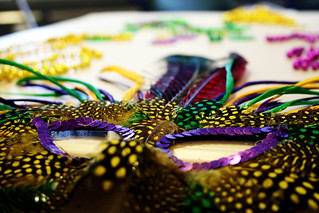
Mardi Gras mask
"Mardi Gras Mask" by Caitlin Reagan
Used under Creative Commons License. Some Rights Reserved
Speaking of masquerade parties, Tuesday is Mardi Gras. Mardi Gras, French for “Fat Tuesday” has its roots in the church. It represented the last chance to use up ingredients like butter and eggs, back in the time when Christians abstained from not just meat but all rich foods throughout Lent, not just on Fridays. This rigorous dietary observance had a practical aspect as well: meat that they had stored away for winter was nearing the end of its usefulness, and there would be lean days ahead until spring produce was ready.

Mardi Gras marks the end of a season known as “Carnival” (literally “farewell to meat”) which may have been adapted from the Roman pagan festival of Saturnalia. In the Middle Ages, when Lent was a period of intense spiritual practice and self-discipline, people needed a good party first to get themselves in the right frame of mind.

As Europeans colonized various parts of the world, they brought these traditions with them, where they would get combined with and flavored by indigenous practices. Different cultures at various times in history have marked the period with more of a wild party atmosphere that would overtake a whole city, still true today particularly in New Orleans, Rio, and Sydney, to name but a few.

Even today there is a scattered practice across the various mainline churches to informally designate the last Sunday before Lent as Mardi Gras Sunday. Some churches will have special brass music at worship, cajun food or even a dance. In the Anglican church, pancakes became the symbolic food of choice, and I hope you will all join us for some on Tuesday night.

Masks, costumes, and other disguises have always figured strongly in the observance of Carnival. From the earliest days, it was an opportunity for commonfolk to put on rich regalia, sometimes poking fun at their wealthy neighbors or otherwise putting the social order on its head.

Venice specifically has a tradition of elaborate masks, which were allowed to be worn from the Feast of St. Stephen (December 26th) until Lent began as a temporary escape from the city’s rigid social hierarchy. This practice lasted from the 12th century until 1797, and was revived in 1979. Carnival of Venice, as the song goes, is again a major celebration and tourist attraction.

On my last trip to New Orleans, I visited a little museum in the Treme neighborhood that showcases the tradition of “Mardi Gras Indians”. These groups of African-Americans pay homage to the native american tribes around the city who once sheltered people escaping slavery, by creating elaborate beaded and feathered costumes. Each outfit takes six to nine months to make, weighs up to 100 pounds, and is generally worn once or only a few times.

In modern-day Belize, prominent community leaders cross-dress or wear decadent costumes while dancing for money and prizes in a traveling band known as a comparsa. Carnival in all its forms presents an opportunity to level the social playing field and escape the norms of behavior that are otherwise expected, and in some times and places brutally enforced.

.But let’s get back to Moses and that veil, shall we? Moses, unable to contain the glow his face took on after speaking to God, covers himself with a veil to soothe his frightened followers. Likewise in the Gospel, Jesus appears transformed into dazzling white before three of his disciples, accompanied by Moses and Elijah, which renders the sleep-deprived Peter incoherent.

Why do you suppose the followers in both these stories were so disturbed by the change they observed in their leader? Moses, surely somewhat enraptured from his one-on-one encounter with the Almighty, didn’t even notice his face had changed until it was pointed out to him. I couldn’t help but feel a little bit bad for him, like “Hey, P.S. I just spoke to God! But sorry if my suntan is freaking you out.” Likewise, I wonder if Jesus, bemused by Peter’s reaction, was tempted to tell his dumbfounded disciples “Fasten your seatbelts, kids. You ain’t seen nothin’ yet!”

But yet we can identify with the followers in both these stories as well, can’t we? They were tired, maybe impatient. They’d already been asked to take extraordinary leaps of faith, giving up their familiar lives and wandering into a physical and spiritual unknown. We tend to like for the people we know to behave predictably, and I suspect they did too. But now, in both stories their leader was suddenly looking radically different and they were being told God was speaking through him with new, life-changing commandments for them to follow.. How much more could be expected of them?

I thought we would spend a few minutes on the kinds of masks we wear in our own lives.  Not actual masks, mind you, although that would make the office or the grocery store more entertaining. To mask or veil something, or ourselves, suggests deception. This isn’t always a literal or visual tactic. Sometimes it can be as simple as the details we include or leave out when telling a story. I think we all do this to ourselves and others by varying degrees, sometimes unconsciously, sometimes in self-defense, or to seem nice or smart or successful or normal. How often do we say or hear “how are you?” and the acceptable one-word response is “fine”?

But it can also be as profound as hiding a major aspect of our identity, like the people who live silently for decades with anxiety, illiteracy, addiction, or abuse; or who suppress feelings about their gender or sexual orientation out of fear they will be rejected by the people in their lives.

Then there are the physical masks we wear. We can say things about how we want to be perceived by others by the things we buy, where we go, and what we do, and we have a multibillion dollar marketing industry ready to help.

The online world introduced a whole new set of masks for us to play with. While we may think of social media as a way to present a more glamorous or exciting version of our lives to an online audience, it also allows people to tap into communities and exchange ideas that either cultural taboos, physical isolation or even political oppression would have made impossible ten years ago.

Anonymous screen names have allowed people to organize resistance movements or escape dangerous situations. However, like real masks which can allow anonymous injury to others, these online personas can have a dark side, too, like when they also allow us to spew vitriol at strangers that we’d likely never have the nerve to say to their faces.

It is not always with deceptive or malicious intent, however, that we embrace these masks.. Sometimes it’s because we don’t think the other person can handle the unshaded truth, and it’s easier or kinder to let them be with an alteration. Maybe Moses donned that veil to keep the people from being distracted while he tried to get them on board with what the covenant with God was going to mean for them, which was far more important, but Paul suggests he wasn’t doing them any favors, because instead of remembering the covenant, their minds went back to the veil.

But sometimes it’s because we’re afraid of how the “real” us would be received. Moses, you may recall, was a stutterer who was dragged reluctantly into a leadership role. When he obtained “that glow” after speaking to God, maybe he was just as uncomfortable with the attention to his appearance as his followers were seeing him in this different light. How often do we stifle our own needs or ideas for fear of sounding silly or presumptuous or “high-maintenance”? There’s an element of our culture that discourages thinking of yourself as too special, and thus we might take steps to “fit in” by dumbing down our dreams or putting them aside to be what is “appropriate” or convenient for those around us.

Yet when Moses went back in to consult with God, the mask comes off. And so it should be with us, as if God couldn’t see past it anyway! Paul tells us, “when one turns to the Lord, the veil is removed. Now the Lord is the Spirit, and where the Spirit of the Lord is, there is freedom.” How freeing indeed that we have a God who knows our frailties and selfish idiosyncrasies and loves us anyway?

My hope for this Lent is that we can all examine the masks we wear, the limits we put on ourselves and others, that are born of fear and doubt; That we challenge ourselves and those we encounter to be transfigured by God’s presence, and not hide but embrace the irrepressible glow that comes from God’s love for us. We have only to listen to to the words and model the actions of his son, whose covenant with us requires only love, pure and unmasked, for God, one another, and ourselves, just as we are. And what a celebration that would be. Amen.

Saturday, December 1, 2018

I'm No Hero; That's Understood | All the Redemption I Can Offer is Beneath This Dirty Hood

Charles de Foucald - Monastic & Martyr (1916)

This week I read an interview in Esquire with Bruce Springsteen, in which the iconic rocker describes his mental health journey as well as his lifelong struggle to process his complex relationship with his father. A remote, hard-edged drinker, the elder Springsteen was enraged by what he saw as the weaker facets of his son's character.  It wasn't until he was near death that he tacitly, sparingly acknowledged Bruce's better points, saying only "You've been good to us."
“All I do know is as we age, the weight of our unsorted baggage becomes heavier . . . much heavier. With each passing year, the price of our refusal to do that sorting rises higher and higher. . . . Long ago, the defenses I built to withstand the stress of my childhood, to save what I had of myself, outlived their usefulness, and I’ve become an abuser of their once lifesaving powers. I relied on them wrongly to isolate myself, seal my alienation, cut me off from life, control others, and contain my emotions to a damaging degree. Now the bill collector is knocking, and his payment’ll be in tears.”
That constant, unfulfilled quest for validation took its toll, and the rocker described two breakdowns, the more recent just ten years ago, and credited decades of therapy and the unwavering support of wife Patty Scafila with his survival.
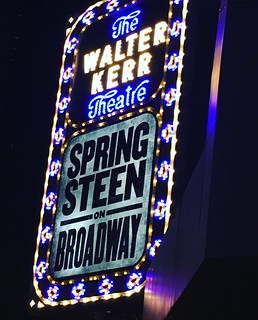
Springsteen on Broadway
I could say more about that, but the interview tells it far better than I could, and you could find more detail in his autobiography.  Later this month, his Broadway stage show, an abridged version of the book interspersed with a dozen or so of his songs, will air on Netflix.  

Having learned these things about him, a man whose music has contributed so much of the soundtrack of my own life, brought back many of the same feelings I wrote about earlier this year. 

As an ardent music fan, I've realized I have a tendency to fill in the blanks in what I know about artists' lives; their characters get shaped in my mind by their lyrics, their stage banter, and whatever they choose to share with the media.  When they do or say something that departs from who I've decided they are, it's jarring.  The rash of premature deaths in the past year notwithstanding, this happens in smaller ways more often by the occasional revelation, misplaced statement, or decision.

Something like this happened this week.  I learned something about another artist whose music I love, which suggests that we'd be in a pretty fundamental conflict on certain social issues if we actually knew each other, which we clearly don't.

And I don't know what to do about it. Unlike some artists, this person's convictions are not widely known, and thus I have little to go on other than scant facts and assumptions you can draw by association. I don't know enough about the situation to decide if it changes how I feel about this individual as a person. If it did, it would change my relationship to the music, which felt yesterday like a house that had been robbed. That would have a follow-on effect on how and with whom I spend my time, especially over the past year.

Part of me wants to go hardcore, only because of the time I spent fighting on this particular issue and in this particular space.  On the flip, I'm reminding myself that no promises were made or broken here.  We are not friends; I do not have the right to expect my values to be shared or my allegiance to be reciprocated.  The music is out there, take it or leave it; anthems by flawed heroes for flawed fans, maybe that much sweeter because of the wrinkles and scars we can compare to our own.